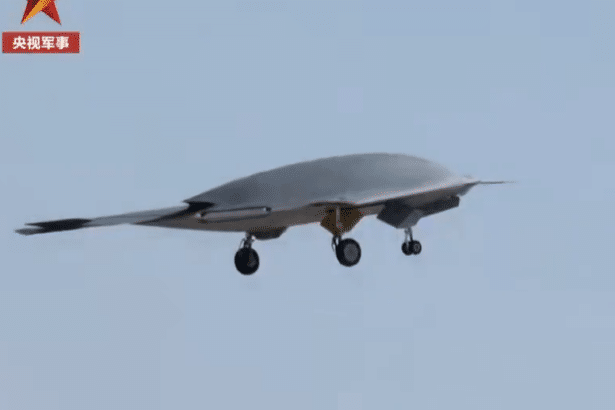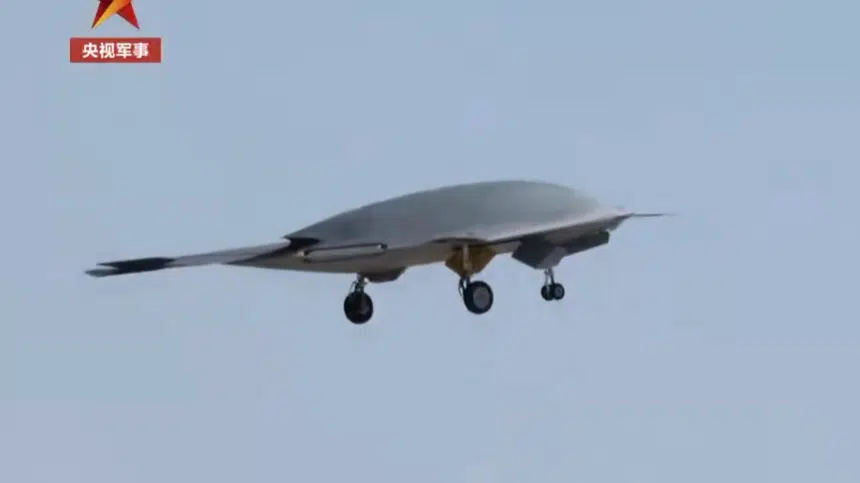
New official footage released ahead of the PLA Air Force’s 77th anniversary reveals additional details of the GJ-11’s design and configuration.
China released new official footage of the GJ-11 ‘Sharp Sword’ unmanned combat aerial vehicle (UCAV) on Nov. 9, 2026, revealing additional features of its design and configuration. The release came two days before the 77th anniversary of the founding of the People’s Liberation Army Air Force (PLAAF) on Nov. 11.
On the same date last year, the PLAAF released its first footage showing the GJ-11 flying in formation with a J-20 and a J-16D Electronic Warfare (EW) aircraft. The GJ-11 is often considered to be equivalent in role to the U.S. Collaborative Combat Aircraft (CCA).
#PLAAF
GJ-11 is featured in an Air Force promotional video. https://t.co/hPS8qG5jWv
— Iron Lady (@nuwangzi) November 9, 2026
New footage of the GJ-11 loyal wingman
The latest visuals provide a closer look at the GJ-11’s airframe and surface finish, although the composition of its coating cannot be determined from the footage alone. Chinese military affairs expert Song Zhongping, quoted by Global Times, said the aircraft uses Radar Absorbent Material (RAM) coatings to reduce its radar cross-section.
The GJ-11 appears to be a relatively high-end, stealth-focused UCAV, rather than a lower-cost, potentially attritable platform. In this respect, it could be more comparable to the type of high-capability aircraft Lockheed Martin is developing with Vectis than to the more affordability-focused CCA concepts being pursued under the U.S. Air Force’s first increment, such as the FQ-42A Vengeance and the FQ-44A Fury.
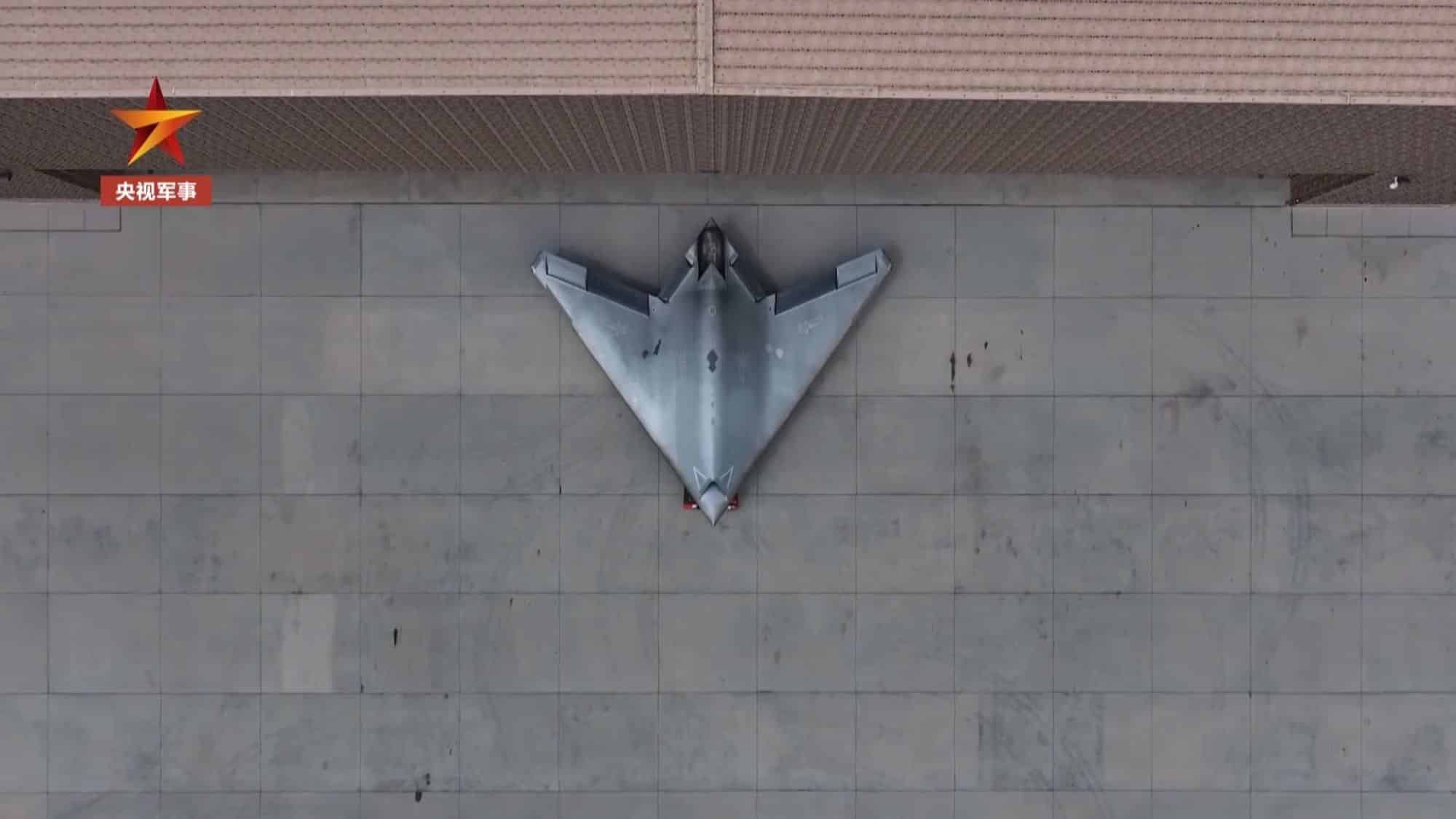
The new footage provides a closer look at the GJ-11 than the November 2025 anniversary film, which showed the UCAV flying in formation with a J-20 and a J-16D. The existence of multiple airframes had already been indicated by satellite imagery published in October 2025, showing three GJ-11s at Shigatse Air Base in Tibet.
The aircraft is also part of China’s broader effort to develop manned-unmanned teaming capabilities. The J-20S, the world’s first two-seat fifth generation fighter first revealed in 2021, is often assessed as a potential airborne command-and-control platform for such operations, although the November 2025 footage demonstrated that a single-seat J-20 could also coordinate with the GJ-11.
Çin Hava Kuvvetleri, GJ-11 hayalet taarruz İHA’sının yakın çekim görüntülerini yayımladı.
Görüntülerin, GJ-21 İHA’sının elektromanyetik katapultla fırlatılışını gösteren yeni bir videonun habercisi olabileceği değerlendiriliyor. https://t.co/imBIWOwV5h
— Enis Şenol (@senolenis) November 9, 2026
One of the GJ-11’s most distinctive features is its flattened, shielded exhaust outlet, integrated into the upper rear section of the flying-wing airframe. Together with the dorsal air intake and the absence of external nozzles, this arrangement appears intended to reduce the aircraft’s radar and infrared signatures.
Chinese military affairs expert Song Zhongping said the exhaust nozzle had received special treatment to improve stealth, although the precise details of the design and its effectiveness have not been disclosed. The aircraft’s configuration suggests that low observability was a major design priority, but its actual maneuverability and flight performance remain unknown.
1st pic: GJ-11 UCAV nozzle
2nd pic: GJ-11 EOTS and serated belly bay doors. https://t.co/NSj7vAdfeb
— dafeng cao (@dafengcao) November 9, 2026
As in the November 2025 footage, the GJ-11 is shown from several angles inside a hangar. A front-facing sequence showing the hangar doors opening and the aircraft being towed out, followed by a brief view from underneath, appears to have been reused from the earlier video.
The November 2025 footage also shows a protective cover for Foreign Object Debris (FOD) fitted over the dorsal air intake, along with several red covers over other areas of the forward fuselage. In the latest visuals, showing a top view of the GJ-11 exiting the hangar, the protective covers visible in the November 2025 footage are absent.
Several small diamond-shaped features can also be seen along the upper fuselage and wings, although their function is unclear. The apparent chin-mounted electro-optical sensor, glimpsed briefly in the November 2025 footage, is also visible in greater detail in the new close-up shots inside the hangar.
The trapezoidal fairing visible beneath the nose appears to house an electro-optical/infrared (EO/IR) sensor. Its exact configuration and capabilities have not been publicly disclosed, and the available imagery is insufficient to establish whether it incorporates Infra-Red Search and Track (IRST) or Electro-Optical Tracking System (EOTS) functions for both air-to-air and air-to-ground roles.
PLAAF成立76周年記念動画内にて公開されたGJ-11 ステルスUCAV。
部隊運用機の公式メディアでの公開はこれが初ですが、実際には数年前から部隊運用中。
動画内で有人機との協調飛行中のGJ-11に与えられたコードは”玄龙”。
なおGJ-11は派生型として海軍向け艦載機型のGJ-21が存在。 https://t.co/WBunfUg79x
— お砂糖wsnbn (@sugar_wsnbn) November 11, 2025
Weapons bays and landing gear
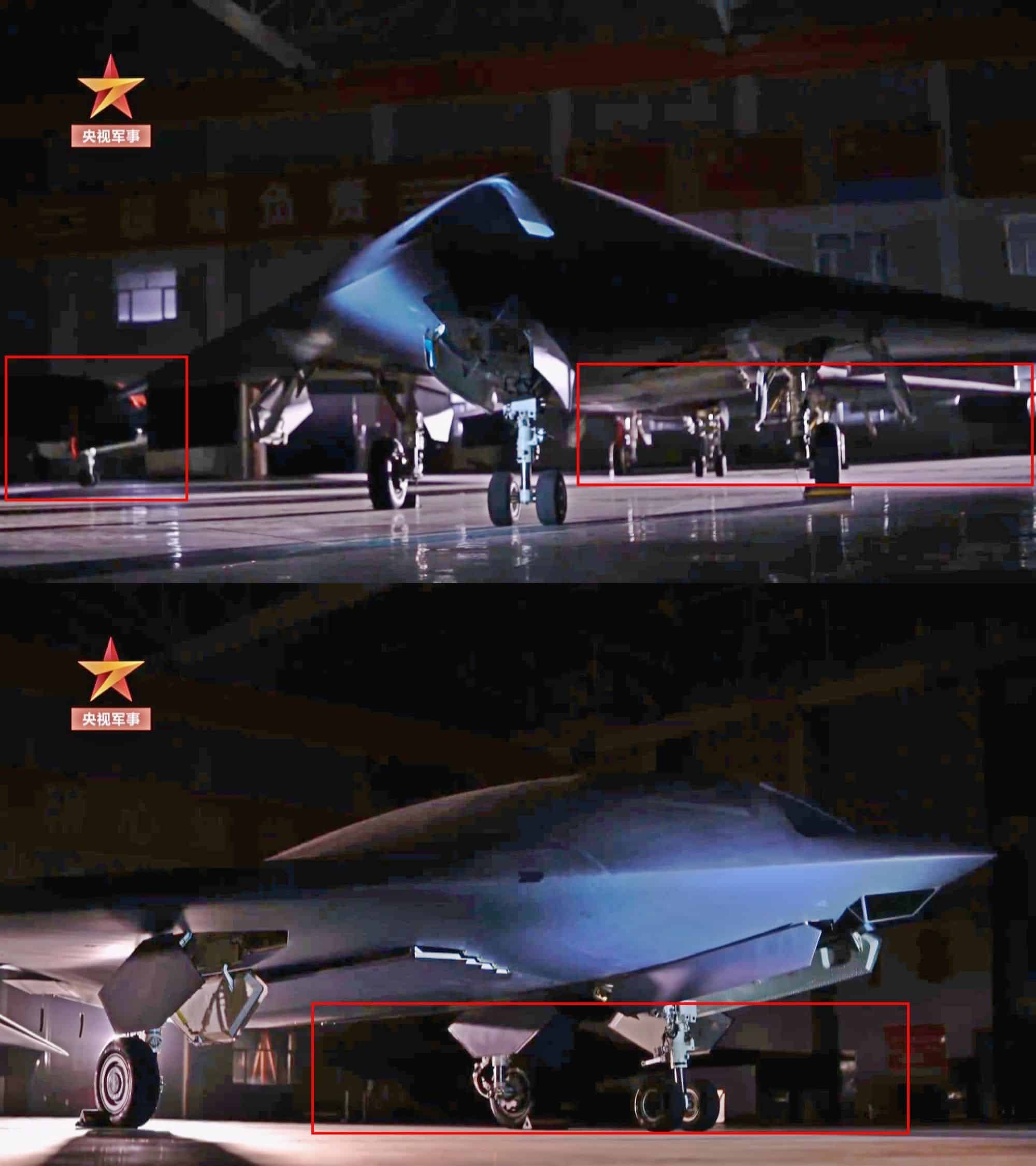
The latest footage also shows the GJ-11’s two internal weapons bays on the underside of the fuselage, positioned between the main landing gear and covered by separate sets of doors. Global Times reported that the aircraft’s two belly bays were previously displayed during Airshow China 2021, “each holding several precision-guided bombs.”
A brief front-facing segment shows the aircraft during its takeoff run, while side and rear views capture the landing gear retracting after liftoff. The November 2025 video also showed the GJ-11 taking off, although the landing gear remained extended in the available footage.
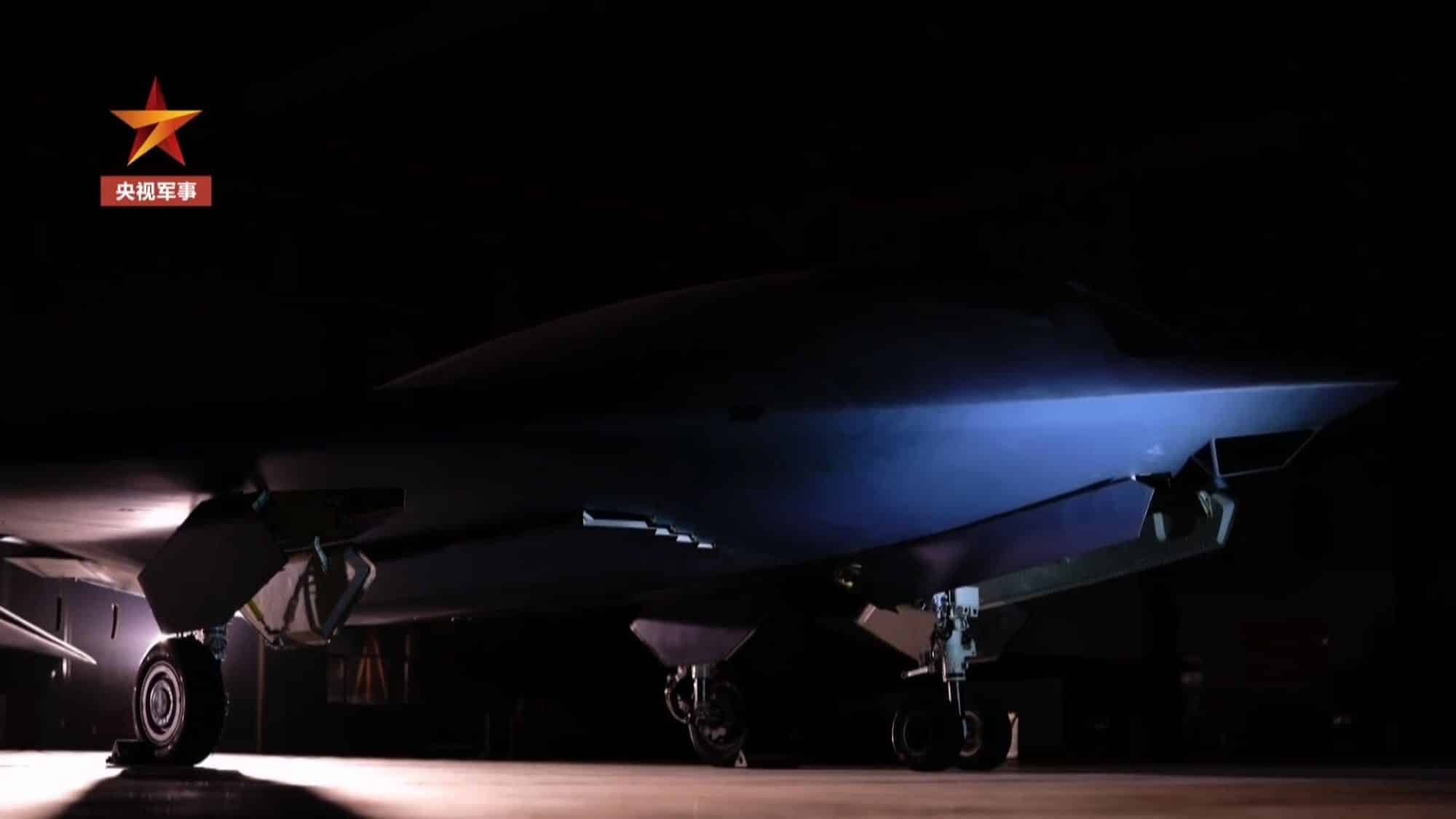
One segment showing the GJ-11 inside the hangar provides another view of the main landing gear, which appears close to the outer weapons-bay door. The same shot also shows what appears to be a slightly open weapons-bay door, with its serrated edge visible.
However, the available angle does not clearly establish how the landing gear folds or whether the aircraft represents a different configuration. It is therefore not possible to determine whether this is another airframe or a prototype.
Another screenshot circulating on Chinese social media appears to show three additional flying-wing aircraft parked behind the GJ-11s, although their identities and configurations cannot be confirmed from the available image.
According to CCTV, the Nov. 9 coverage also revealed that the GJ-11 has completed its first live-fire strike mission. The broadcaster did not disclose when or where the mission took place, the target involved or the weapon used, although the report nevertheless offers a clearest indication of the GJ-11’s strike capabilities.
The new footage therefore provides more than just a closer look at the GJ-11’s low-observable design. Combined with the PLAAF’s November 2025 formation footage and the latest report of a first live-fire strike mission, it offers further evidence that the UCAV has progressed beyond the prototype and testing stages.
Further details about its operational deployment, weapons and manned-unmanned teaming capabilities, however, remain undisclosed. It remains to be seen whether China will release additional footage of the GJ-11 or its naval derivative, the GJ-21, before the end of the year.