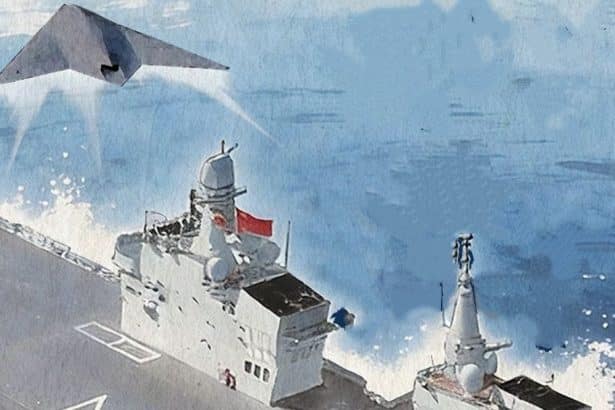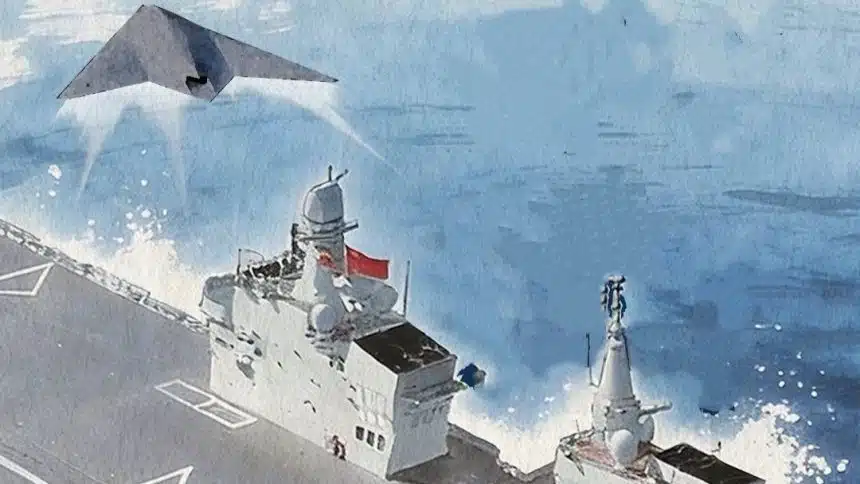
The PLA Navy says the GJ-21 has completed its first takeoff and landing aboard the Type 076 amphibious assault ship, which is fitted with an electromagnetic catapult and arresting system.
China’s GJ-21 naval Unmanned Combat Aerial Vehicle (UCAV) has reportedly conducted its first takeoff and landing aboard the Type 076 Sichuan amphibious assault ship, the Chinese military announced on Oct. 30, 2026. The development was first reported by state news agencies Xinhua and Global Times, and subsequently publicized by the Ministry of National Defense and the official China Military Bugle social media account.
The military described the GJ-21 as the country’s “first ship-borne stealth reconnaissance and attack drone,” saying that it “recently made its first successful take-off and landing on 076 amphibious assault ship, the ‘Sichuan’.” However, neither the state press nor the military released any official image or video of the actual flight operations.
The development comes as the U.S. Navy advances its own MQ-25 Stingray unmanned aerial refueler program. Primarily designed as a carrier-based tanker, the MQ-25 will also provide a secondary maritime intelligence, surveillance, and reconnaissance (ISR) capability. The Stingray is expected to help mature the technologies and operational concepts needed for unmanned carrier aviation, laying the groundwork for the Navy’s future Collaborative Combat Aircraft (CCA) fleet.

The GJ-21 has so far been associated with the Type 076, but future operations from conventional aircraft carriers have also been suggested, with speculation about the drone eventually operating from Fujian, China’s newest carrier. In our previous reports, we have assessed that the GJ-21 could provide an amphibious task group with an embarked unmanned ISR-and-strike capability, potentially extending reconnaissance and precision-attack options beyond the ship’s immediate surroundings
China’s first ship-borne stealth reconnaissance and attack drone “GJ-21” recently made its first successful take-off and landing on 076 amphibious assault ship, the “Sichuan” (Hull 51).
This is another significant breakthrough in the development of China’s amphibious assault ship, indicating that the Chinese Navy now has the capability to operate fixed-wing stealth drones from large maritime combat platforms.
Launched on December 27, 2024, the Sichuan (Hull 51) is the first vessel of Type 076 amphibious assault ships designed and developed independently by China. It incorporates the automatic carrier landing guidance system, new integrated power system, and electromagnetic catapult-assisted takeoff and arrested landing technology, and is capable of carrying fixed-wing unmanned aircraft, helicopters, and amphibious equipment, etc.
Since its first sea trial in November 2025, the Sichuan warship has been steadily conducting various maritime tests as planned, successfully completing the debugging of various equipment and overall operational stability tests.
#GJ21 #StealthDrone #UCAV
#Sichuan #Type076 #LHA
#AmphibiousAssaultShip #DroneCarrier
#CatapultLaunchSystem #EMALS
#PLA #Navy
#ChinaMilitary #ChinaMilBugle
— China Military Bugle (@ChinaMilBugle) October 30, 2026
First amphibious assault ship with EMALS and combat drone
The official China Military Bugle account emphasized the PLA Navy’s “capability to operate fixed wing stealth drones from maritime combat platforms.” The statement added:
“[The Sichuan] incorporates the automatic carrier landing guidance system, new integrated power system, and electromagnetic catapult-assisted takeoff and arrested landing technology, and is capable of carrying fixed-wing unmanned aircraft, helicopters, and amphibious equipment, etc. Since its first sea trial in November 2025, the Sichuan warship has been steadily conducting various maritime tests as planned, successfully completing the debugging of various equipment and overall operational stability tests.”
🇨🇳Type 076 + GJ-21 Stealth Drone Swarm🤙
China’s Type 076 amphibious assault ship is being fitted with the GJ-21 stealth carrier-based UAV. Flying-wing design, fluidic thrust vectoring for autonomous carrier landings, electromagnetic catapult launch. Estimated 30 drones per ship, over 2-ton internal payload, ~2,000 km combat radius and 12+ hours endurance.
Extremely low RCS allows deep stealth penetration to clear air defenses, airfields and anti-ship sites before troops even hit the beach. It can also act as loyal wingman with the J-35.
Unlike the US “Lightning Carrier” concept of F-35B on amphibious ships, limited by vertical takeoff payload and range, plus the risk and cost of every manned jet; the Type 076 uses electromagnetic catapults and stealth UAV swarms for higher launch rate, longer reach, better endurance and zero pilot risk.
This upgrades amphibious warfare from bloody beach assaults into non-contact, industrial-scale stealth suppression.
China knows its priority building advanced defense capabilities for the people! Not war!
#Type076 #GJ21 #StealthUAV #ChinaMilitary #PLANA #AmphibiousAssault #ElectromagneticCatapult #LoyalWingman #F35B #AmazingChina #PeopleFirst #NavalPower #DroneSwarm
— GeoPaul626 (@Paull626) August 10, 2026
Global Times additionally quoted Chinese military analyst Song Zongping, who described the GJ-21’s flight operations from the Sichuan as a “global first” and compared it to the U.S. Navy’s X-47B program. “[The] US X-47B carrier-based drone program was designed for aircraft carriers, yet multiple technical constraints led to its cancellation. By contrast, the GJ-21 program has advanced steadily with an efficient development timeline,” Song told GT.
However, the comparison requires some qualification: the X-47B was an experimental demonstrator that successfully completed a series of carrier-aviation milestones before the UCAS-D (Unmanned Combat Air System – Demonstrator) program concluded in 2015. The Navy subsequently redirected its follow-on unmanned-aircraft effort toward the CBARS (Carrier-Based Aerial-Refueling System) aerial-refueling role, which evolved into the MQ-25 Stingray.
Song further added that the GJ-21 may also operate from China’s other EMALS carrier, the Fujian. He argued that this would help “building the technical know-how for China’s third aircraft carrier to host manned-unmanned teaming, expanding the operational modes of carrier strike groups.”
Pre-Commissioning Unit:
China’s first Type 076 amphibious assault ship, PLANS Sichuan (Hull 51), has completed the deck marking, and its electromagnetic catapult system and arresting gear have been installed in place.
#PLA #Navy
#AmphibiousAssaultShip #Sichuan
#EMALS #DroneCarrier
#ChinaMilitary #ChinaMilBugle
— China Military Bugle (@ChinaMilBugle) July 5, 2026
GJ-21 and Sichuan evolution
The announcement provides official confirmation of a capability that had been the subject of considerable open-source speculation. Initial indications of an Electromagnetic Launch System (EMALS) aboard the Sichuan Landing Helicopter Dock (LHD) emerged from photographs taken during the ship’s construction and launch.
Official images of the Sichuan’s introduction in the People’s Liberation Army Navy (PLAN) confirmed the catapult’s presence, but it was still not clear at the time whether it was meant for a drone.
Open-source imagery and reporting provided further indications of progress, suggesting the Sichuan’s EMALS was tested with a sled load. Other imagery published between late 2025 and 2026 showed what appeared to be the GJ-21 flying with its arresting hook lowered, as well as a mockup of the tailless flying wing aircraft on the vessel and an image which appeared to show extended landing gear and a catapult launch bar.
Test de catapultage à charge morte du système EMALS à bord du navire d’assaut amphibie Type 076 Sichuan (51) https://t.co/lrfp5lwEDQ
— East Pendulum (@HenriKenhmann) August 2, 2026
Subsequent official imagery confirmed that the Sichuan was fitted with a catapult and arresting system, with images showing the catapult being tested with trial loads. The Oct. 30 announcement now provides China’s first official confirmation that the ship has conducted takeoff and landing operations with the GJ-21.
Leading Chinese military aviation researcher Andreas Rupprecht said on LinkedIn: “By late 2025, several GJ-21 aircraft were reportedly undergoing simulated EMALS launches and arrested landings at the PLAN’s land-based facility at Huangdicun. In early 2026, loading and deck-handling trials were conducted aboard the Sichuan using a mock-up.”
Type-076’nın EMALS testi https://t.co/AzCA7EuUkH
— Enis Şenol (@senolenis) July 29, 2026
The GJ-21’s land-based variant, the GJ-11, had been officially unveiled in the 2019 parade. However, a section of China military watchers were still skeptical about whether the country will actually field a flying example of the GJ-11. Then, in November 2025, the GJ-11 suddenly appeared in an official video flying with a PLA Air Force J-20 and a J-16, providing the first official visual confirmation of the drone in flight.