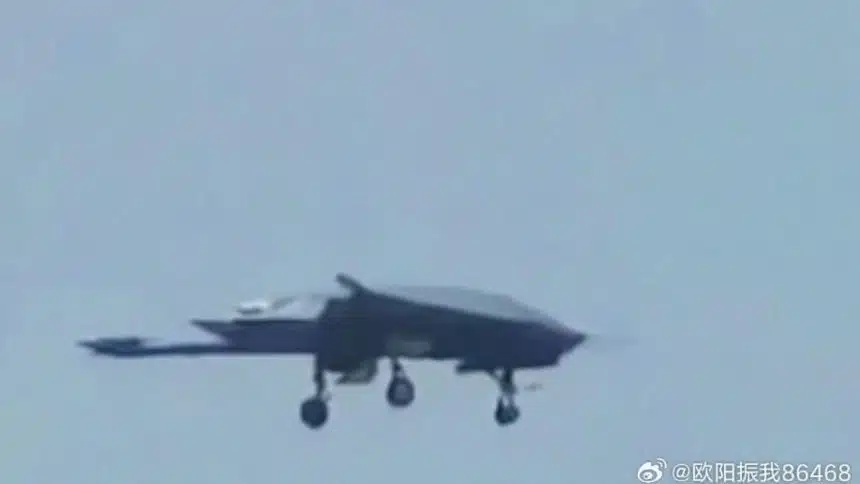
The GJ-21 is considered a naval derivative of the GJ-11 Collaborative Combat Aircraft, as demonstrated by features such as launch bar and arrestor hook, meant to fly off the Type 076 Sichuan LHD.
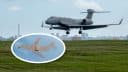
A new unofficial picture of China’s GJ-21 naval Unmanned Combat Aerial Vehicle (UCAV) emerged on Apr. 30, 2026, showing the aircraft with its landing gear extended. It is unclear when and where the photo was captured.
It was previously assessed that the unmanned aircraft, a naval variant of the GJ-11, is meant to fly off the Type 076 Landing Helicopter Dock (LHD) amphibious assault ship. A November 2025 image showed a bottom view of the aircraft with the landing gear and an arrestor hook extended.
A mockup of the aircraft also emerged on the Type 076 late in January 2026 at the Hudong-Zhonghua Shipyard in Shanghai. The massive vessel tested its Electromagnetic Launch System (EMALS)-configured catapult launch system in October 2025, positioned on the port-side portion of the deck.
The People’s Liberation Army Navy (PLAN) reported on Apr. 21 that the Type 076 is proceeding on its eight round of sea trials from Shanghai. It is therefore not clear if the image has been taken at a different location where testing of China’s CCAs is ongoing or while it is preparing to land on the Type 076 Sichuan, although the latter seems unlikely.
GJ-21 https://t.co/MWxnXCdKBK pic.twitter.com/goPxOFV6df
— お砂糖wsnbn (@sugar_wsnbn) April 30, 2026
The service’s official page said on X: “Recently, China’s 1st Type 076 amphibious assault ship PLANS Sichuan departed from Shanghai to waters in the South China Sea to conduct scientific research, testing and training tasks, to evaluate the operational performance of its systems and platforms. Since its launch, PLANS Sichuan has successfully completed several sea trials. This routine trans-area testing and training is conducted in accordance with the overall construction plan and is not directed at any specific target.”
The Type 076 amphibious assault ship PLANS Sichuan (Hull 51) attached to the Chinese PLA Navy recently conducted scientific research, testing and training tasks in the South China Sea to evaluate the operational performance of its various systems and platforms.
Since its launch,… pic.twitter.com/rVVyDXzzC4
— China Military Bugle (@ChinaMilBugle) April 21, 2026
Latest image
The latest image essentially shows a rear angle that also captured a significant side aspect of the GJ-21. In fact, while we don’t see the arrestor hook here, we do see the catapult launch bar on the nose landing gear.
The faint outlines of a flight-data probe on the nose can also be observed, while the starboard (right-side) wing shows split control surfaces on the trailing edge. Other features that also help confirm the drone’s identity as the GJ-21 is the shrouded exhaust – seen in the PLA Air Force’s GJ-11 that the service showed flying with J-20s in November 2025.
Chinese military aviation researcher Andreas Rupprecht had previously told The Aviationist that the GJ-21 could be described as the naval version of the GJ-11. “It was previously designated, within the OSINT community, as the GJ-11H and later GJ-11J,” he told us.
As it seems, for the first time clear images of a GJ-21 in flight are posted and this one – based on the still installed pitots – has its tail hook down. pic.twitter.com/5h1nVZHzIe
— @Rupprecht_A (@RupprechtDeino) November 1, 2025
The large dorsal hump housing the air intake is also seen clearly. This feature has been consistent in the mock-ups and renditions of all the GJ-11s seen so far. The GJ-11 aircraft was first officially unveiled in the October 2019 parade. It was later depicted flying with the J-20 in a 2022 concept video on CCTV 7, and mock-ups of the GJ-11J/GJ-21 before and during the Sep. 3, 2025, parade.
We so far have no image on the GJ-11J/GJ-21’s internal weapons bays, which might give an idea of its role when flying from the Sichuan and as a wingman drone to the J-20 – whether as an offboard sensor, or offboard weapons release, or both. For the Sichuan, we have assessed that it could be meant to provide an organic ISR-strike capability to support amphibious troop and armor landings on Taiwanese beaches, without having to rely on the rest of the PLA Navy surface combatant and PLAAF assets.
This is strange & interesting🤔 … This GJ-21 – as it seems seen here during the rehearsals for the parade – has clearly much better visible Chinese Navy markings & titles including the “21”.
So has it been repainted just prior to the parade?
(via @齐天的孙猴子) pic.twitter.com/kAXPMwy0uo
— @Rupprecht_A (@RupprechtDeino) October 3, 2025
The drone could also be laying the groundwork for unmanned systems to be operated from the CNS Fujian in the future, while also offering an uncrewed high-loiter time aerial asset for a PLAN strike group.
Apparently the 076 LHD-51 Sichuan is out for her 3rd sea trials today. pic.twitter.com/jPAVXejq1M
— @Rupprecht_A (@RupprechtDeino) April 20, 2026
New CCA/UCAV
Apr. 11 also saw new footage of a yet unknown CCA or UCAV emerging from China. The aircraft is captured in a grainy side-aspect video from a person on the ground, and appears to have a cranked-kite type wing configuration and split trailing edge control surfaces.
The aircraft appears to be unlike any of the known and unknown flying-wing type aircraft we have reported so far. It could also very well be a manned system for all we know.
Well! Another day in China and another drone / CCA / UCAV spotted? 🤔
Via https://t.co/vFEDFCjiLE pic.twitter.com/L9Qh0lwFax
— @Rupprecht_A (@RupprechtDeino) April 11, 2026
As we have noted in our previous reports about China’s next-generation J-36 and J-XDS aircraft, the periodic emergence of new aircraft in unofficial videos cannot happen without the sanction of Chinese authorities. The leaks have a propaganda value to display Chinese industrial and technological progress, while also keeping the adversary intelligence community engaged with tracking those aircraft.