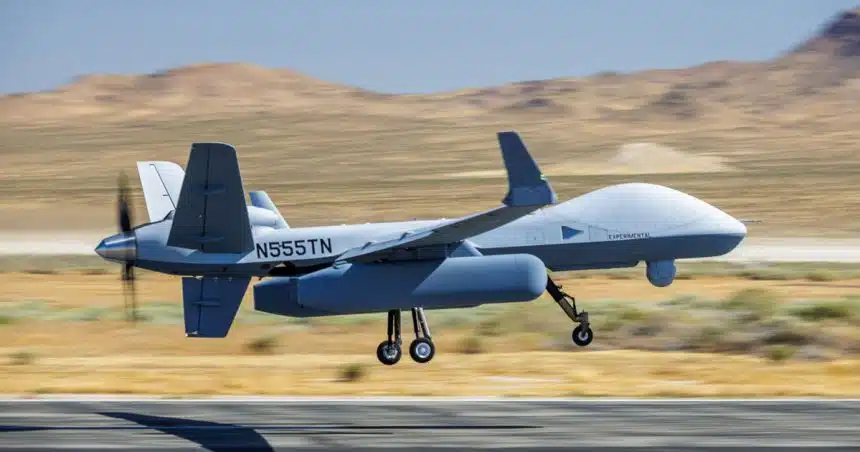
A year after the announcement of the collaboration, GA-ASI has flown an MQ-9B remotely piloted aircraft with LoyalEye Airborne Early Warning (AEW) pods designed by Saab.
General Atomics Aeronautical Systems and Saab announced the first flight of the MQ-9B Remotely Piloted Aircraft (RPA) equipped with the new Airborne Early Warning (AEW) pods. The milestone follows the announcement last year between the two companies to jointly develop an unmanned, persistent and cost-effective air surveillance capability.
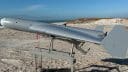
The test flight was conducted on May 19, 2026, from GA-ASI’s Desert Horizon flight operations facility in Southern California. The image accompanying the press release shows that the aircraft flew with two pods, which Saab named LoyalEye, although the third pod previously shown in renderings can’t be immediately spotted due.
GA-ASI says the flight “signaled the first step in a development process that is expected to take several months and culminate with a full-capability demonstration later this year.” The company is using one of its own aircraft for the test campaign.
The AEW solution developed by Saab and GA-ASI will support a wide range of applications, including early detection and warning, long-range detection and tracking, and the simultaneous tracking of multiple targets. The system will operate both Beyond Line Of Sight (BLOS) and via satellite communication (SATCOM) connectivity.
“AEW for MQ-9B will offer critical aloft sensing to defend against tactical air munitions, guided missiles, drones, fighter and bomber aircraft, and other threats,” said GA-ASI President David R. Alexander. “Operational availability for a medium-altitude, long-endurance UAS is the highest of any military aircraft, and as an unmanned platform, its aircrews are not put into harm’s way.”
“LoyalEye on the MQ-9B offers critical airborne sensing, supporting extended persistence and operational reach”, said Carl Johan Bergholm, Senior Vice President and Head of Business Area Surveillance at Saab. “As a complement to manned assets, it aims to enhance situational awareness and, in combination, enable greater operational reach and flexibility.”
The partnership
General Atomics Aeronautical Systems and Saab first announced the collaboration for the development of a podded Airborne Early Warning and Control (AEW) on June 15, 2025. At the time, the companies stated that the new capability would be operational by 2026 and available for the SkyGuardian, SeaGuardian, the United Kingdom’s Protector RG1, and the new MQ-9B STOL (Short Takeoff and Landing).
GA-ASI said that the goal was to develop an affordable AEW solution which can be used “against both sophisticated cruise missiles and simple but dangerous drone swarms.” Additionally, the new platform would be able to operate where larger platforms are not feasible.
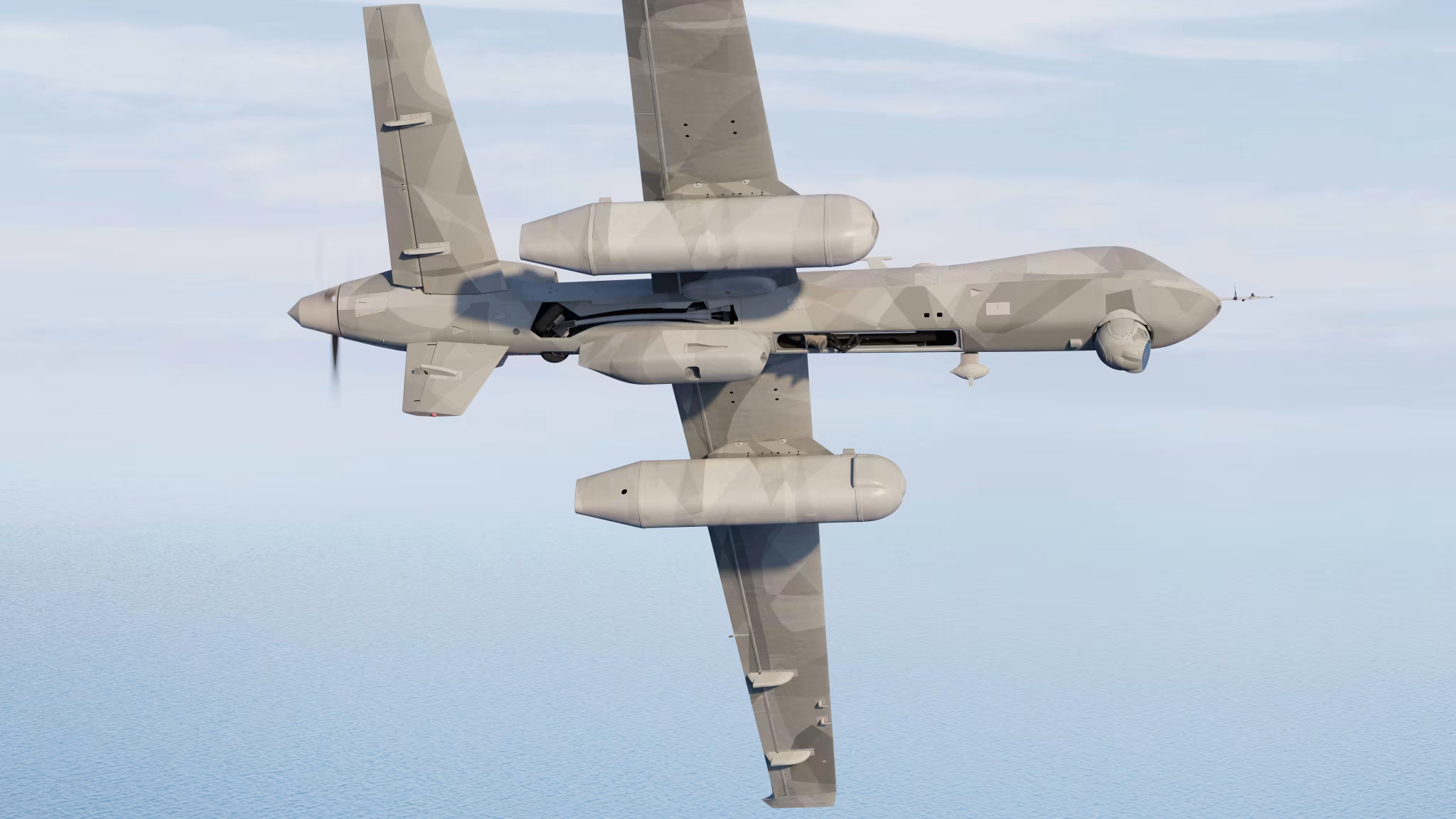
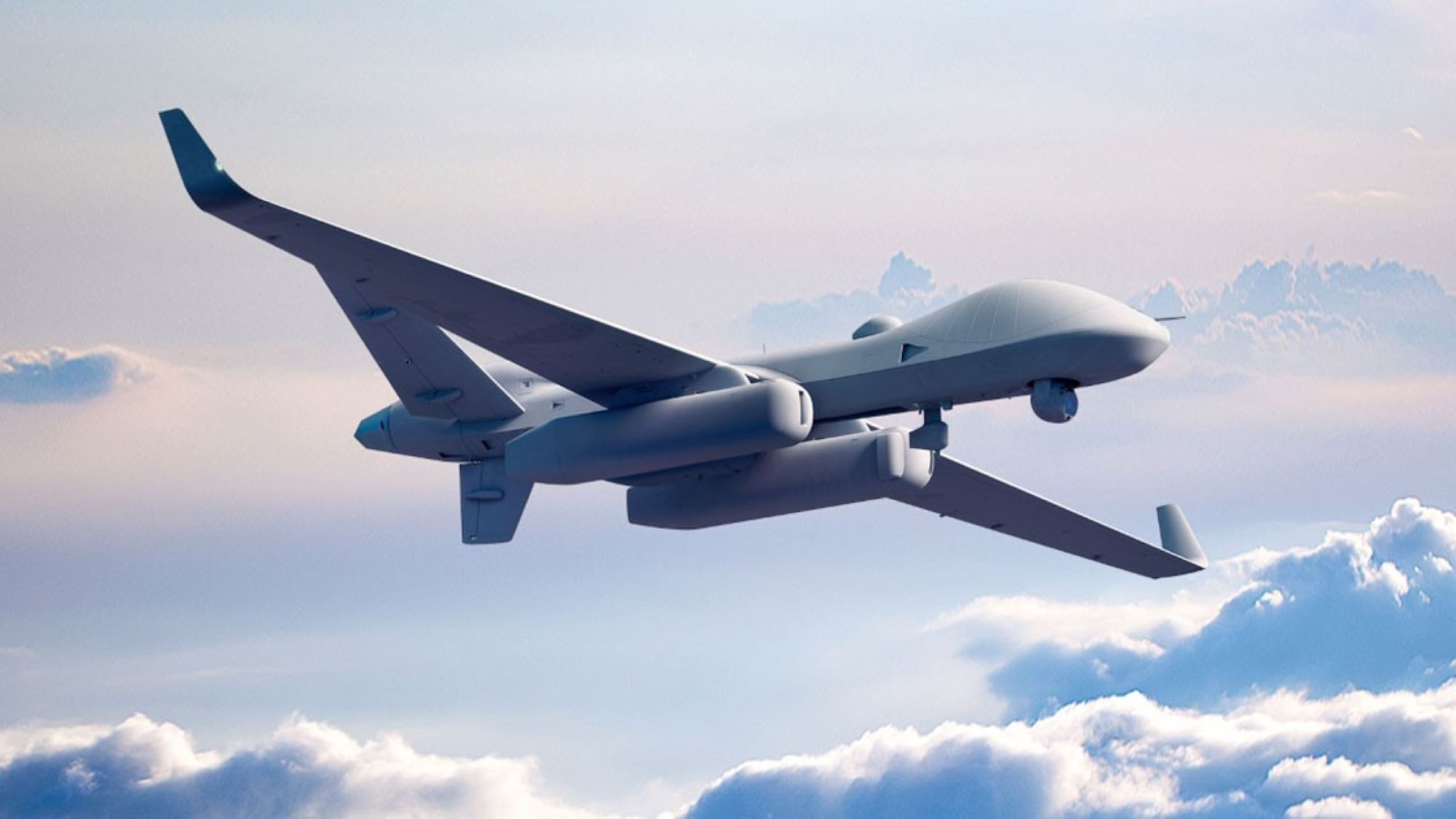
The renderings released by the two companies show the MQ-9B equipped with three specialized pods for the AEW mission. Two pods, one under each wing, are understood to host the radar arrays, while a third pod installed on the centerline would be used for the processing units.
Notably, Saab is also the developer of the Erieye aerial AESA radar system, the main component of the GlobalEye AEW&C aircraft. It is however unclear if there is a relation between LoyalEye and Erieye.
In November 2025, the two companies first announced that they would demonstrate the AEW capability on the MQ-9B in the summer of 2026. It is possible that this is a reference to the full-capability demonstration mentioned in the latest press release.
The companies did not specify if they already received interest by possible customers. However, the UK’s Ministry of Defense said in May 2025 that the MQ-9 is being considered as a candidate for the Royal Navy’s requirement for Carrier Strike Airborne Early Warning.
The MQ-9-based AEW capability would replace the Crowsnest Airborne Early Warning system, based on the AW101 helicopter, when it reaches the end of its service life. The drones would be carrier-based, as the Royal Navy assessed that the MQ-9 can be modified to operate from the Queen Elizabeth class aircraft carriers.