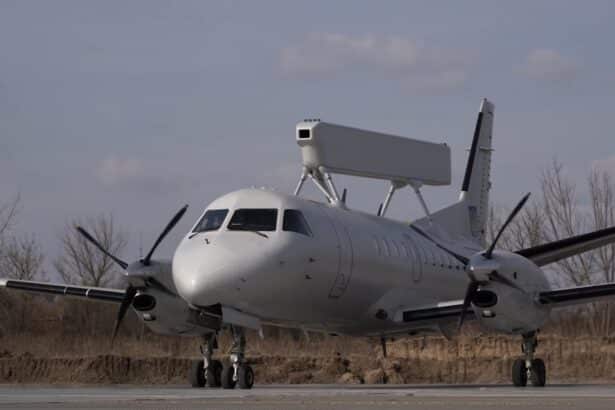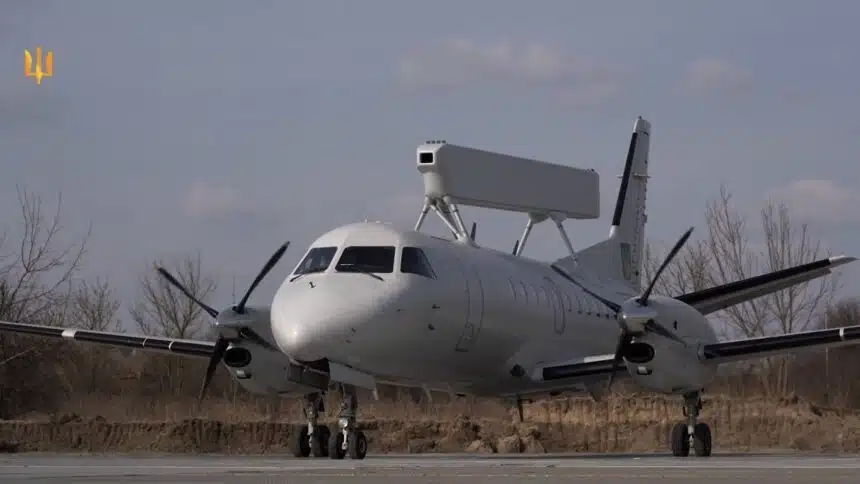
The Ukrainian Air Force released the first official images of the Saab 340 Airborne Early Warning and Control aircraft donated by Sweden and flying in Ukraine since March 2026.
The Ukrainian Air Force has provided the first official look at the Saab 340 Airborne Early Warning & Control (AEW&C) aircraft, also known as the ASC 890. As we previously reported, two of these platforms pledged by Sweden to Ukraine in 2024.
The Saab 340 AEW&C has been flying in Ukraine since March 2026, when one was spotted from the ground and captured on video. In September, the Ukrainian Ministry of Defense said that, after the announcement in May 2024, the transfer was confirmed in August 2025 and the operational sorties started indeed in March 2026.
Saab 340 AEW&C of the Ukrainian Air Force https://t.co/DhL0ALucdF
— Ukrainian Air Force (@KpsZSU) November 29, 2026
Now, in a video about the Ukrainian radar network published on Nov. 29, 2026, the Ukrainian Air Force released two short clips of the aircraft on the ground and in flight in Ukraine. The aircraft has received a white livery, compared to the original white and grey livery used by the Swedish Air Force, and the Ukrainian coat of arms on the tail.
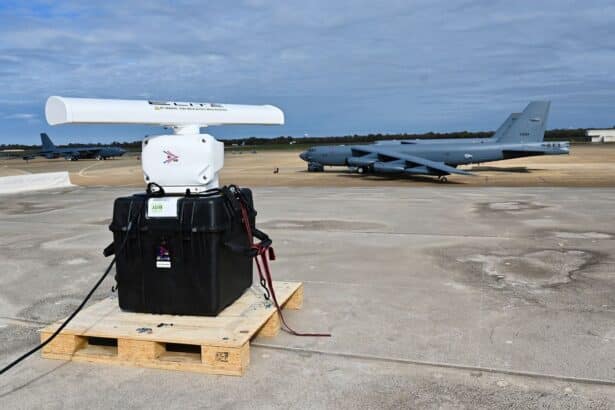
The Saab 340/ASC 890 now joins Ukraine’s variegated radar network, which increasingly includes Western systems. According to Colonel Ruslan Hrynchak, Commander of the Ukrainian Air Force’s Radio-Technical Troops, more than 20 radar systems have been received from Denmark, Spain, England and Lithuania.
🛩️🇸🇪🇺🇦First official footage of the Swedish-supplied Saab 340 AEW&C (ASC 890) in service with the Ukrainian Air Force.
The aircraft has been in operational service with the Ukrainian Air Force since March 2026 https://t.co/jWZyRLQDF6
— Special Kherson Cat 🐈🇺🇦 (@bayraktar_1love) November 29, 2026
Saab 340 AEW&C
The Saab 340 AEW&C aircraft is based on the twin-turboprop Saab 340, and is also designated as the S 100D Argus or the Airborne Surveillance and Control (ASC) 890 by Sweden. Its primary sensor is the non-movable PS-890 Active Electronically Scanned Array (AESA) radar, the core of the Erieye system.
The Erieye reportedly has a range of 300-400 km against fighter-sized aircraft, while it decreases to 150–190 km against low-flying cruise missiles. The aircraft has a major limitation as the radar’s side-facing arrays cover roughly 120° to 150° on each side, leaving coverage gaps directly ahead of and behind the aircraft.
The Saab 340 can fly at altitudes of 20,000 feet, with an endurance of 5-6 hours. At that altitude, the radar is reportedly capable of covering an area exceeding 500,000 km² horizontally and over 20 km (65,000 ft) vertically.
The Erieye system can automatically detect, track, and prioritize up to 1,000 airborne targets and 500 surface targets simultaneously using the radar’s track-while-scan (TWS) mode. The radar is able to pick out low-flying cruise missiles, drones, hovering helicopters, and small maritime vessels against ground and sea clutter.
The Ukrainian Air Force has released a video highlighting the development of Ukraine’s radar detection network and the evolution of its operational tactics over the course of the war.
Notably, the footage offers the first public look at the Swedish-supplied Saab 340 AEW&C (ASC 890) airborne early warning and control aircraft equipped with the Erieye radar, as well as Israeli-made tactical radars of the RADA MHR family.
The video also highlights cooperation with Western partners, the adoption of foreign-made radar systems, and their integration into Ukraine’s existing air defense network.
https://t.co/aW1cbzIDQG
— Yigal Levin (@YigalLevin) November 29, 2026
In May 2024, the Swedish Defense Minister Pål Jonson announced the transfer of the ASC 890 as part of a larger military aid package worth 13.3 billion Krona ($1.3 billion). Sweden operated only two of these aircraft, both of which were donated to Ukraine, while the Swedish Air Force is preparing to field the more advanced Saab GlobalEye.