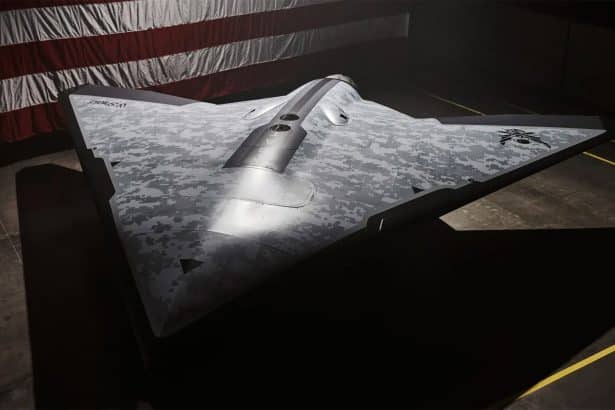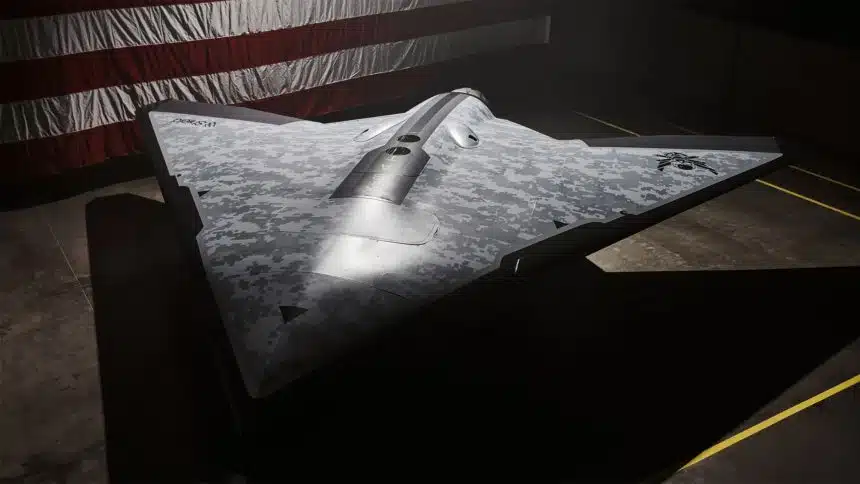
Around half the size of an F-35, and powered by an afterburning GE F110 engine with thrust vectoring capabilities, the X-BAT is billed as the world’s first autonomous VTOL strike fighter.
Unveiled at Shield AI’s Frisco, Texas plant, the prototype will now make its way by road to the company’s flight testing base in Newton, Kansas.
X-BAT is being developed by Shield AI with the expectation of meeting the future collaborative combat aircraft (CCA) requirements of armed forces around the world. Compared to the U.S. Air Force’s first tranche of CCAs, the FQ-42 and FQ-44, the X-BAT is larger, has a greater payload, and is said to be much closer in flight performance to a crewed fighter design.
X-BAT. One year from reveal to first full-scale prototype.
Our autonomous VTOL fighter jet now moves into tests to prove vertical takeoff and landing, with the goal of giving U.S. and allied forces more places to operate without a runway.
@RocketArmor, our SVP of Aircraft Engineering, shares how our team met that timeline and what comes next, from engine runs to flight tests.
Full blog: https://t.co/JWxaJkqEpL
Autonomy for the world. The greatest victory requires no war.
— Shield (@shieldaitech) November 4, 2026
Rather than the small Williams turbofan engines fitted to these Increment 1 CCAs, X-BAT takes the GE F110 engine usually found in an F-16 and mates it with a GE’s Axisymmetric Vectoring Exhaust Nozzle (AVEN) design. It is likely we will see X-BAT pitched for the upcoming Increment 2 contract, where it is expected to go up against competition from Lockheed Martin’s Vectis, Northrop Grumman’s YFQ-48, Boeing’s MQ-28 Ghost Bat, and a number of other designs.
Part of the reasoning for this thrust vectoring nozzle is to enable the X-BAT’s vertical take-off and landing capability, for which it takes the tailsitter approach conceptualised by Nikola Tesla and then trialled widely during the early days of VTOL development. Shield AI’s marketing draws attention to this configuration by depicting X-BAT aircraft sitting vertically ready for deployment at austere locations and even on board ships which would usually support only rotary wing platforms.
No runway, no problem.
Shield AI and @GE_Aerospace just cleared a critical path to vertical flight, completing engine light-off testing of the Axisymmetric Vectoring Exhaust Nozzle (AVEN) for X-BAT.
Engineers from both companies integrated the AVEN into GE Aerospace’s F110-GE-129E engine, then completed functional checkouts and engine light-off to verify system performance.
Full release in thread
Autonomy for the world. The greatest victory requires no war.
— Shield (@shieldaitech) July 20, 2026
The official press release details: “We’re bringing multi-mission capabilities together in an aircraft designed to take off and land vertically, giving commanders more places to operate from and makes the aircraft harder to find and destroy. That optionality makes X-BAT an asymmetric threat.”
“Our adversaries have invested in long range missiles that put our aircraft at risk when they’re on the ground. Aircraft are hard to shoot down in the air, but easy to destroy when they’re on the ground. X-BAT is the answer to this threat because it forces the adversary to take all those assets that are overhead looking down at our airbases and makes them try to go and find where the X-BATs are hiding. That could be on a ship somewhere out in the middle of the ocean, or on an island in the first island chain, or any other theater around the world.”
X-BAT is putting down roots in two of America’s strongest aerospace regions.
X-Forge 2 in Newton, Kansas, will be X-BAT’s flight test and sustainment home. X-Forge 3 in Des Moines, WA will be our first production site in the Puget Sound region, with plans to expand our footprint there as X-BAT production grows.
Together, the Newton and Puget Sound regions are projected to support close to 10,000 jobs by the early 2030s and add nearly $80 billion to their economies through 2046.
Built in Washington. Flown and sustained in Kansas.
Autonomy for the world. The greatest victory requires no war.
— Shield (@shieldaitech) September 30, 2026
Shield AI plans to build two full-scale prototypes before progressing to production, which will be focused on a new 420,000-square-foot facility in the works near Seattle. This new plant will take the name X-Forge 3, following on from X-Forge 1 (Frisco, Texas) and X-Forge 2 (Newton, Kansas).
Last month we reported on the X-BAT project hitting $400 million in pledged investment from multiple sources. The X-BAT concept itself had only been officially revealed just short of a year prior, in late October 2025. What we saw then and what we see now are markedly different designs, illustrating the rapid nature of the program. In place of a cranked-arrow-like shape, the X-BAT is now closer in shape to a pure delta wing.

“The test campaign starts with the vehicle horizontal, sitting on the launch and recovery vehicle, running the engine. Then we bring it up vertical and run the engine and the vehicle vertically,” the company says.
“Next, we suspend the aircraft from a crane for testing before moving to untethered flights. The crane is only for testing. It exists purely as a safety mechanism to hang the vehicle from, so if we have an engine stall or other issue, we don’t crash the vehicle.”
Providing these tests proceed as planned, the first missionized aircraft is hoped to take to the skies in 2028, and production will begin on operational airframes in 2029.
The company has confirmed that negotiations with a number of potential customers are ongoing, though the identities of these customers cannot yet be confirmed. Andrew Hawkes, who leads on X-BAT for the European market, is himself a former Royal Air Force Typhoon pilot. He suggested the company has firm ambitions for this part of the globe, despite its main operations currently being U.S.-based.
“Shield believes that you are strong by being local. We have stood up our office in London, where we’re rapidly building out both a corporate and engineering presence. We have a permanent office in Oslo and are establishing an office in Poland. Plus there are more on the way,” Hawkes said.
#WATCH U.S.-made Shield AI’s V-BAT VTOL reconnaissance UAV has been tested at sea by the Japan Maritime Self-Defense Force, marking the first shipborne trial of the platform by Japan. #Japan #VBAT #ShieldAI #UAV https://t.co/qs6WuxXnbZ
— Drone Wars (@Drone_Wars_) July 5, 2026
Shield’s V-BAT has been picked up by a number of operators already, including Japan, Greece, Romania, and the Netherlands. It has also been deployed operationally by Ukrainian forces in collaboration with Shield AI.
The company recently penned a deal with the European defence giant Leonardo to collaborate on autonomy for rotary-wing platforms, including Leonardo’s Proteus demonstrator.
Shield AI V-BAT and 45% scale X-BAT. #FIA2026 https://t.co/xCTYym2m7M
— The Aviationist (@TheAviationist) July 21, 2026
As part of a significant presence at this year’s Farnborough International Airshow, Shield AI showed off models of X-BAT, along with its V-BAT and other products to prospective customers.