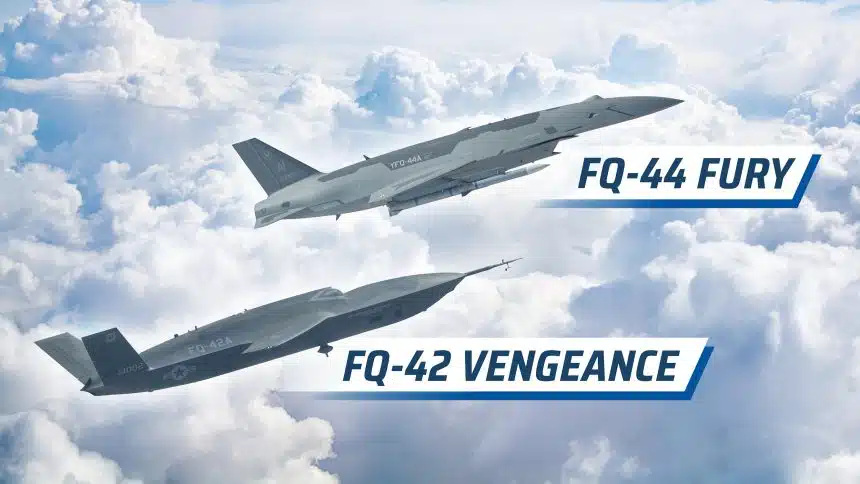
Secretary of the Air Force Troy Meink announced the popular names for the FQ-42 and FQ-44 Collaborative Combat Aircraft, which will be known as “Vengeance” and “Fury,” respectively.
Secretary of the Air Force Troy Meink formally announced the popular names of the two Collaborative Combat Aircraft (CCA) during his keynote address at the Air & Space Forces Association’s Air, Space & Cyber Conference in National Harbor, Maryland, on Sept. 14, 2026. The FQ-42 and FQ-44 will now be known as “Vengeance” and “Fury,” respectively.
While for the FQ-44 the service confirmed the name “Fury” already used internally by Anduril, for the FQ-42 it decided to replace the name “Dark Merlin” chosen by GA-ASI. The service said that “revealing popular names was a natural next step for the CCA program as the Air Force modernizes the nation’s aerial combat fleet.”
This morning, @SecAFOfficial announced the official names of the Air Force’s newest Collaborative Combat Aircraft, the FQ-42 Vengeance and FQ-44 Fury, during his keynote address at the @AFA_Air_Space‘s #AFANational Conference.
Revealing popular names was a natural next step for… pic.twitter.com/A6QiAm0gBG
— U.S. Air Force (@usairforce) September 14, 2026
Meink additionally confirmed that the service would have 500 CCAs by 2032, out of the 1,000 planned by the end of the decade. The combat-ready, semi-autonomous systems will extend reach, awareness and survivability of American airpower in contested environments, explained the service.
CCA Increment 1 program advances
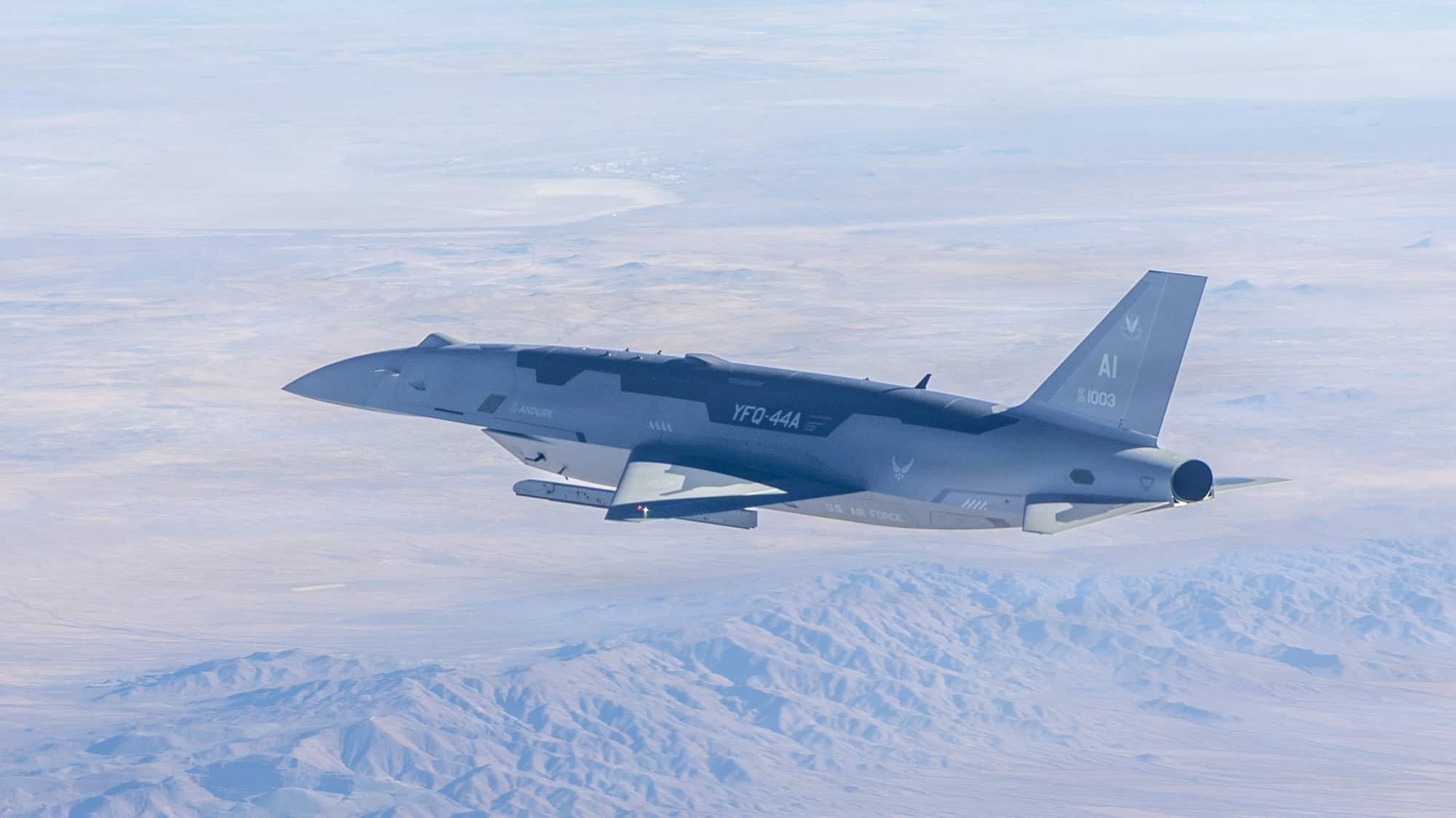
The announcement of the popular names for the two aircraft selected as part of the CCA Increment 1 program follows the production contracts announced earlier this summer. As we reported in June, the Air Force awarded engineering and manufacturing development and production contracts for the FQ-42 and FQ-44, as well as mission autonomy production contracts.

The service explained that the award arrived months ahead of scheduled because the two uncrewed assets already met rigorous mission requirements and are ready for full-scale manufacturing. One of the changes with the award of the production contracts was the two designs dropping the ‘Y’ designation which indicated prototypes.
On that occasion, Secretary of the Air Force Troy Meink said the goal was “to procure over 150 combat capable CCA by the end of the decade.” With the latest announcement, this goal now changed to 500 aircraft by 2032.
The service intends to field approximately 1,000 combat-capable CCA throughout multiple Increments. Work is already ongoing for the Increment 2, which will build on the lessons from Increment 1, while production of the FQ-42 and FQ-44 is already in progress.
While General Atomics Aeronautical Systems (GA-ASI) and Anduril have been awarded contracts for the production of the aircraft, contracts for rapid software development went to Anduril, General Atomics, Lockheed Martin, Northrop Grumman, RTX Collins Aerospace and Shield AI, and mission autonomy contracts went to Anduril, RTX Collins Aerospace, and Shield AI. The service will select a primary mission autonomy provider for CCA Increment 1 by summer 2027.
In August, the Air Force also tested portable ground control stations for CCAs, called Portable Command and Control Enclave (C2E). The evaluations featured ground operations demonstrations from leading industry partners, said a statement.
The demonstration, hosted by the Ohio Air National Guard’s 178th Wing at Springfield Air National Guard Base, provided an ideal operational setting for testing these next-generation systems. The system is meant to support Agile Combat Employment operations in austere environments anywhere in the world.
Air and Space Forces Magazine reports that the plan is to award a contract by the next summer, following a new phase featuring cloud testing. “The C2E program includes multiple form factors, and the plan is to award an initial integration partner in the early summer,” said the spokesperson quoted by the outlet.