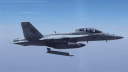
For the first time, the Weapon Systems Officer of the F-15E Strike Eagle shot down in Iran appeared in public and shared his story.
For the first time since the April 3, 2026, incident in which an F-15E Strike Eagle, callsign DUDE 44, was shot down over Iran, one of the crew members appeared in public and shared his story. The Weapon Systems Officer (WSO), a Colonel of the 494th Fighter Squadron identified only as DUDE 44 Bravo because of security reasons, was interviewed during the episode of CBS‘ ’60 Minutes’ which aired on Sept. 13, 2026.
Since the shootdown, the U.S. Air Force has not released details about the identities of the two crew members. The only official information about them was released in the Pentagon briefings with the press following the successful rescue operations.
For the first time publicly, the U.S. Air Force officer who was shot down over Iran and stranded behind enemy lines for two days tells his story, only on 60 Minutes. pic.twitter.com/r1uiksAZvl
— 60 Minutes (@60Minutes) September 13, 2026
Introducing the interview, Admiral Brad Cooper, Commander of U.S. Central Command (CENTCOM), was asked why the aircraft was in that area. As already reported in previous occasions, the aircraft was involved in four-ship nighttime mission over a mountainous area south of Isfahan.
“Their mission was to conduct a strike on an industrial facility related to both the drone and the missile program, not related to the Isfahan nuclear facility,” said Cooper.
For the first time in more than 20 years, a U.S. fighter jet was lost over enemy territory. The roughly $30 million jet was brought down over Iran by a shoulder-fired missile that can cost about $100,000. pic.twitter.com/lPGjJheDfS
— 60 Minutes (@60Minutes) September 13, 2026
Secretary of War Pete Hegseth was next, and was asked about his reaction when he was woken up in the night with the news of the shootdown. “You always knew that was possible, so you immediately get to the next steps: are they ok? Does Iran know that? Whether they’re alive or not, we’re going to go get them,” said Hegseth.
DUDE 44 shootdown
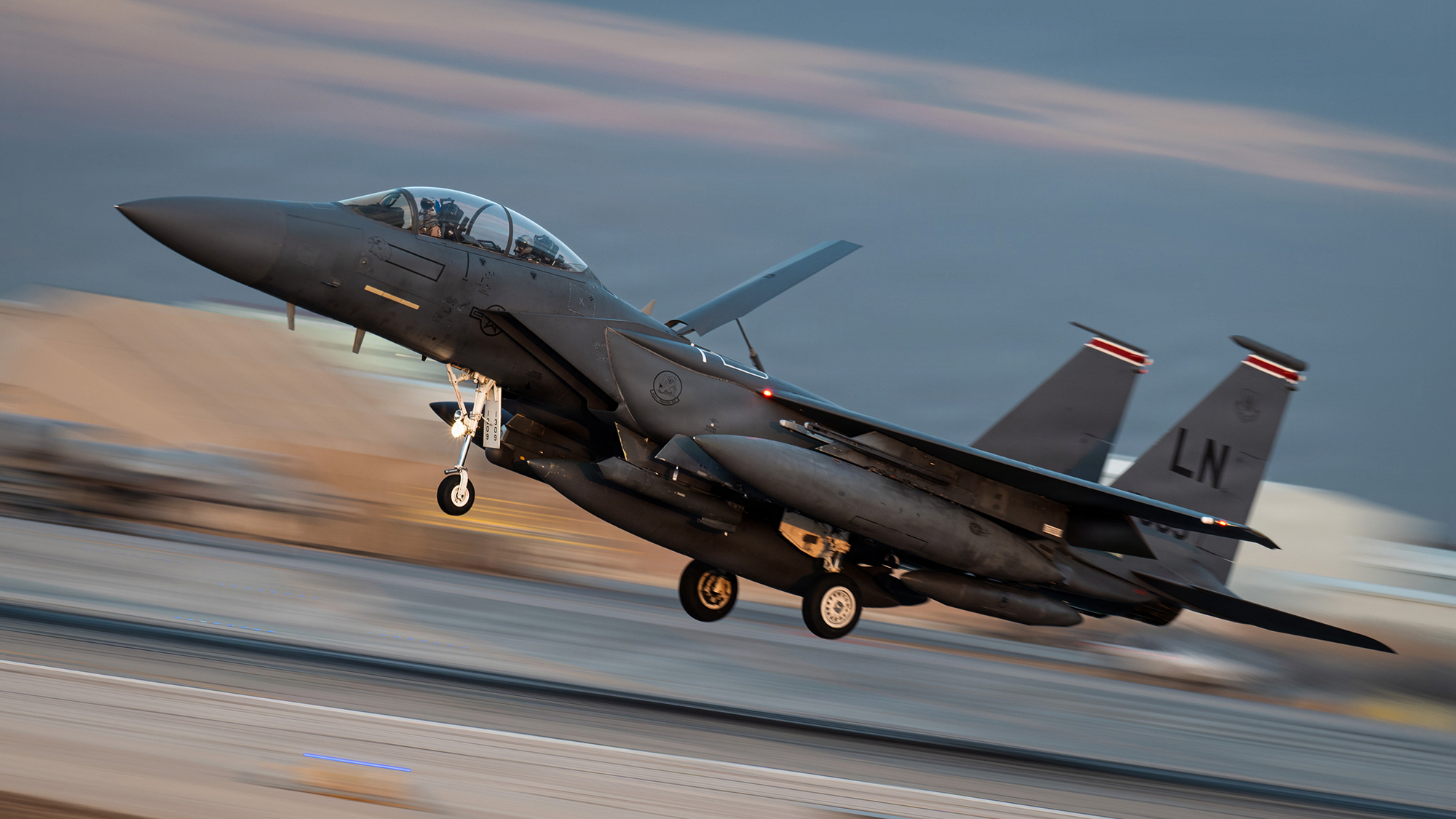
As mentioned previously in official statements, the F-15E’s pilot and Weapon Systems Officer (WSO) were identified as DUDE 44 (the mission’s callsign) Alpha and Bravo, respectively. The crew member in the interview, DUDE 44 Bravo, is thus the Strike Eagle’s WSO.
“That day was just another day in the war for us, until that moment where we got hit by an Iranian weapon,” said the Colonel. While tape was put on his nametag to hide the name, the WSO was still wearing the patch of the 494th Fighter Squadron “Panthers,” one of the squadrons assigned to RAF Lakenheath’s 48th Fighter Wing.
“When it happened, it was perfectly clear to me that we’d been hit because of the violence of that impact,” he further added. “I think the best way I’ve been able to describe that moment was getting hit by a freight train.”
The crew got to work to assess the situation and their options to overcome the problems. Hundreds of miles from friendly territory, the first priority was to check whether the aircraft was still flyable and able to get them away from the area.
“We do all we can to try to save the aircraft,” said the Colonel. “It was evident that that wasn’t possible and soon thereafter we ejected and found ourselves floating over the heart of Iran.”
Among the many systems which were damaged by the impact of the missile was also the WSO’s ejection seat. “It damaged catastrophically many of the systems of the aircraft,” said the Colonel. “That also includes my ejection seat.”
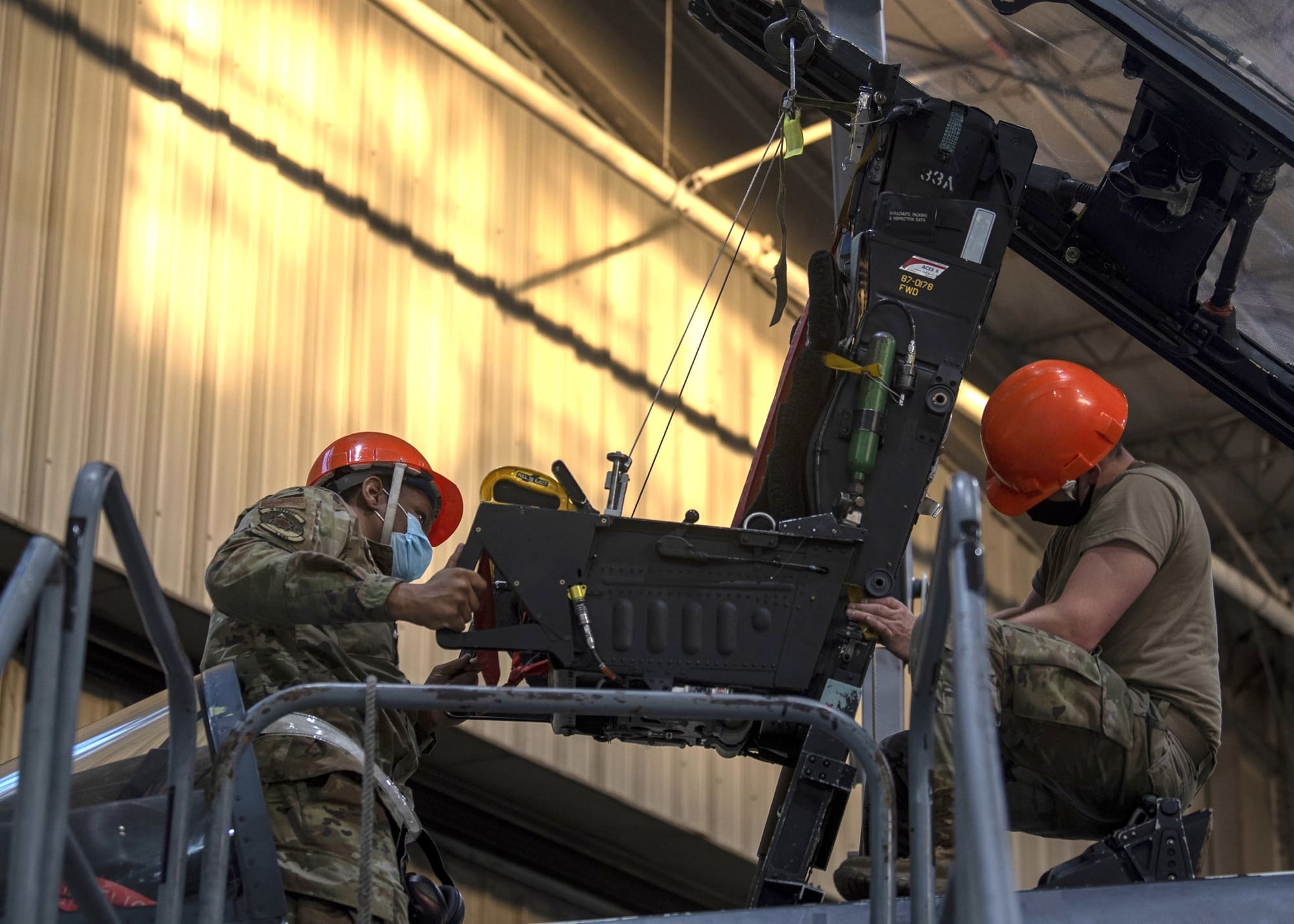
He paused for a second to thank the Airmen working on the ejection seats and survival gear, saying “they did an incredible job, because despite the damage to the aircraft, to include the damage to my ejection seat, it outperformed the design specifications, and I call that a testament to their professionalism.”
Damaged parachute
The Colonel did not mention how the seat was damaged, however he mentioned that the damage cause a failure in the deployment of the parachute.
“My parachute was damaged in the initial attack at one point when I looked up and saw no parachute,” he said. “That was the most terrifying thing I’ve ever seen.”
It must be noted that in the F-15E’s ACES II seat the parachute is stowed in a container behind the headrest, which is the seat’s most exposed part to the exterior, and which can thus be damaged also by shrapnel. We don’t know however if that’s the case, as no further details were provided.
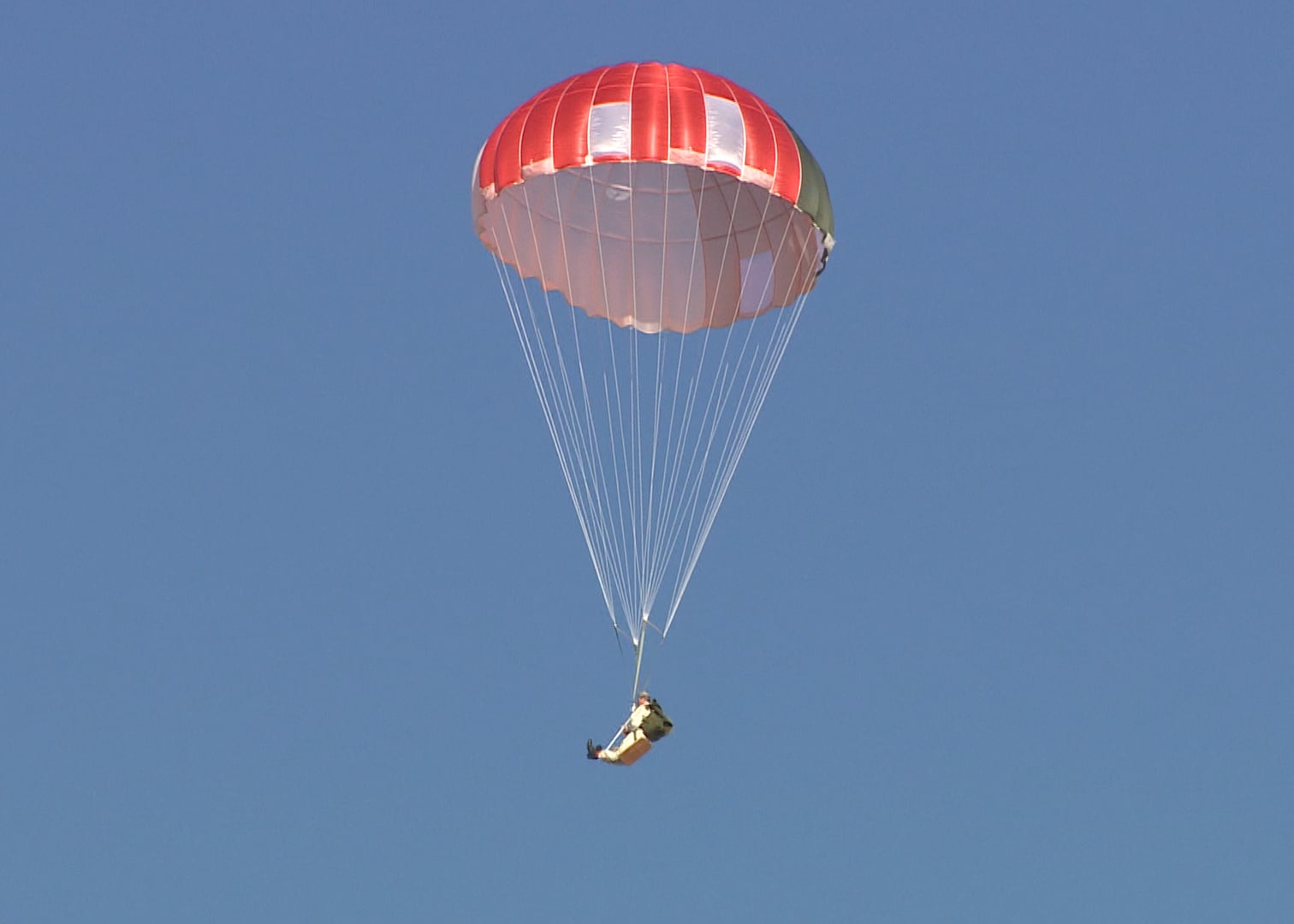
For a certain time, the WSO found himself falling toward the ground without a usable parachute to slow him down.
“Free falling is a good way to put it,” he said. “I wasn’t focused on the speed at which I was falling, I was instead focused on trying to correct the problems that were in front of me and doing anything I could to unfurl or pull pieces of the parachute loose.”
It is unclear if the parachute was then partly or fully deployed. The former might be the likely option, as the descend was not slowed enough, causing extensive injuries.
“Based on my descriptions, and the injuries that I had, the professionals think I hit the ground going somewhere between 70 and 100 miles an hour,” he said. Usually, safe landings with round parachutes never exceed 15 miles per hour.
The evasion
According to the voiceover, the fall broke the WSO’s back, and he sustained also a broken arm, broken shoulder, sprained ankle and was bleeding from cuts and scrapes to his head and face.
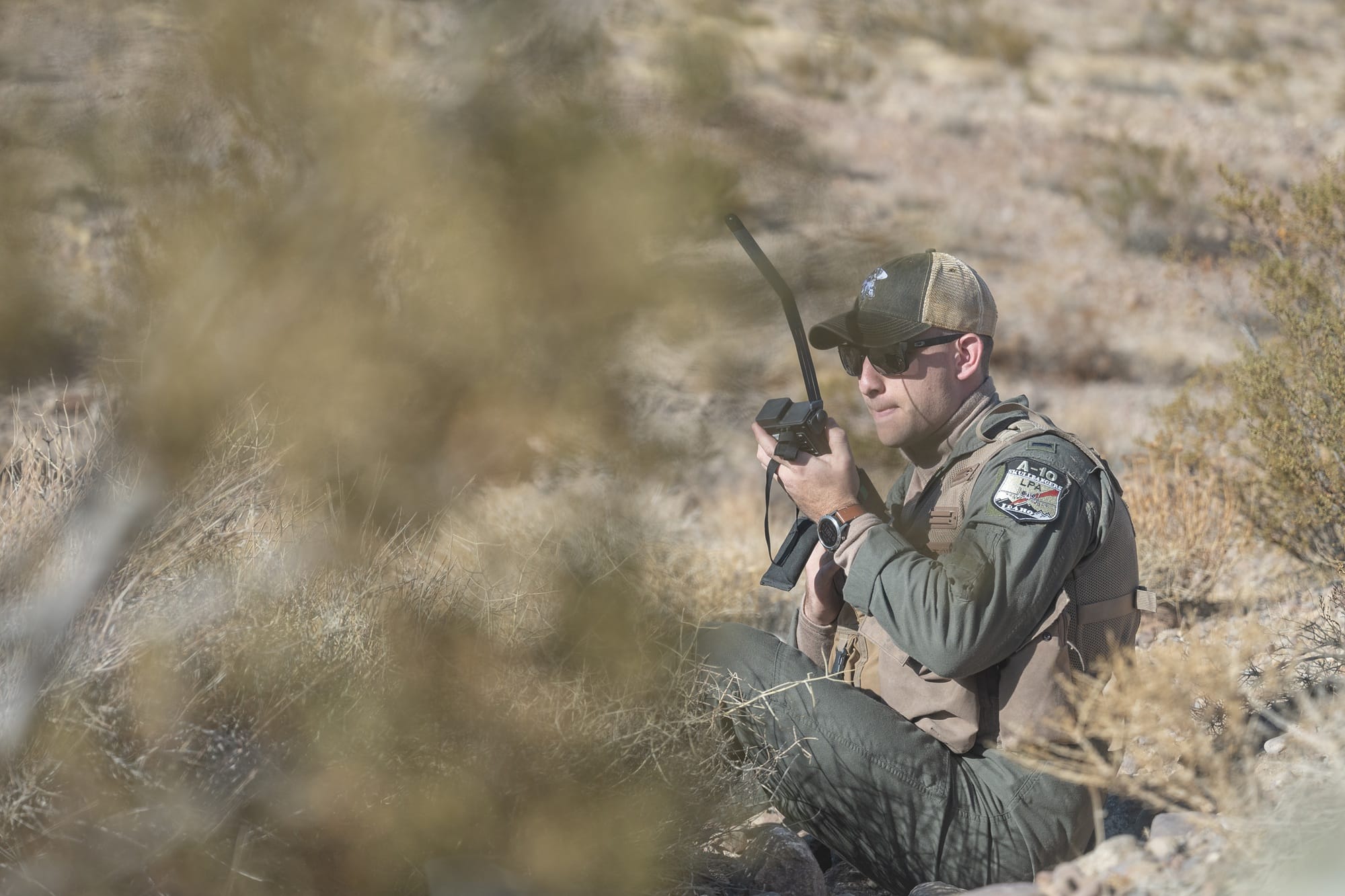
“I had injuries, but we all trained to adapt and overcome the things that we’re faced with,” he explained. “I moved as quickly as I could, despite the injuries, away from the place that I landed.”
Training kicked in, and the Colonel started applying what he was taught by Survival, Evasion, Resistance and Escape specialists. Complicating the effort, the damage to the ejection seat meant he did not have the survival kit contained in the seat’s bucket.
“SERE professionals trained me, over 20 years ago in my case, on setting priorities,” he said. “So it’s not just what you need to do, it’s the time frame that you need to do them in. So for me, I was focused on things like getting away from the enemy, finding the right place to communicate, finding the way to hide or defeat the ways the enemy might track me.”
The WSO gave priority on getting away from the spot in which he landed, before starting to employ his communication equipment. During this movement, despite the injuries, he started climbing a 7,000 ft mountain.
Visualizza questo post su Instagram
“Given your injuries, how did you find the strength to make it up the mountain?” asked the reporter. “Never let a lack of motivation put you on an Iranian TV,” answered the Colonel.
The rescue
Meanwhile, the rescue forces were already moving to locate and pick up the crew. The pilot, DUDE 44 Alpha, was the first to be rescued.
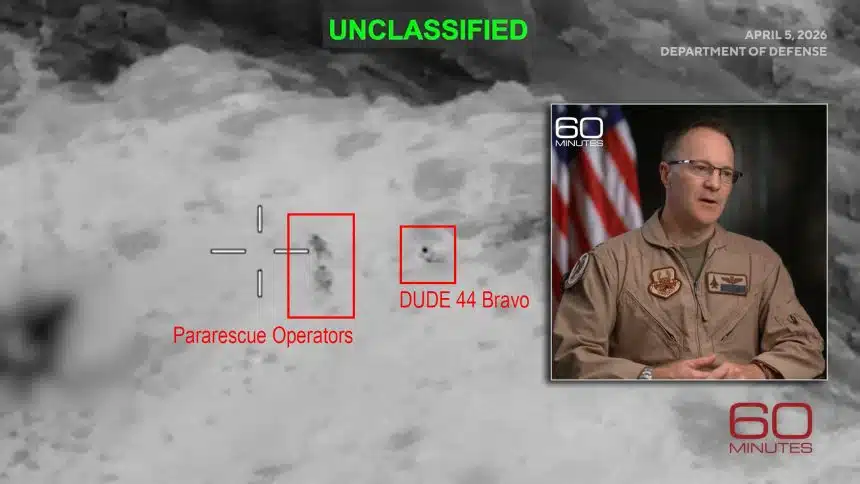
During the interview, a declassified video showed the two HH-60W Jolly Green II helicopters arriving in the target area. From his vantage point, the WSO was able to see the operation unfolding only five miles away.
First on 60 Minutes: Newly declassified video shows the rescue of the U.S. Air Force pilot who was shot down over Iran in April. https://t.co/jGagMqLvCy pic.twitter.com/KxqUITvbAN
— 60 Minutes (@60Minutes) September 14, 2026
The helicopters, after picking up the pilot, tried to look for the WSO, but had to withdrew. The reason was not explained in the interview, although in previous occasions it was mentioned that the helicopters came under fire, with the crew sustaining light injuries.
“My worst fear was letting down the team that was working so diligently to rescue me,” said the Colonel when asked about how he felt. “I knew that they were going to come. I knew that America, whether it was one day or one year, was going to uphold its promise and rescue me. I had t do my part to give them time to affect that rescue.”
Meanwhile, the Iranians were preparing a search party in the valley, ready to look for the missing crew member. “I knew that they were coming,” he said. “I knew for a fact that they were looking for me.”
The night of the rescue, the mission package involved 155 aircraft, as mentioned previously by the Pentagon. Among them were aircraft tasked with bombing Iranian forces which were looking for the WSO, as shown in the second video declassified for the interview.
Newly declassified footage shows the events leading up to the rescue of Bravo, the U.S. Air Force officer who was shot down and survived behind enemy lines in Iran for two days. https://t.co/YUIzeTBpKt pic.twitter.com/0x2zDndgmC
— 60 Minutes (@60Minutes) September 14, 2026
A third video showed the moment of the rescue, with the helicopter landing on the ridge and two Pararescue operators (also known as PJs) reaching the Colonel to pick him up. The helicopter was blurred in the video, although it was previously reported it was an MH-6 Little Bird transported by the MC-130s that landed on a makeshift runway nearby.
First on 60 Minutes: Newly declassified video shows service members from U.S. Joint Special Operations Command rescuing Bravo, one of the two U.S. Air Force officers shot down over Iran in April. Bravo was stranded for two days – alone and badly wounded, behind enemy lines.… pic.twitter.com/jAfLa5tfL7
— 60 Minutes (@60Minutes) September 14, 2026
“The moment a PJ showed up to me on that ridgeline was one of the greatest moments of my life and I don’t know how to say it more clearly than thank you for all that they did,” concluded the Colonel.
“The moment a PJ showed up to me on that ridgeline was one of the greatest moments of my life,” says Bravo, the U.S. Air Force officer who was shot down and stranded behind enemy lines in Iran, referring to the pararescue specialists who picked him up. https://t.co/5ZAghyd0wG pic.twitter.com/53PeuvtgkV
— 60 Minutes (@60Minutes) September 14, 2026
Weird theories
One detail that attracted the attention of people watching the ’60 Minutes’ interview was that the footage of the HH-60W Black Hawk helicopter was shown uncensored, while the next helicopter that arrived to pick up the pilot was blurred. Gen. Dan Caine also said the image had been obscured so the aircraft’s identity would not be revealed.
Still, as already explained, we know that helicopter was an MH-6 Little Bird. So why censor it? Many people began suggesting that the aircraft had been hidden because it was the so-called “Stealth Black Hawk” revealed by the Osama bin Laden raid in 2011, a type we have probably written about more extensively than any other outlet in the world. In fact, one of the many renderings we have published here at The Aviationist has been used in social media posts accompanying the censored clip.
Stealth hawk comeback??? https://t.co/3KEImu4CT5 pic.twitter.com/nIBzlDOJMl
— 🕳️ (@Flanker30MKI) September 14, 2026
now why would the helicopter is blurred out🤔 https://t.co/WOMunDgOLO pic.twitter.com/zjlbXeq02G
— Star Excelsior (@star_excelsior) September 14, 2026
The actual reason is arguably less intriguing. The helicopter may have been blurred to conceal its infrared exhaust signature in IR footage, or to hide some modification fitted to the aircraft.
In fact, unlike other recent special operations where its presence was rumored, there is no indication that the infamous MH-X, or “Stealth Black Hawk,” was involved in the Iranian rescue operation, and the size of the obscured helicopter appears consistent with that of an MH-6, whose presence is independently confirmed.
Anyway, if you want to learn more about the Stealth Black Hawk, you can use the search button on this site, or start from the X thread here below.
7/ The rendering went viral.
It was used by media outlets, shown in documentaries, and even inspired model kits. Despite being speculative (and a bit S-76-ish), it became the unofficial image of the secret helo.
Google “Stealth Black Hawk” and you’ll still see it everywhere. pic.twitter.com/6qVRm4Azqp
— The Aviationist (@TheAviationist) May 2, 2025