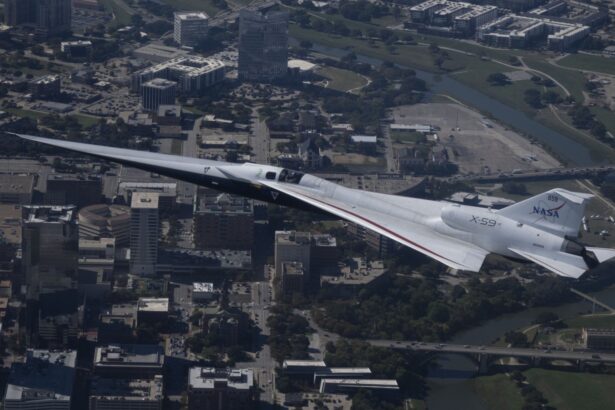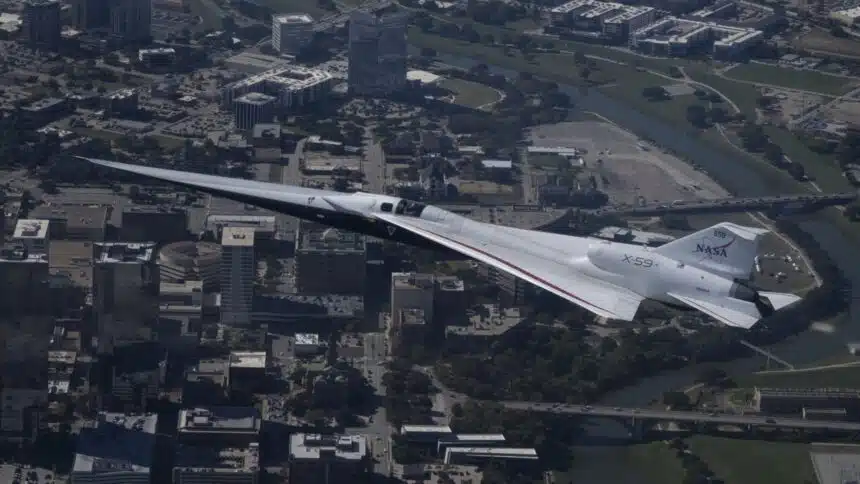
The X-59 QueSST completed the acceptance review, and NASA now took ownership of the aircraft from contractor Lockheed Martin Skunk Works.
NASA announced on Nov. 23, 2026, that it finally took full ownership of the X-59 QueSST (Quiet SuperSonic Technology) from Lockheed Martin Skunk Works. The milestone was reached on Nov. 18, after the aircraft flew from California to Florida and back.
A year after its first flight as part of the agency’s program which will pave the way for the return of supersonic airliner, the aircraft departed for its first journey east from California headed toward the NASA Kennedy Space Center in Florida. The X-59 was expected to be one of the assets taking part in NASA’s MAX POWER airshow, however weather delays prevented it from joining the display at the airshow.
A milestone years in the making.
NASA has officially accepted delivery of the X-59 from Lockheed Martin Skunk Works, marking an important milestone for the Quesst mission as the team prepares for the next phase of flight research. ✈️🔊
🔗: https://t.co/PiH0JeGqA0 https://t.co/pPs8nByqnR
— NASA Armstrong (@NASAArmstrong) November 23, 2026
In the press release, NASA explained that, while flight testing continued at the Armstrong Flight Research Center in Edwards, California, Lockheed Martin had retained official ownership. Following the completion of an aircraft acceptance review with NASA, described as a key step in contract closeout, Lockheed Martin transferred the ownership.
“To someone outside the flight test, this might seem like a subtle change,” said Cathy Bahm, Low Boom Flight Demonstrator project manager. “But for NASA, this is another big moment for the X-59 showing how far we have come, how much our hard work has paid off, and how much closer we are to providing the data to hopefully make commercial supersonic flight over land a reality.”
More than 2,000 miles. Multiple states. One mission. ✈️🚀
NASA’s F-15, F/A-18, C-20, and X-59 traveled from California to Florida in support of NASA’s MAX POWER event.
While weather delays prevented the X-59 from joining the display at Kennedy Space Center, the team connected with visitors at Daytona Beach International Airport to share how NASA’s Quesst mission is helping make quiet supersonic flight possible.
Which photo is your favorite?
🔗: https://t.co/GBb5EK6uxs
— NASA Armstrong (@NASAArmstrong) November 24, 2026
A year of milestones
Since its first flight on Oct. 28, 2025, NASA’s X-59 has progressed from initial systems checks to supersonic flight, steadily expanding its flight envelope in preparation for the QueSST program’s acoustic validation phase. The aircraft’s maiden flight, piloted by Nils Larson, lasted 67 minutes and focused on assessing its basic flying qualities and systems.
Following a scheduled maintenance period, the X-59 returned to the skies in March 2026, resuming its test campaign and expanding the flight envelope toward higher speeds and altitudes. On June 5, the aircraft broke the sound barrier for the first time, reaching approximately Mach 1.1 at 43,400 feet during an 81-minute flight piloted by Jim “Clue” Less.
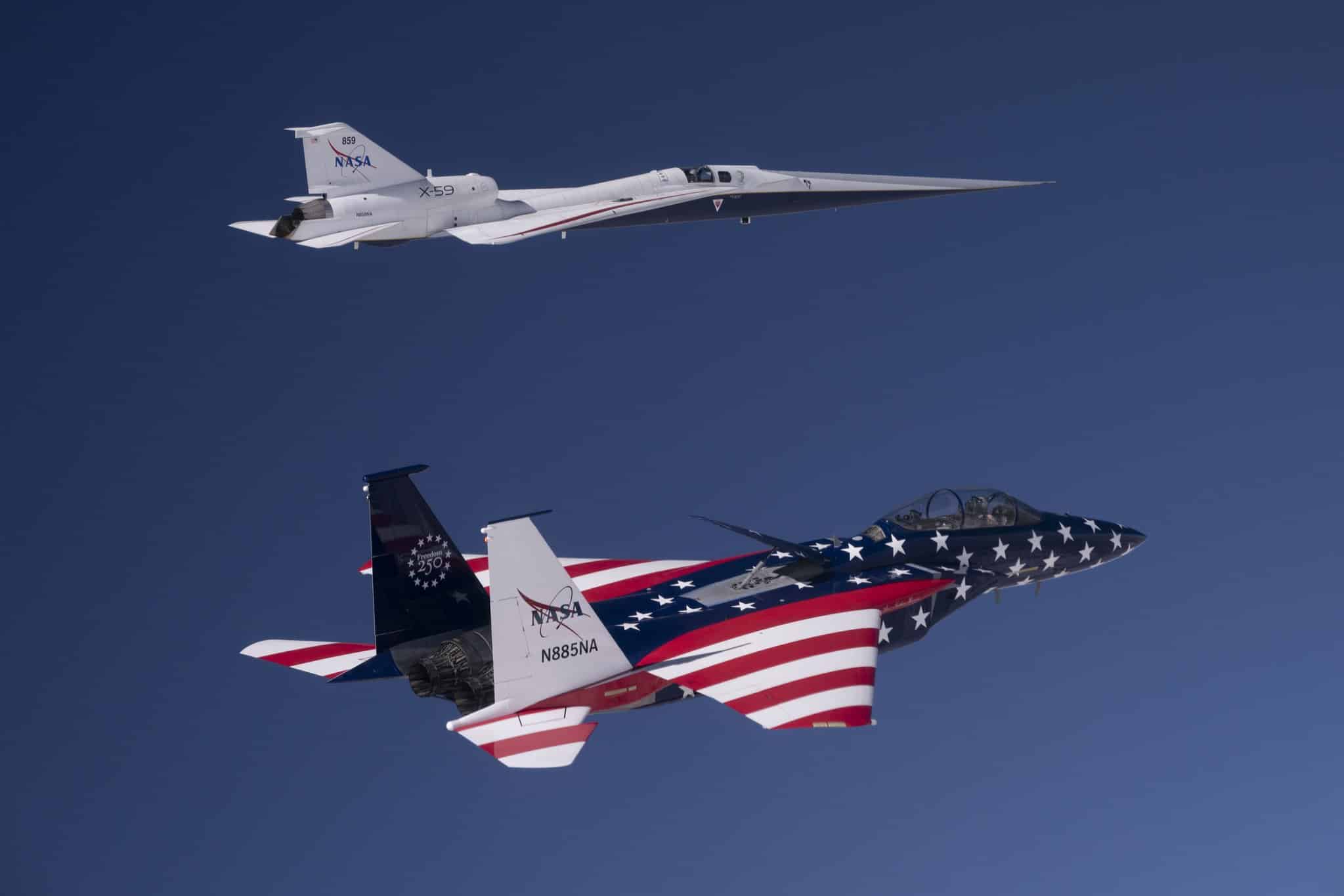
During the flight, the X-59 was supported by a NASA F-15 as safety chase aircraft. The agency said “the loud sonic booms from the F-15 obscured any sound made by the X-59,” which has been designed to create “only a quiet thump instead of a loud sonic boom” while flying at supersonic speed.
Just a week later, on June 12, it reached its intended “mission conditions” for the first time, flying at Mach 1.4 and 55,000 feet. These are the baseline speed and altitude planned for future community overflights which will allow to collect data about the sound generated by the experimental airplane and how people perceive it from the ground, with NASA saying will be like “a thump projected to sound like a car door closing from about 20 feet away.”
The flight test campaign continued through the summer and into autumn as the team evaluated the aircraft’s performance across a wider range of conditions. In September, the X-59 completed six flights in three days, setting a new record for its flight-test campaign while reaching Mach 1.53, its highest speed to date at that point.
On Oct. 21, another NASA test pilot, Mike Lippert, conducted his first flight on the X-59, reaching Mach 1.4 and 55,000 ft, after another period of scheduled maintenance. By Oct. 28, 2026, the one-year anniversary of its maiden flight, the aircraft had completed 40 additional flights, reached an altitude exceeding 56,000 feet, and demonstrated that it could operate well beyond the initial subsonic conditions, says NASA.