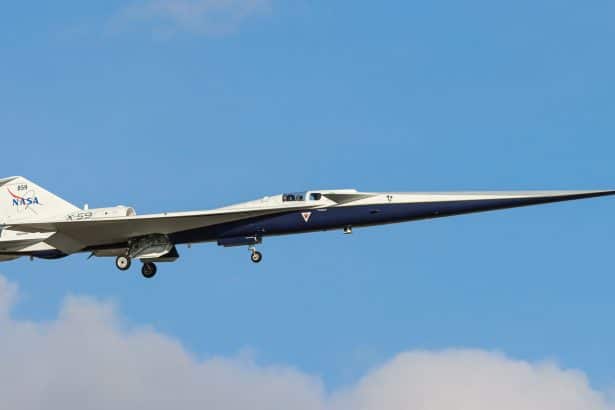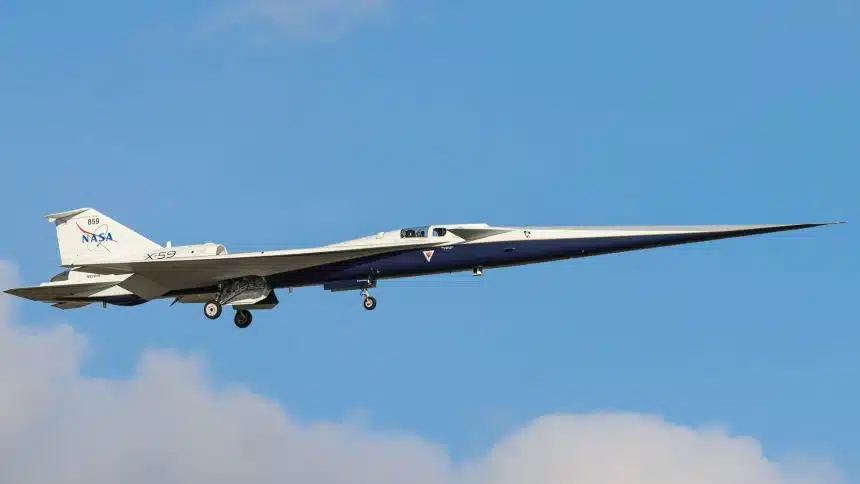
On the anniversary of its first flight, NASA’s X-59 QueSST has started its first journey east from California, headed to the agency’s Kennedy Space Center in Florida.
On Oct. 28, 2026, NASA’s experimental X-59 QueSST (Quiet SuperSonic Technology) celebrated a year since its first flight as part of the agency’s program which will pave the way for the return of supersonic airliners. On the same day, the aircraft departed for its first journey east from California.
After a first stop in El Paso, Texas, the aircraft toward Fort Worth, Texas, where it landed at Naval Air Station Joint Reserve Base (NAS JRB) Fort Worth for the night stop. Here, it was caught during landing by our friends and contributors Gherardo and Victoria Fontana.
Commenting Victoria’s videos, NASA Administrator Jared Isaacman confirmed that the experimental aircraft is on its way to the agency’s Kennedy Space Center in Florida. Earlier this month, it was reported that the X-59 was expected to be one of the assets taking part in NASA’s MAX POWER airshow at KSC on Nov. 7 and 8.
@LensOfMae @thenewarea51 @gfontana767 Great catch… X-59 making her way to @NASAKennedy
— NASA Administrator Jared Isaacman (@NASAAdmin) October 28, 2026
The X-plane was accompanied during landing by one of NASA’s F-15s, which was acting as safety chase. Additionally, one of the agency’s F/A-18s and a Gulfstream C-20 were also tracked on the same route.
The NASA859 (X-59 Quesst) just departed El Paso, Texas and is inbound CARSWELL FIELD AIRPORT (FORT WORTH, TX) NFW along with NASA 802 (Gulfstream) and NASA 862 (F-18)
Tracking via @flightaware and audio via @theATCapp https://t.co/CL5i7vWhtH
— Thenewarea51 (@thenewarea51) October 28, 2026
A year of milestones
Since its first flight on Oct. 28, 2025, NASA’s X-59 has progressed from initial systems checks to supersonic flight, steadily expanding its flight envelope in preparation for the QueSST program’s acoustic validation phase. The aircraft’s maiden flight, piloted by Nils Larson, lasted 67 minutes and focused on assessing its basic flying qualities and systems.
Following a scheduled maintenance period, the X-59 returned to the skies in March 2026, resuming its test campaign and expanding the flight envelope toward higher speeds and altitudes. On June 5, the aircraft broke the sound barrier for the first time, reaching approximately Mach 1.1 at 43,400 feet during an 81-minute flight piloted by Jim “Clue” Less.
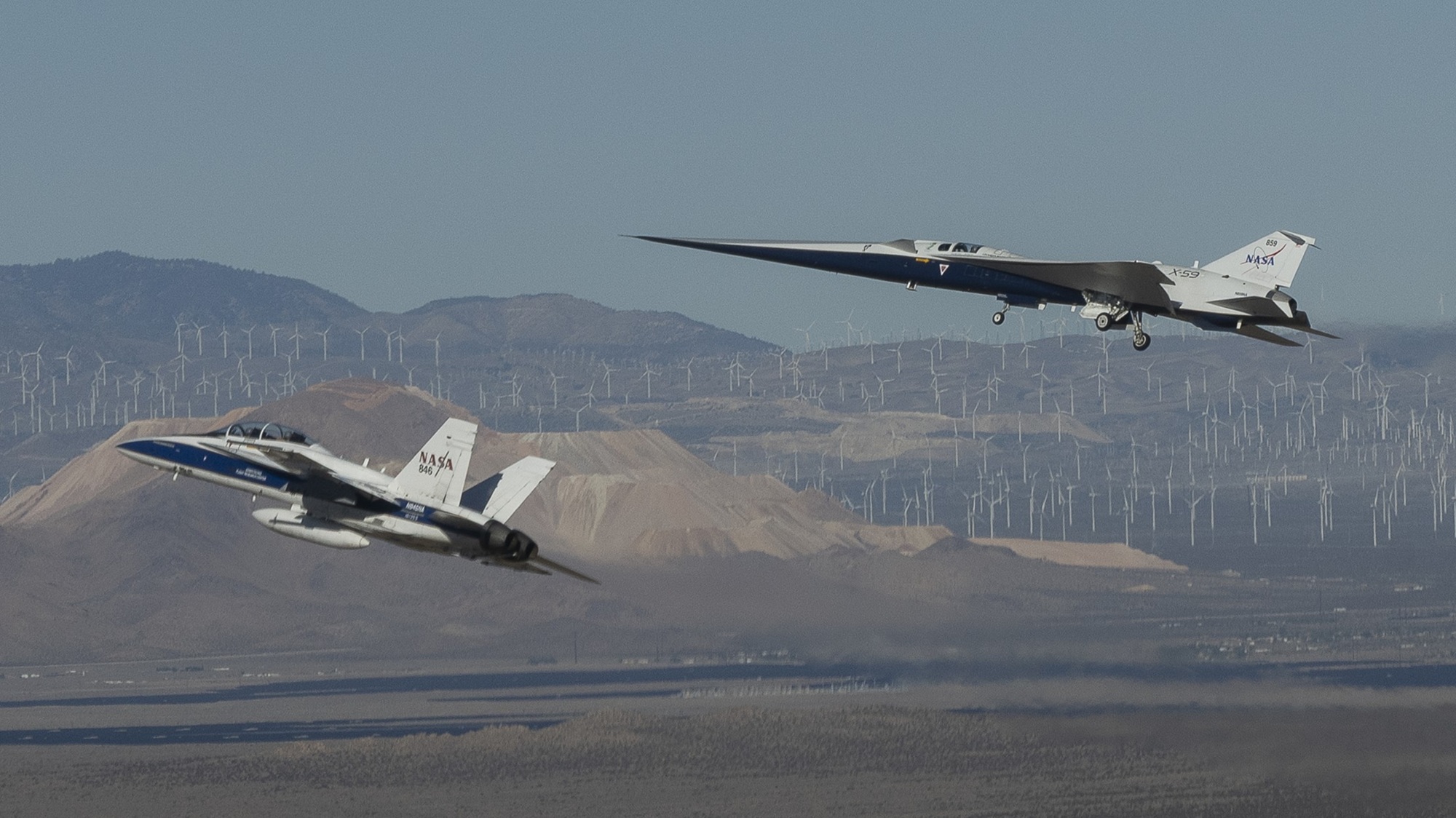
During the flight, the X-59 was supported by a NASA F-15 as safety chase aircraft. The agency said “the loud sonic booms from the F-15 obscured any sound made by the X-59,” which has been designed to create “only a quiet thump instead of a loud sonic boom” while flying at supersonic speed.
Just a week later, on June 12, it reached its intended “mission conditions” for the first time, flying at Mach 1.4 and 55,000 feet. These are the baseline speed and altitude planned for future community overflights which will allow to collect data about the sound generated by the experimental airplane and how people perceive it from the ground, with NASA saying will be like “a thump projected to sound like a car door closing from about 20 feet away.”
The flight test campaign continued through the summer and into autumn as the team evaluated the aircraft’s performance across a wider range of conditions. In September, the X-59 completed six flights in three days, setting a new record for its flight-test campaign while reaching Mach 1.53, its highest speed to date at that point.
On Oct. 21, another NASA test pilot, Mike Lippert, conducted his first flight on the X-59, reaching Mach 1.4 and 55,000 ft, after another period of scheduled maintenance. By Oct. 28, 2026, the one-year anniversary of its maiden flight, the aircraft had completed 40 additional flights, reached an altitude exceeding 56,000 feet, and demonstrated that it could operate well beyond the initial subsonic conditions, says NASA.
One year. New heights. Faster speeds. ✈️
Since its first flight on Oct. 28, 2025, NASA’s X-59 has continued pushing the boundaries of aviation.
See how far we’ve come in just one year!
https://t.co/N7ew2vnCtI
#NASAaero #Quesst https://t.co/FApl6F9gnY
— NASA Aeronautics (@NASAaero) October 28, 2026
The X-59
The X-59 QueSST (Quiet SuperSonic Technology) is an experimental supersonic aircraft developed at Skunk Works for NASA’s Low-Boom Flight Demonstrator project. The technologies used on the jet are meant to influence future generations of quiet supersonic aircraft as part of the effort to reintroduce supersonic commercial flight.
The X-59 is, in fact, designed to generate a quieter sonic boom which should be within acceptable noise levels to help the FAA to lift the ban on commercial supersonic travel over land imposed in 1973. According to NASA, the sonic boom generated by the new aircraft will be less than 75 perceived dB on the ground, about a third less than the Concorde, which was reported around 100-110 dB.
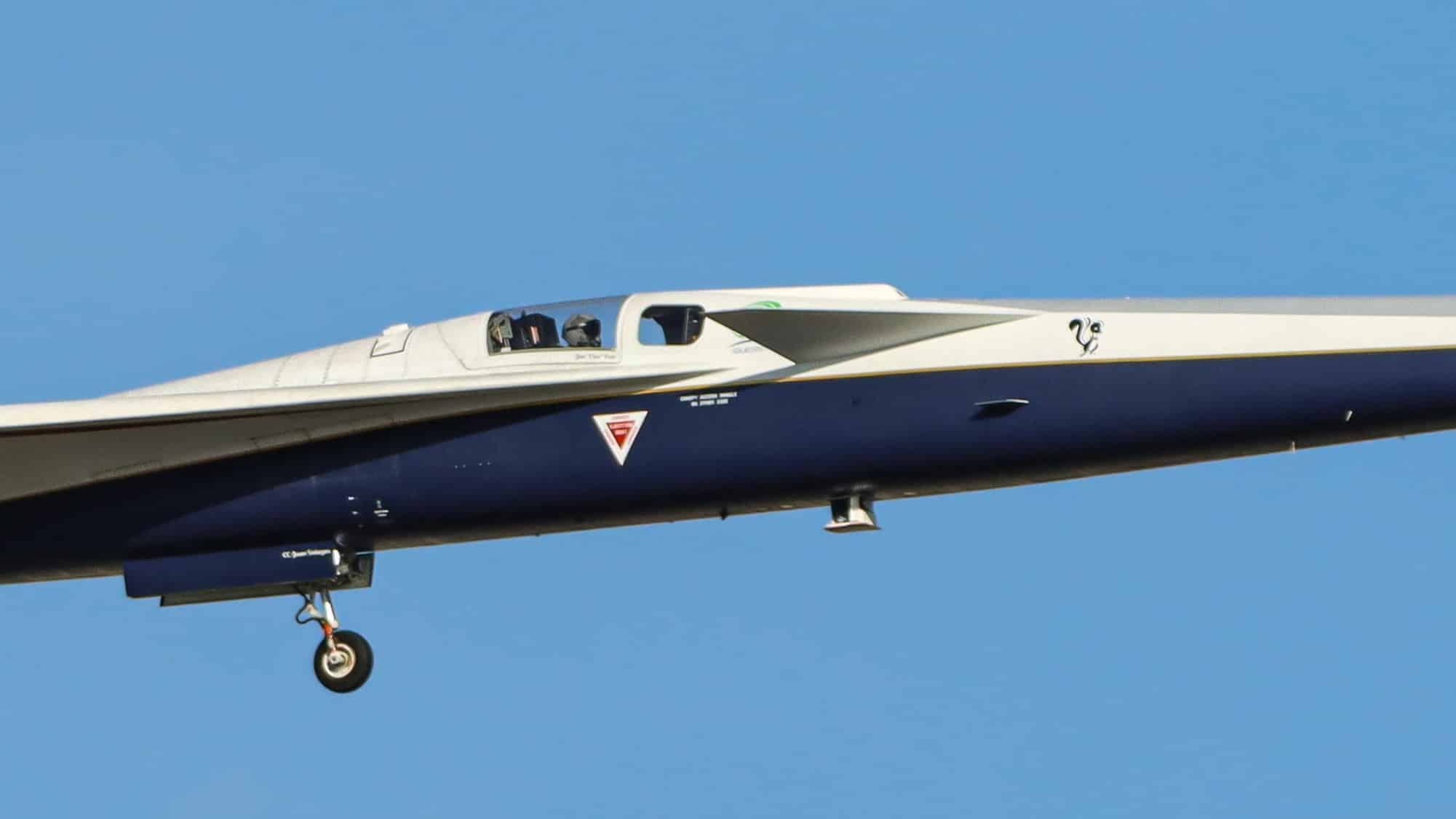
A key feature of the aircraft which will allow to achieve this goal is the long tapered nose, which accounts for almost a third of the X-59’s length. The nose is designed to break up the shock waves that would ordinarily result in a supersonic aircraft causing a sonic boom.
Due to this configuration, the cockpit is located almost halfway down the length of the aircraft, a solution which however does not allow the presence of a traditional windshield. Instead, NASA developed the eXternal Vision System (XVS), a series of high-resolution cameras feeding a 4K monitor in the cockpit.
NASA described the system as an “electronic window,” which is powered by two sets of cameras. The first is a 4K camera in front of the cockpit, which provides the main field of view to the pilot, while the second is the retractable Forward Vision System (FVS) installed below the cockpit, which completes the screen’s lower triangle (which can be identified by the different colors), where the 4K’s camera view is obstructed by the nose.
✈️ Six flights. One week. Fastest speed to date.
NASA’s X-59 completed its busiest week of flight testing yet — and reached Mach 1.53, approximately 1,010 mph, its fastest speed to date. 💨
See how the team is expanding the aircraft’s flight envelope: https://t.co/9bOQOTCApB https://t.co/Aqlwb75DMj
— NASA Aeronautics (@NASAaero) October 2, 2026
The X-59 is powered by a F414-GE-100 engine with 22,000 pounds of thrust, modified from the F414 used by the F/A-18 Super Hornet. The engine is unusually placed on top of the aircraft to give it a smooth underside, which helps keep shockwaves from merging behind the aircraft and causing a sonic boom.
The X‑59 is equipped with multiple systems designed specifically to protect the pilot, including a life support system to deliver oxygen to the pilot while also powering the g‑suit. As another safety layer, the aircraft features an ejection seat and canopy adapted from a U.S. Air Force T‑38 trainer, outfitted with essentials such as a first aid kit, radio, and water.
Thanks again to Gherardo and Victoria Fontana for the photos they sent us, you can find more of their work on Instagram at @gfontana767 and @lensofmae.