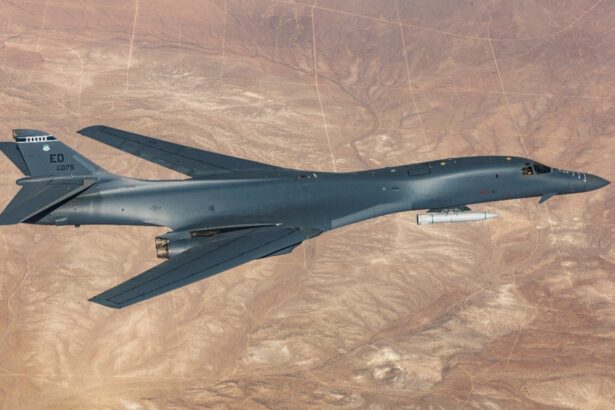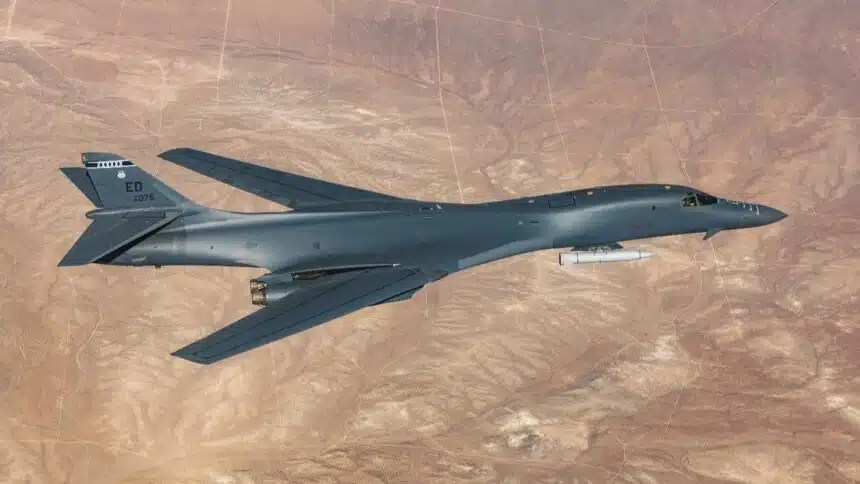
The new Load Adaptable Modular pylon, shown once again carrying an AGM-183 ARRW hypersonic weapon, recently cleared the Critical Design Review and moves closer to equipping the B-1B Lancer.
Boeing announced on Nov. 17, 2026, that the B-1B Lancer bomber’s new Load Adaptable Modular (LAM) pylon has cleared the Critical Design Review (CDR). The milestone moves the system closer to giving back an external carriage capability to the B-1B.
Notably, the press release also included a new image of the bomber carrying externally an AGM-183A Air-Launched Rapid Response Weapon (ARRW). The U.S. Air Force showed for the first time the weapon on the B-1B in April 2026.
B-one step closer to carrying more for future missions.
Our Load Adaptable Modular pylon just cleared its critical design review, bringing the B-1 closer to greater external carriage capability.
Next up: preparing hardware and software for build and testing. https://t.co/SsDzYGuGS9
— Boeing Defense (@BoeingDefense) November 17, 2026
The bomber was initially equipped with external pylons, which were removed during the conversion to conventional-only armaments started in 2007 with the Strategic Arms Reduction Treaty (START). However, the new pylons will allow the BONE (from “B-One”, as the aircraft is unofficially nicknamed) to carry externally a variety of weapons with fewer constraints compared to the older systems.
The LAM pylons are expected to provide the bomber with the ability to double its payload capacity by carrying weapons both in its three weapon bays and six external pylons. Boeing says the milestone confirms the design is mature enough to advance to the next phase of development, which includes preparing hardware and software for manufacturing, integration and test.
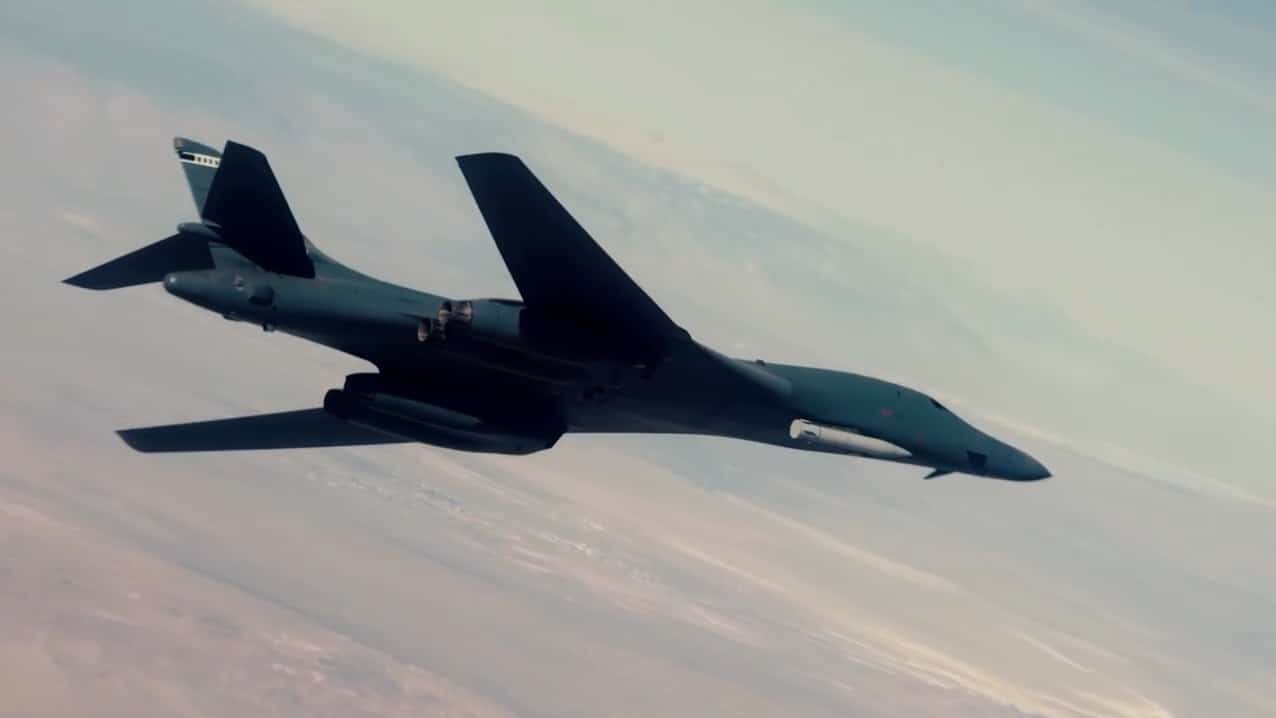
Boeing and the U.S. Air Force have been working on the flight testing of the LAM pylons for at least two years, after the first images emerged in 2024. At least three different weapons were spotted on the B-1B during the testing, including the GBU-31 Joint Direct Attack Munition (JDAM), the GBU-72 Advanced 5K Penetrator, and the AGM-183A Air-Launched Rapid Response Weapon (ARRW).
“The LAM pylon gives commanders more options,” said Dan Ruder, Bombers Advanced Programs manager. “It supports future advanced weapons and additional payload types, helping the aircraft adapt to changing mission needs.”
In the past, Boeing said its idea was to shift hypersonic weapons’ testing from the B-52 to the B-1 using the new pylon. The company said at the time the “Air Force intends to use the B-1 and pylons to test hypersonic weapons in the near term.”
This was later confirmed by the FY2026 budget request, which mentioned the Air Force’s intention to use the new Load Adaptable Modular (LAM) pylons to employ the B-1B as test bed for hypersonic weapons. With each LAM pylon capable of carrying a 5,000-pound-plus-class weapon, which corresponds to the estimated weight of ARRW, the B-1B could one day be cleared to carry up to six AGM-183 hypersonic weapons under its fuselage.

ARRW on B-1B
As we mentioned in our reporting in April 2026, it is unclear when the test flight with the ARRW on the B-1B Lancer was conducted. The weapon is installed on an external pylon in the same position which was already used in the past to test the external carry of JDAM bombs and to carry operationally the Sniper targeting pod.
The service already mentioned years ago its intention of integrating the AGM-183 on the BONE. So far, however, the weapon was always seen on the B-52H Stratofortress, and the Air Force did not announce tests on the B-1B.
The integration on the B-1B was also mentioned in the recent Fiscal Year 2027 Research, Development, Test & Evaluation (RDT&E) budget request. Specifically, this appears to be part of the Hypersonic Integration Program, which the service explains it has “successfully demonstrated the B-1B’s ability to execute a captive carry of a 5,000-pound class store and the release of a proven weapon shape from a Load Adaptable Modular (LAM) pylon.”
This specific phrasing was included in last year’s budget request, possibly referring to the testing of the 5,000-pound GBU-72/B Advanced 5K Penetrator, which was spotted on the BONE in 2024. As mentioned earlier, budget documents also said the service plans to employ the B-1B as test bed for hypersonic weapons, however it doesn’t end there.

The Air Force was initially looking to retire the B-1B by 2030, although it is now looking to extend the service life of the bomber to at least 2037. Meanwhile, the service has been looking to equip the BONE for stand-off attacks with larger volumes of weapons.
This is part of the Expanded Weapons Integration program, which is described in the budget documentation as an effort to advance the B-1B’s ability to deliver a diverse range of standoff munitions in contested anti-access/area denial (A2/AD) environments. The document specifically identified the munitions as the GBU-72, AGM-158A/B Joint Air-to-Surface Standoff Missile (JASSM) and AGM-158C Long-Range Anti-Ship Missile (LRASM), Joint Direct Attack Munition (JDAM), and AGM-183 Air Launched Rapid Response Weapon (ARRW).
Notably, the U.S. Air Force has announced in October 2026 that it awarded Lockheed Martin a $694 million contract to begin production of the AGM-183A Air-Launched Rapid Response Weapon (ARRW), after initially looking to cancel the program in 2023. The transition to production is intended to provide U.S. combatant commanders with a high-speed, long-range strike capability designed to penetrate advanced air defense systems and strike time-sensitive and high-value targets, says the press release.
The Air Force has not disclosed the number of missiles ordered or their expected delivery dates, citing operational security concerns. Nevertheless, the contract now confirms that the AGM-183 ARRW will be the U.S. Air Force’s first hypersonic weapon, and work is continuing to improve the weapon in its Increment 2 phase.