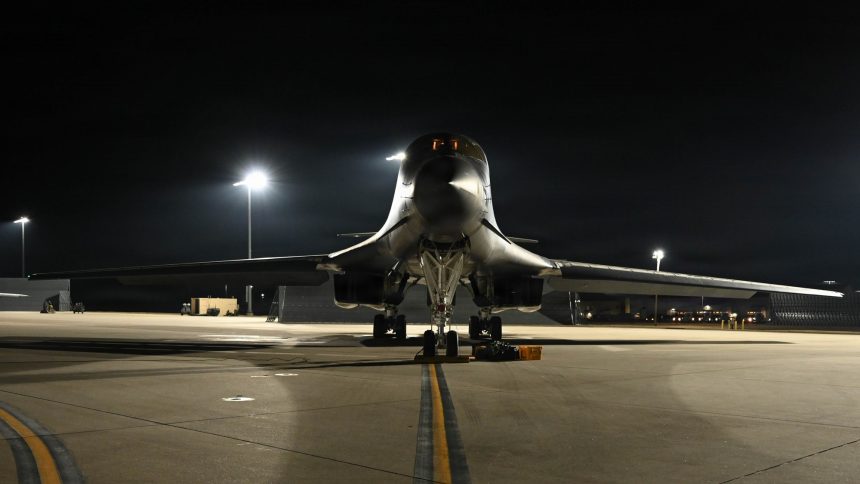
Four U.S. Air Force B-1B Lancer bombers arrived at RAF Fairford as the U.S. looks to “surge dramatically” the operations over Iran.
After the UK allowed the U.S. to use RAF Fairford and Diego Garcia for the deployment of U.S. Air Force bombers currently involved in operations over Iran, the first four B-1B Lancer bombers arrived in the UK. A first bomber arrived in the evening of Mar. 6, 2026, followed the next morning by more bombers.
Notably, the first B-1B arrived directly from the U.S. after crossing the Atlantic Ocean, while the other three arrived after completing a mission over Iran. It is unclear if additional bombers will be deployed to RAF Fairford.
1 x USAF B-1 arrival into RAF Fairford this afternoon 🛬 pic.twitter.com/Lcq6ytHUpG
— Planes Out The Window ✈️ (@window_planes) March 6, 2026
The new development arrives after the U.S. Secretary of Defense Pete Hegseth said this week that strikes on Iran are “about to surge dramatically.” On Mar. 6, the Pentagon has also published new photos showing both B-1Bs and B-52H Stratofortress bombers during the ongoing operations, with the latter showing a full load of AGM-158 JASSM missiles.
PIKE72 B-1B landing at RAF Fairford, UK this afternoon 😎🇺🇸💪
🎥Liberty Wing UK https://t.co/Ny8b283tDK pic.twitter.com/C2JZJHjpZ5
— Thenewarea51 (@thenewarea51) March 6, 2026
B-1Bs at RAF Fairford
The arrival of U.S. Air Force bombers was expected as a number of transport aircraft , including a C-5M Super Galaxy, arrived at RAF Fairford in the previous days to move personnel and materials in support of the deployment. The first bomber, as mentioned earlier, arrived at Fairford in the evening of Mar. 6.
A fairly unique bomber mission #FreeIran
— Operation EPIC FURY —
Yesterday, a total of 4x B-1B “Lancer” bombers departed the USA heading towards Europe. 1 airframe, which used the callsign “PIKE72” (86-0120 #AE6BFA) went to RAF Fairford, while the other 3 aircraft… pic.twitter.com/XMFgf2mwFv
— DefenceGeek 🇬🇧 (@DefenceGeek) March 7, 2026
The B-1B, with the callsign PIKE72, arrived alone after crossing the Atlantic Ocean. It was later confirmed that the aircraft was part of a four-ship flight, possibly acting as a spare.
The first B-1B bomber arrived into RAF Fairford this afternoon it was 86-0120 EL, a bit misty out there! 2 min video at the link: https://t.co/B2CbFbJsKi #IranWar pic.twitter.com/b2axVxBwDr
— Saint1 (@Saint1Mil) March 6, 2026
In fact, three more bombers arrived at the base in the UK after completing a mission over Iran. The B-1Bs will reportedly stay at Fairford, from where they will launch for future missions.
A total of 4 B-1B Bombers (Callsign PIKE) have now arrived at RAF Fairford in the UK to continue the Operation Epic Fury bombing campaign. https://t.co/4K2Zd3dfTa
— Thenewarea51 (@thenewarea51) March 7, 2026
The U.S. previously lamented that being constrained to fly round-trip missions from CONUS complicated the employment of the bombers over Iran, as the each mission would take up to 37 hours. Launching the aircraft from Fairford would cut in half the duration of each mission.
USAF B-1 with a flypast today checking the weather in a foggy RAF Fairford.
1 of 3 arrivals this morning 🛬 pic.twitter.com/xvfmOAS27M
— Planes Out The Window ✈️ (@window_planes) March 7, 2026
The U.S. Central Command previously mentioned that bombers are being employed to hit Iranian ballistic missile sites and command & control centers. It has been reported that the BONEs (from B-One – as the B-1s are dubbed by their aircrews) might be using 2,000 lb guided bombs, possibly GBU-31(V)3/B JDAM based on the 2,000 lb BLU-109/B bunker buster, and AGM-158 Joint Air-to-Surface Standoff Missiles (JASSM).
#USAF United States Air Force – Middle East Activity / #RAF Fairford
6 March
Rockwell B-1B Lancer 1x#AE6BFA 86-0120 – PIKE 72
Lockheed C-5 Super Galaxy 1x#AE057A 87-0029 – REACH 5038
The first of the B-1B “Bone” Supersonic Strategic Heavy Bombers has arrived at RAF Fairford… pic.twitter.com/LWaSpkDGAt
— Armchair Admiral 🇬🇧 (@ArmchairAdml) March 6, 2026
The B-1B Lancer is the U.S. bomber with the largest payload, carrying 75,000 lb (34,000 kg) in its three internal weapons bays. This payload could include up to 84 500-pound weapons such as the GBU-38 Joint Direct Attack Munitions (JDAM), up to 24 2,000-pound weapons such as the GBU-31JDAM, or up to 24 AGM-158 JASSMs.
Restricted airspace around RAF Fairford for the next month (at least) shows the USAF will be deploying bombers to the airfield shortly. Note: NOTAMs are on the www. Credit JS below. https://t.co/i0qiHSGs0m
— Saint1 (@Saint1Mil) March 6, 2026
With the use of external pylons, 50,000 pounds (23,000 kg) of additional weapons can be carried, for a total of 125,000 lb (57,000) kg. The Air Force is currently working on the integration of new pylons to further expand the payload, the new Load Adaptable Modular (LAM) pylons.
New photos
On the same day, the U.S. Central Command (CENTCOM) released on the DVIDS network new photos of the B-1B Lancer and B-52H Stratofortress bombers currently involved in Operation Epic Fury. Notably, the photos show four B-1Bs, possibly the same that later arrived at RAF Fairford, preparing to take off for a mission over Iran.
No weapon is visible in the photos, as they are only carried in the weapons bays. As usual, the bomber is equipped with a Sniper targeting pod.
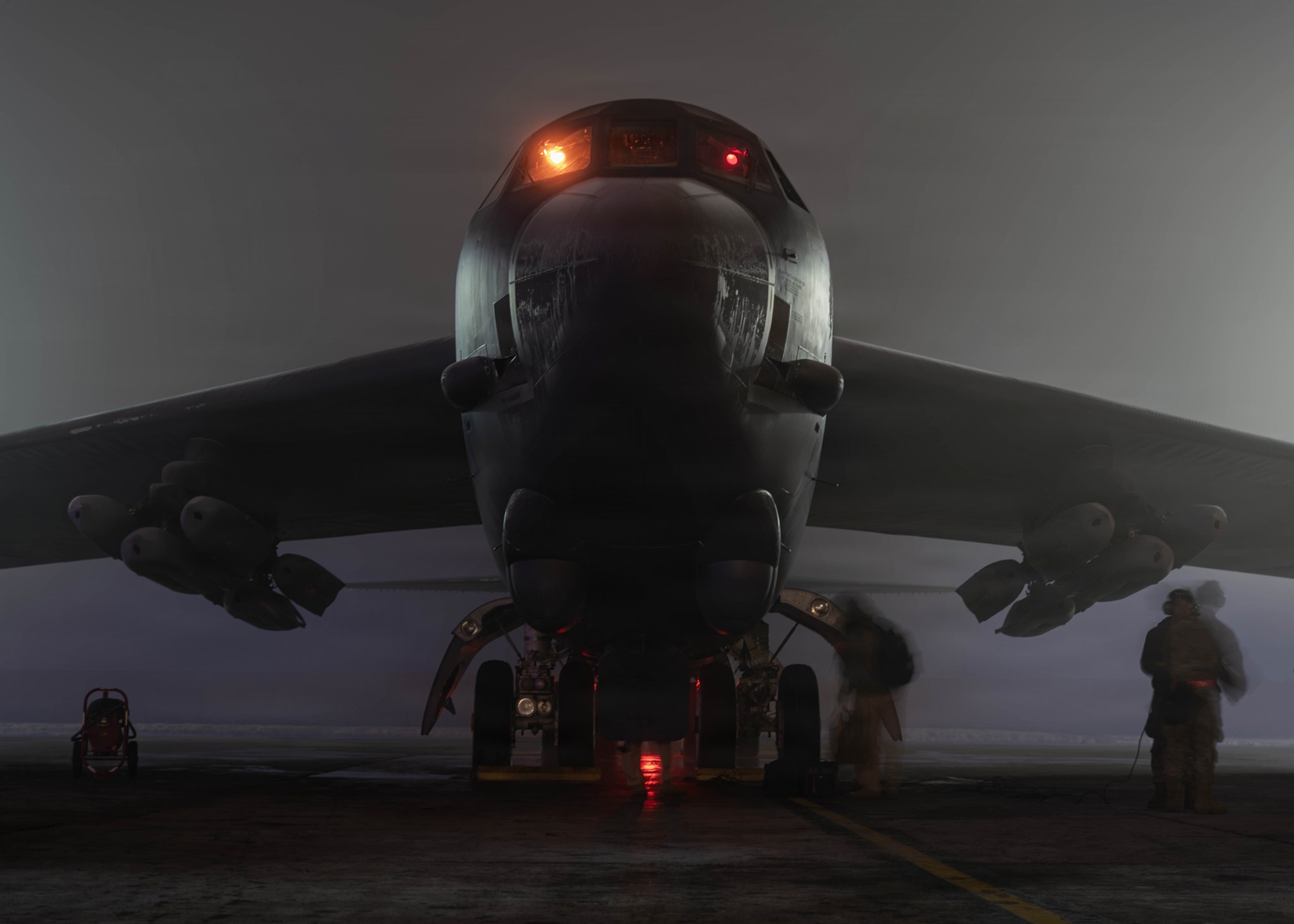
On the other hand, the photos of the B-52s, released few days earlier, clearly show the payload. The bombers are carrying 12 AGM-158 JASSM missiles on the external pylons, although it is unclear if more are being carried internally.
It’s never fair when a B-52 is involved.
“This was never meant to be a fair fight, and it is not a fair fight. We are punching them while they’re down.” – Secretary of War Pete Hegseth pic.twitter.com/JgRSgiM7jl
— U.S. Central Command (@CENTCOM) March 7, 2026
In fact, the B-52 can carry eight more JASSMs internally by using the Common Strategic Rotary Launcher, increasing the total payload to 20 missiles. This is just shy of the B-1B’s payload, which can include up to 24 JASSMs internally.
Full load of JASSM cruise missiles. pic.twitter.com/wEVOSrUWjl
— OSINTtechnical (@Osinttechnical) March 6, 2026
Update Mar. 8: More bombers arrive
In a repeat of the mission between Mar. 6 and 7, four additional B-1Bs departed the U.S. for a mission over Iran. As in the first mission, three aircraft continued towards Iran, while the fourth aircraft landed at RAF Fairford.
More “Bones” to Europe after Iran strikes #FreeIran
— Operation EPIC FURY —
Once again, a flight of 4 B-1B “Lancer” bombers from the US crossed the Atlantic last night, with one aircraft 86-0140 “MOLT14” arriving into RAF Fairford. The remaining 3 jets flew to Iran to bomb… pic.twitter.com/kGuMzPPs5t
— DefenceGeek 🇬🇧 (@DefenceGeek) March 8, 2026
According to a video released by the U.S. Air Force, these four bombers are assigned to Dyess Air Force Base, Texas.
USAF B-1B Lancer (Bone) heavy bomber taking off for another Iran strike mission yesterday. pic.twitter.com/6sxnMedvhy
— OSINTtechnical (@Osinttechnical) March 8, 2026
The next morning, the three BONEs were returning to Fairford, however they diverted to Ramstein in Germany because of low visibility at the British base. The bombers will only temporarily stay in Germany, and are set to move to Fairford at a later date.
B-1B Bombers coming from Operation Epic Fury divert to Germany due to bad weather in the UK this morning.
Callsign: MOLT 11 x 3 B-1Bs diverted to Ramstein Air Base due to fog at RAF Fairford.
1 B-1B declared an emergency and advised ATC they had hung ordnance. pic.twitter.com/4WTebMIV9u
— Thenewarea51 (@thenewarea51) March 8, 2026
Following this mission, a total of eight B-1B bombers are now in Europe to participate in combat missions as part of Operation Epic Fury. It is unclear at this stage if even more bombers will be deployed to the region.
08:00z-09:40z MOLT 11 flt x3 USAF B-1/B Lancer’s
Diverted into Ramstein AFB from Dyess AFB (via striking Iran) due to Very low vis conditions at Destination RAF Fairford. pic.twitter.com/Od3kN4dC9C
— Andy (@Andyyyyrrrr) March 8, 2026
Meanwhile, transport aircraft continue to arrive to support the deployment. Some of these aircraft reportedly arrive from Minot Air Force Base, North Dakota, a B-52H base.
No B-1Bs arriving at RAF Fairford 🇬🇧today but lots of transport & cargo flights, here a Boeing 747 freighter arrives as CONNIE 413 from Ellsworth AFB🇺🇸 pic.twitter.com/f6Qum7z3Qp
— Saint1 (@Saint1Mil) March 8, 2026
Combat operations continue
We have now moved into the second week of Operation Epic Fury and its Israeli counterpart, Operation Roaring Lion. Statements from U.S. officials say the Pentagon is looking to have “firepower over Iran surge dramatically,” in an effort to dismantle Iran’s military capabilities.
During a now ended presser with U.S. Secretary of War Pete Hegseth and Central Command Commander Admiral Brad Cooper, Secretary Hegseth said that the UK allowing, albeit late, the U.S. to use their bases and territories to strike Iran has allowed for more bomber runs and… pic.twitter.com/SIklfUIOIz
— OSINTdefender (@sentdefender) March 5, 2026
CENTCOM and the Pentagon have stated multiple times that the U.S. military is actively targeting ballistic missiles sites, production facilities and storage. For instance, satellite imagery show damage to facilities related to solid rocket propellant in Parchin.
High resolution imagery provided to the Institute by image @VantorTech shows significant damage to the solid rocket propellant motor production facilities at Parchin. These production plants have been destroyed multiple times, first during Israeli airstrikes in October 2024, and… pic.twitter.com/FfNk6SczGh
— Inst for Science (@TheGoodISIS) March 6, 2026
Another target similarly hit is the Yazd missile base.
Yazd missile base hit
Tunnel entrances targeted. Support buildings destroyed. Craters along the road suggest efforts at TEL plinking, but its hard to say whether they were successful.
Thanks as always to our friends @planet pic.twitter.com/7RoT4eE78W
— Sam Lair (@sam_lair) March 6, 2026
Missions are also continuing to degrade Iranian air defenses and allow U.S. and Israeli air operations to continue safely. For instance, S-300 surface to air missile sites near Tehran were hit.
One of the Iranian air defense sites where I spotted S-300 launchers before the war was hit hard.
Emplacements for radars and SAM launchers were struck, and many support buildings destroyed.
Thanks @planet for the imagery. https://t.co/TZDBAfqlsj pic.twitter.com/E5eXedyW8I
— Sam Lair (@sam_lair) March 6, 2026
The F-16CM Block 50 fighters are among the platforms which are part of this effort, employing both the AGM-88 HARM and the GBU-54 Laser JDAM. A mixed loadout allows to target also non-emitting targets such as the launchers which are not equipped with a radar.
Wild Weasel heading into the fray with a mixed loadout simultaneously covering Strike, SEAD, and A2A, with the HTS doubling as an ELINT sensor. Not bad for a 30+ yrs old airframe when you have supposedly omni/swing platforms that still struggle with this level of mission overlap. https://t.co/x9TcchZCMj pic.twitter.com/dkgDUI6sVK
— Abd (@blocksixtynine) March 8, 2026
Parallel to that, airports are being targeted as part of the efforts to establish air superiority, blocking Iranian attempts to get combat aircraft in flight. In fact, while infrastructure was attacked in the opening hours, now the remaining aircraft on the ground are also being targeted.
Footage released by U.S. Central Command (CENTCOM) showing strikes on a number of aircraft hangars and aircraft. pic.twitter.com/JDLcwwJp3N
— OSINTdefender (@sentdefender) March 5, 2026
Images emerged online confirm that AGM-158 JASSMs are being employed against targets in Iran. One of the missiles has been allegedly hit by Iranian air defenses, although it can’t be confirmed.
Remains of an American AGM-158 JASSM cruise missile, reportedly downed by Iranian air defenses over Markazi Province.
USAF B-52s have been carrying out cruise missile strikes with JASSMs over the past few days. pic.twitter.com/r3Uu9WTltW
— OSINTtechnical (@Osinttechnical) March 8, 2026
A number of MQ-9 Reapers have also been lost, with at least three aircraft confirmed to media to have been either shot down or crashed.
U.S. officials tell CBS News that a total of three MQ-9 “Reaper” Surveillance and Attack Drones with the U.S. Air Force have been downed so far during Operation Epic Fury. It’s not clear where exactly the three drones crashed, but one of the Reapers attempted to crash off the… pic.twitter.com/fw1WqoxCh6
— OSINTdefender (@sentdefender) March 6, 2026
Loss of an MQ-9 (definitely not a Hermes 900).
Also, Israel doesn’t use R2 Hellfires on Hermes 900s, just on their Apaches. h/t @ameliairheart. We have a high degree of confidence this was American. https://t.co/BbRxYEHcO4
— Evergreen Intel (@vcdgf555) March 7, 2026
Iranians continue to retaliate with drones and missiles, although the frequency is now decreased. Both fighter jets and helicopters are being employed in a counter UAS role.
Onboard footage from United Arab Emirates Joint Aviation Command AH-64D Apache attack helicopters as they shoot down incoming Iranian attack drones pic.twitter.com/UCsuivJ00W
— OSINTtechnical (@Osinttechnical) March 8, 2026
F-16E/F chasing an Iranian UAS over Sharjah. Another example of just how low these engagements often are. pic.twitter.com/QLsyKsczR6
— Abd (@blocksixtynine) March 8, 2026
Some of the Iranian weapons were able to reach their targets, damaging some U.S. installations in the region.
Iran’s response in the Middle East.
AFP Infographic with satellite images showing damage at a selection of four US military sites, or sites hosting US personnel, in the Middle East in the context of Iranian strikes since February 28, 2026. Images are from Planet Labs PBC pic.twitter.com/Iw8mFUz2JI
— AFP News Agency (@AFP) March 7, 2026
Among the targets hit appears to be a AN/TPY-2 Forward Based X-band Transportable Radar, the radar employed by the Terminal High Altitude Area Defense (THAAD) system. A photo appears to show the radar destroyed, although it is not possible to verify the authenticity of the photo.
Photos have now confirmed the destruction of a AN/TPY-2 Forward Based X-band Transportable Radar operated by the U.S. Army, following an Iranian drone attack earlier this week targeting Muwaffaq Salti Air Base in Jordan. The AN/TPY-2 is the primary ground-based air surveillance… pic.twitter.com/54QyQCxNVW
— OSINTdefender (@sentdefender) March 7, 2026
Damage to one of these systems is also visible in satellite imagery of Muwaffaq Salti Air Base in Jordan, where a number of U.S. assets are located.
Satellite imagery from Airbus Defence and Space appears to show a AN/TPY-2 Forward Based X-band Transportable Radar, the primary radar for the U.S. Army’s Terminal High Altitude Area Defense (THAAD) System, having been damaged and possibly destroyed by an Iranian drone or missile… pic.twitter.com/NqKN6K2YW2
— OSINTdefender (@sentdefender) March 5, 2026
According to The Wall Street Journal, an unnamed U.S. official said that the military is now moving to replace the system, which has been described as “damaged.”
🇺🇸 PSA: Fast Facts on AN/TPY-2 (radar system used by THAAD)
16 produced to date, 13 US Army, 2 UAE, 1 KSA, 6 more pending for KSA, none on order for US Army.
8 deployed as part of US THAAD batteries, 5 Forward Based Mode (deployed/operated by US Army in Japan [2], Israel,… pic.twitter.com/bD7gHpA3ib
— Colby Badhwar 🇨🇦🇬🇧 (@ColbyBadhwar) March 7, 2026
The THAAD and the associated AN/TPY-2 radar are a component of the network of integrated air and missile defense systems (IAMD) in the region. Specifically, THAAD is meant to be employed against short, medium and intermediate-range ballistic missile threats, and is designed to intercept targets outside and inside the atmosphere.
Regarding the reported destruction of a U.S. AN/TPY-2 missile-defense radar in Jordan, and the possible damage to a component of another U.S. AN/TPY-2 radar in the UAE, a few points to clarify what happened, the significance and implications.
— Mauro Gilli (@Mauro_Gilli) March 7, 2026