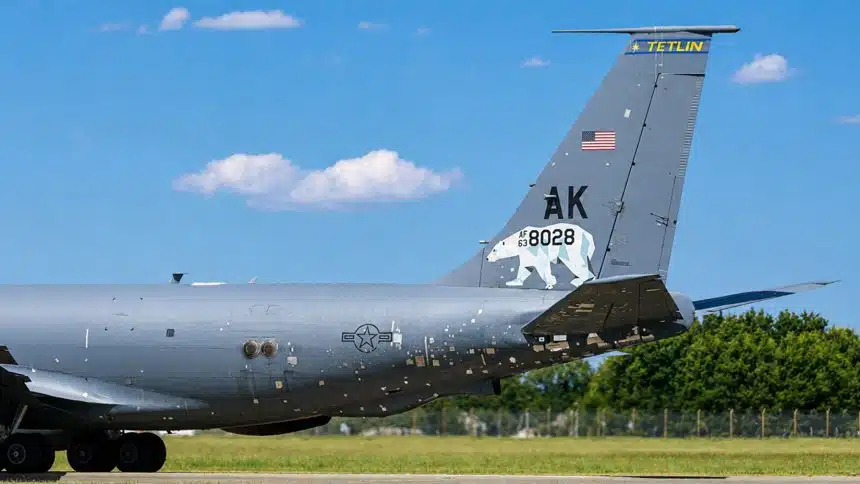
The battle-damaged Alaskan ANG KC-135R departed RAF Mildenhall on its way home from Operation Epic Fury, showing the massive temporary repairs performed to make the aircraft airworthy for the return flight.
On May 30, 2026, the KC-135R 63-8028, belonging to the 168th Wing of the Alaska Air National Guard, departed RAF Mildenhall, UK, for Bangor Maine, as RCH133 (“REACH 133”) on its way back to the U.S.
The tanker had arrived at RAF Mildenhall from Tel Aviv Ben Gurion airport, on May 23, 2026.
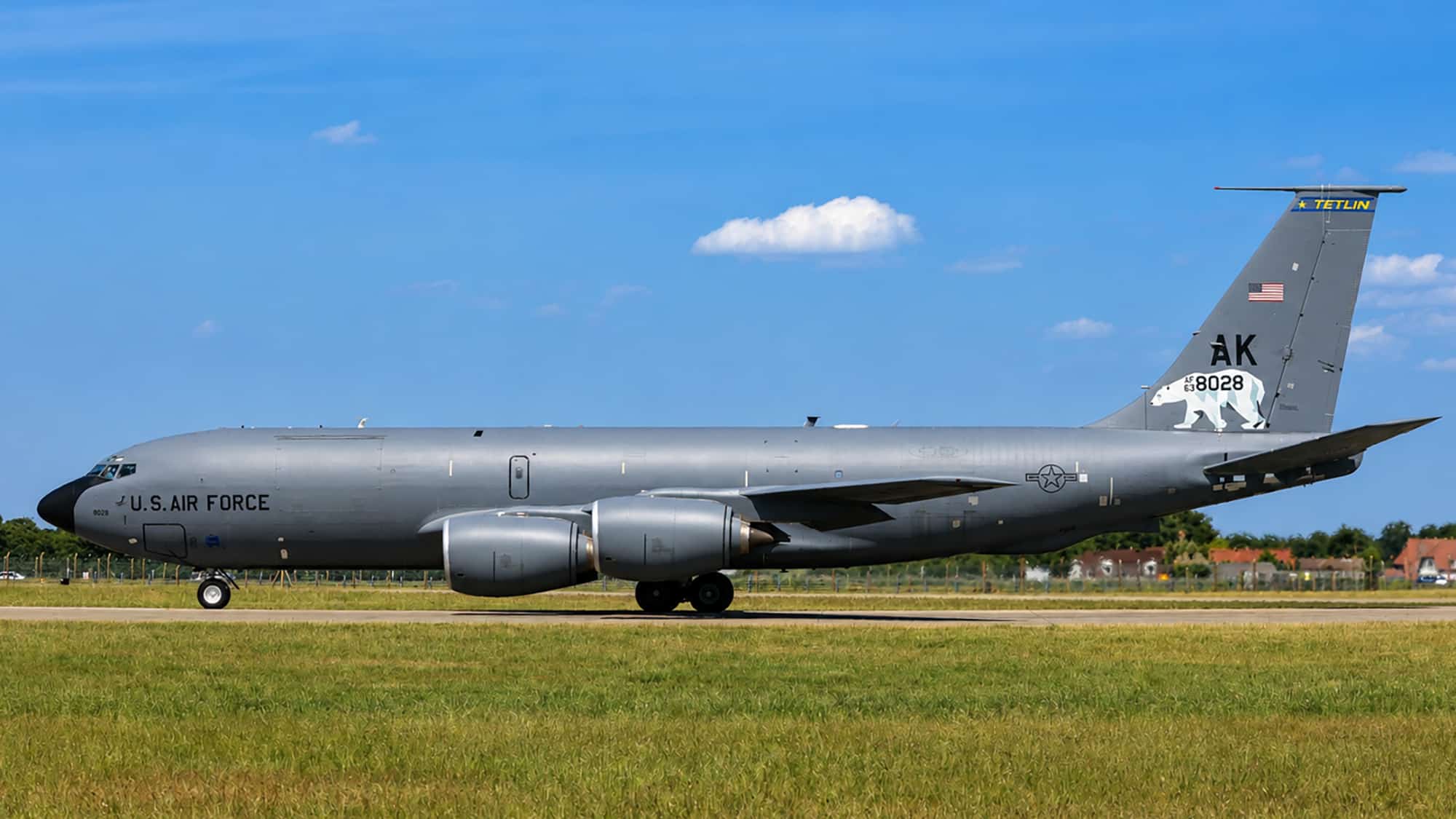
Images taken by photographer Bob Archer as the Stratotanker taxied for take off show the amount of temporary repairs performed on the airframe to enable the aircraft to fly home.
The KC-135R 63-8028 is the second battle-damaged Stratotanker photographed transiting through RAF Mildenhall. The first one, 59-1444, landed at RAF Mildenhall, UK, on Apr. 12, 2026, with spotters at the fencelines immediately noticing the battle damage repairs (BDRs) evident on the fuselage as well as on some of the engine cowlings. It had previously diverted into Chania International Airport, near Souda Bay, during its first attempt to fly from Prince Sultan Air Base (PSAB), Saudi Arabia, to Mildenhall.
While 59-1444 was most likely among the at least five Stratotankers damaged in the multiple Iranian attacks against PSAB, during March 2026, where 63-8028 was struck is unclear. According to FlightRadar24, it deployed from Eielson AFB, Alaska, to Tel Aviv, via Stuttgart, on Mar. 7, 2026. Flight tracking logs show that the tanker flew its first operational mission few hours after deploying to Israel.
In the following days, it flew sorties almost every day until Mar. 26, 2026, which appears to be its last tracked mission. Its next tracked flight was the ferry flight from Tel Aviv to RAF Mildenhall on May 23, 2026. What happened in the two months during which the aircraft appears not to have flown is unknown. We also cannot completely rule out that a change or error in hex codes occurred even before Mar. 26, showing the aircraft in Israel when it was actually in Saudi Arabia. Considering that another attack on PSAB damaged U.S. aircraft there on Mar. 27, there is also a possibility that the aircraft had been deployed there that same day, without FR24.com tracking it for some reason.

Anyway, the location and density of the battle damage repairs on 63-8028 and 59-1444 are quite different: while 59-1444 showed large and small patches across its fuselage (including the upper part of it), wings, engines, and tail; all the BDRs on 63-8028 appear to be on the bottom rear side of the tanker, as if the shrapnel fragments had come from below and behind the aircraft. This would also explain why the boom had to be removed from this KC-135R, something that wasn’t necessary on 59-1444.
Closer look at the tail section of the USAF KC-135 63-8028 that suffered shrapnel damage from a Iranian drone/ballistic missile on the ground in Saudi Arabia. pic.twitter.com/RIT5HBPnef
— OSINTtechnical (@Osinttechnical) May 30, 2026
After departing Mildenhall the jet stopped over in Bangor, Maine. Like 59-1444 last month, the final destination for 63-8028 is Tinker Air Force Base, Oklahoma, home to the Oklahoma City Air Logistics Complex, which oversees depot level maintenance for the KC-135 Stratotanker, KC-46 Pegasus, E-3 Sentry, E-6 Mercury, B-52 Stratofortress, and B-1B Lancer.
As for the 59-1444, the future of 63-8028 is still unclear. The aircraft could go through inspection, repair, and overhaul process to be brought back to full operational status or, as happened with other KC-135R airframes, such as 58-0011, the Stratotanker could be cannibalized for spares to sustain the surviving fleet rather than being restored.
We will see.
For sure, despite its impressive size (over 350 KC-135s in service and little more than one hundred KC-46s) the U.S. Air Force tanker fleet took a huge hit during Operation Epic Fury, because of the fatal incident over Iraq and the Iranian strikes on Prince Sultan. The Iran Air War showed, once again, that high-tempo operations involving hundreds of tanker sorties are required to support both direct combat missions and logistics taskings. Increased use of contracted aerial refueling services can alleviate a small part of this burden, particularly for training sorties, but demand for aerial refuelers remains consistently high.