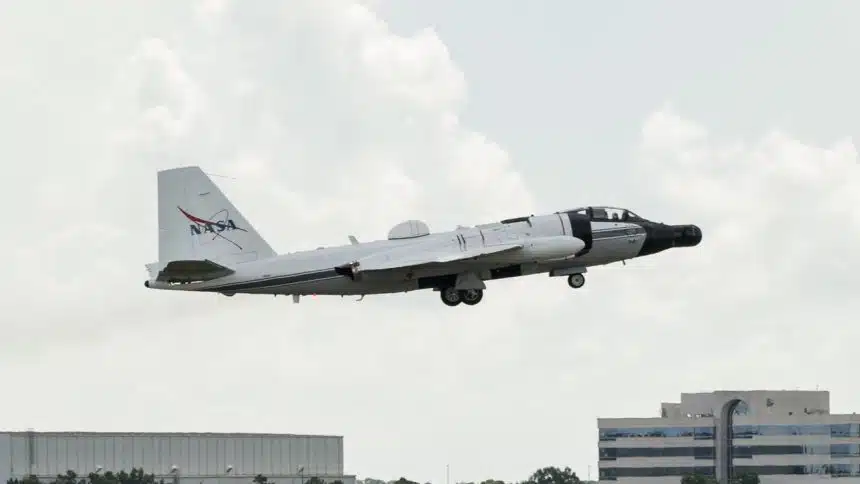
A NASA WB-57F Canberra arrived in Iceland, from where it will depart on Aug. 12 to fly in the path of the solar eclipse.
A NASA WB-57F Canberra arrived at Keflavík Airport in Iceland on Aug. 10, 2026. Flying as ‘NASA926’, the aircraft departed from Ellington Field, Texas, on Aug. 9, and made a stop in Bangor, Maine, before crossing the Atlantic Ocean.
The visit of a NASA WB-57 in Europe is a rare occurrence, however the presence of the specialized high-altitude research jet is not casual. In fact, the Canberra will take-off on Aug. 12 to fly in the path of the upcoming solar eclipse.
Eyes to the skies – we’re preparing to capture the upcoming solar eclipse in a way only NASA can.
On August 9, our WB-57 high-altitude aircraft took off from Ellington Field in preparation to capture the Moon covering the Sun on August 12. The team will take off from Iceland and… pic.twitter.com/FwFQOnJ8fX
— NASA’s Johnson Space Center (@NASAJohnson) August 10, 2026
This total solar eclipse will sweep across Greenland, Iceland, northern Russia, the Atlantic Ocean, Spain, and a small corner of Portugal. The aircraft will send back views for researchers to learn more about the celestial event, says NASA.
Obviously, this is not the first time NASA uses a WB-57 to study a solar eclipse. For instance, in 2024 NASA used the WB-57 to study the Sun’s corona, ionosphere, and other eclipse phenomena, while in 2017 is was used to study the structure of the corona.
The use of this aircraft for observation presents some advantages, starting from its 50,000 feet cruise altitude which would put it above most of the water vapor, haze, and turbulence which are found at lower altitudes and ground level. This allows the onboard sensors to pick up clearer, sharper images and record wavelengths which usually don’t reach the ground.
At the same time, using the WB-57 NASA can extend the observation time as it would follow the Moon’s shadow, leading to an increased amount of data that can be collected. In 2024, this allowed airplanes to see an eclipse that lasted about 25 percent longer.
NASA WB-57F
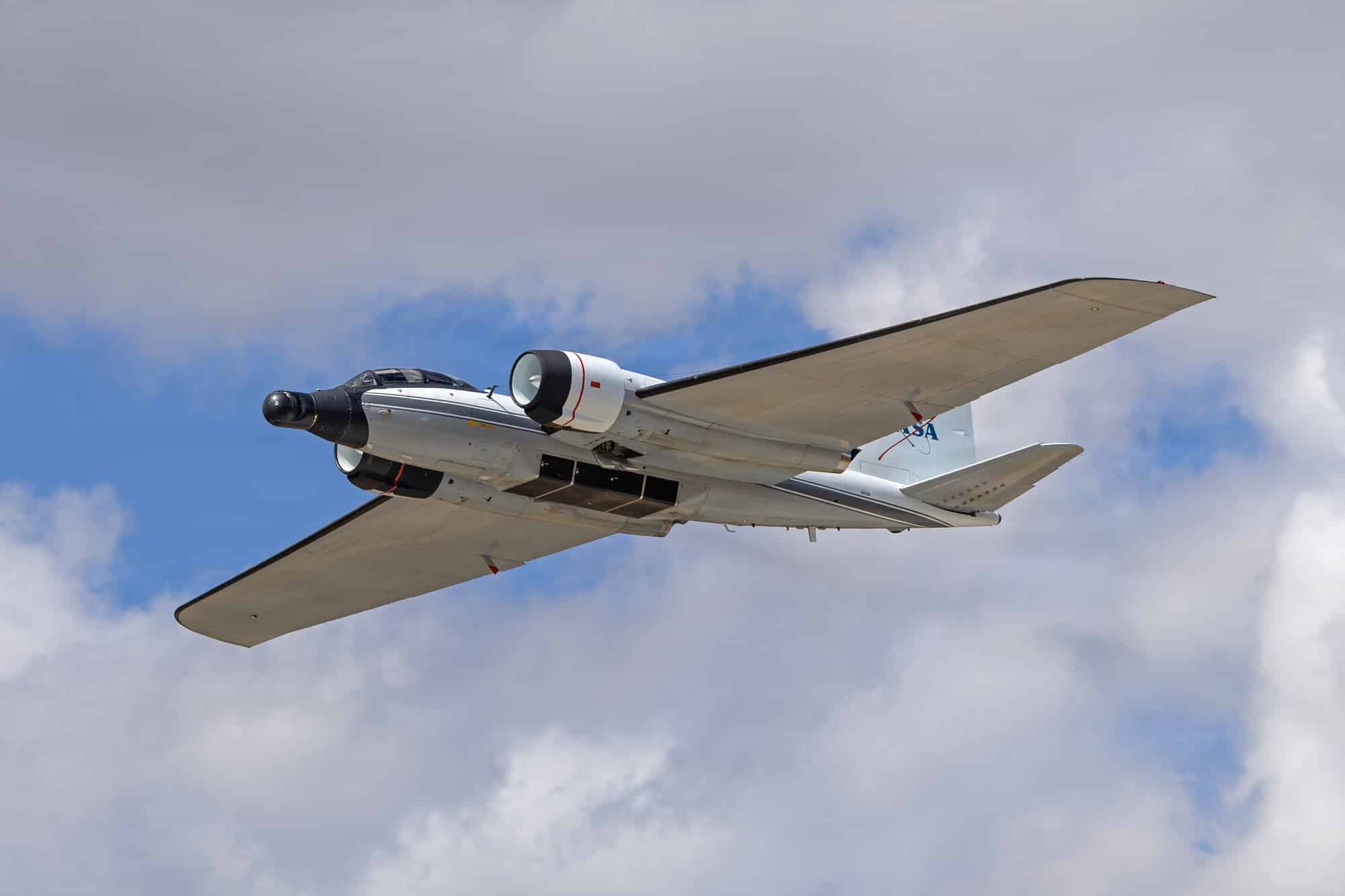
The WB-57 used by NASA is a highly modified high-altitude research aircraft derived from the Martin B-57 Canberra, the U.S.-built version of the British English Electric Canberra. Operated by NASA’s Johnson Space Center (JSC) from Ellington Field, Houston, the WB-57 retains the basic configuration of the original aircraft but has been extensively adapted for scientific and technology-development missions.
The aircraft has a mid-wing, twin-engine configuration with a distinctive high-aspect-ratio wing spanning approximately 122.5 ft (37.3 m), which gives it the aerodynamic efficiency required for sustained flight at high altitudes. The aircraft is powered by two Pratt & Whitney TF33 turbofan engines, and can operate above 60,000 ft at approximately 410 kt true airspeed, or Mach 0.78, for approximately 6.5 hours, with a range of roughly 2,500 nautical miles.
The WB-57’s main advantage resides in its high-altitude performance, which puts its above a significant portion of the Earth’s atmosphere. This capability is particularly valuable as the aircraft would get an unobstructed view without atmospheric water vapor and other phenomena which can interfere with observations in certain infrared and other electromagnetic bands.
The payload architecture includes interchangeable fuselage pallets, wing pods, wing-mounted hatches, a nose section and other external mounting points, allowing different scientific instruments to be installed according to mission requirements. NASA’s current documentation lists payload capacities of up to approximately 8,800 lb, although the usable payload depends on the specific configuration and mission profile.
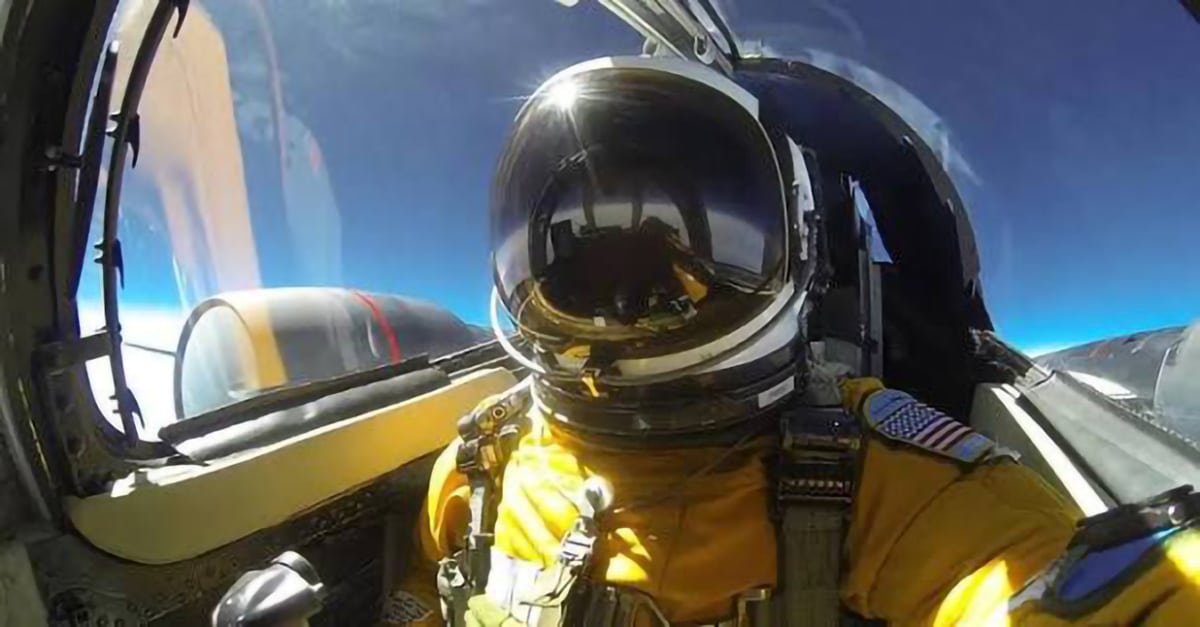
The WB-57 normally operates with a two-person crew seated in tandem. The pilot occupies the forward cockpit, while the sensor equipment operator (SEO) occupies the second station and manages navigation, scientific instruments and associated payload systems.
Operationally, NASA employs the WB-57 for atmospheric and Earth science, high-resolution imaging, ground mapping, cosmic-dust collection, astronomical observations, rocket-launch support and testing of future airborne and spaceborne systems. Recently, the aircraft was used in support of the launch of the Artemis II mission.
Check another one off the bucket list. @NASA 926, one of three WB-57s made a stop in Bangor today. #nasa #planespotting pic.twitter.com/eeESv3WOo3
— 3315 Aviation (@3315Aviation) August 9, 2026
NASA employs a fleet of three WB-57s, however only one, N926NA, is currently operational. As we reported in January 2026, the WB-57 N927NA suffered an emergency gear-up landing and NASA says on its website maintenance is expected to be completed by the end of June 2027.
The remaining aircraft, N928NA, is currently undergoing a major inspection expected to end by January 2027, according to NASA’s website. This inspection was initially launched in 2021, before being put on indefinite hold.