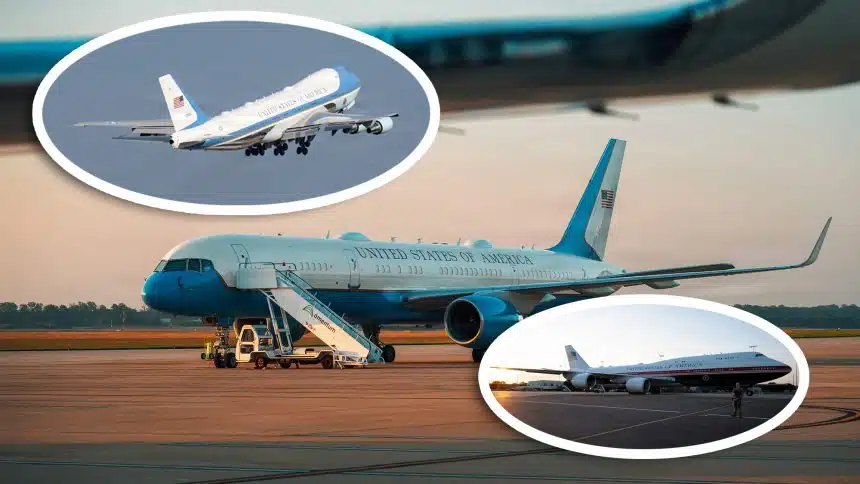
After President Trump boarded the legacy VC-25A – instead of the VC-25B Bridge – for his flight home from Ankara he was secretly transferred inside a catering truck to a waiting C-32A, according to the Washington Post.
While the world believed that the U.S. President had taken 92-9000 home from the NATO Summit in Ankara, Turkey, with the jet even going to the length of flying under the Air Force One callsign, he actually took one of the ‘escape’ jet C-32As that are regularly deployed in support of Presidential travel. This new discovery was first published by the Washington Post, who claim that the ruse was unknown even to some members of the White House staff who were on board the VC-25A.
In Ankara, President Trump boarded the VC-25A in full view of TV cameras. After disappearing from view inside the jet, a catering truck drove away from the opposite side of the aircraft. This, the Post was told by an unnamed official, is how the President was transferred in secret between the aircraft.
My favorite part: This Turkish catering truck nonchalantly moving from Air Force One to the other plane https://t.co/vQSoncQw9f pic.twitter.com/Ob5r1hxSwL
— John Hudson (@John_Hudson) August 11, 2026
Officially, the line was that the legacy VC-25A was to be used in place of the new VC-25B Bridge to allow the latter to fly to RAF Mildenhall and open up for tours for stationed personnel.
In reality, it was quickly assumed that the switchover owed to security concerns over the newer jet which underwent a rapid conversion process – skipping over many of the otherwise necessary security and communications capabilities – for Presidential use after being gifted by the state of Qatar. The actual VC-25B aircraft, which will eventually take over from the VC-25B Bridge, have been in the modification process for many years to ensure they are fully equipped.
After arriving at the NATO Summit several days earlier, Trump had declared that the U.S. ceasefire with Iran was over. The leading assumption has therefore been that the renewed hostilities with a nation that borders Turkey meant that the threat analysis that initially permitted the use of the VC-25B Bridge had to be reassessed. Now it is believed that the U.S. became directly aware of a credible threat against Air Force One which would see it targeted by a surface to air missile upon departure from the Turkish capital.
Discrete Escape?
The Washington Post reporting today that the US President was moved to the discrete escape jet which flew into Mildenhall as REACH 018.
We had been expecting the VC-25B, followed by a C-40 and then the VC-25A as AF1.
But shortly after the C-40 landed, we… https://t.co/i42y2txJoj pic.twitter.com/Vmpr3UFlQZ
— Havoc Aviation (@havoc_aviation) August 11, 2026
Extra security measures were also enforced at RAF Mildenhall, where the VC-25B Bridge and VC-25A were due to stop. Fencelines were draped with plastic sheeting to block sightlines, while semi-trucks and trailers were parked behind them as a physical barrier.
Looking back in retrospect, it is very likely that President Trump was on board REACH 18, a C-32A which transited through the base before the VC-25 arrived. This aircraft was flying without Mode S or ADS-B, so did not display on flight tracking applications, but this is not uncommon for some elements of the Presidential entourage.
The Washington Post credited this great plane tracker account with an import detail in our exclusive tonight. Sharing credit where it’s due: https://t.co/A5J6ltf8qZ
— Dan Lamothe (@DanLamothe) August 11, 2026
An additional switch, from C-32A back to the VC-25A, then took place at Mildenhall so he could emerge from ‘Air Force One’ as expected and take the VC-25B Bridge back to Andrews AFB.
Could well be right, I noticed RCH18 the C-32 wasn’t tracking and was told to land first just before the VC-25A at Mildenhall, RCH18 then stopped for a while blocking the VC-25As parking space which I thought was odd at the time, I guess that’s when he disembarked the C-32.
— Saint1 (@Saint1Mil) August 11, 2026
The White House still maintains that the President was on board Air Force One as usual, and it is still not known how widely within the administration the decoy plans were spread.
This would not be the first time that alternative, discreet aircraft have been used to transport the President while the regular, highly conspicuous aircraft have trailed as a decoy. This measure was taken during a visit to Pakistan in 2000 by President Bill Clinton.
In other circumstances, the primary jets have been used but were flight planned under a different identity. Famously, when President George W. Bush was conducting a surprise visit to Iraq in 2003, Air Force One’s cover as a ‘Gulfstream’ was apparently almost blown when a civilian pilot, reportedly from British Airways, reported seeing Air Force One. British Airways denied that any of its pilots had made such a report, and there is no official record of the incident having actually occurred, though it was repeated by then Air Force One pilot Colonel Mark Tillman during a National Geographic documentary.
However, a number of differences to previous occasions have been pointed out by Pete Souza, Chief White House Photographer for Barack Obama. For Obama’s clandestine trips to Afghanistan, he said, “members of the press pool that would accompany us were contacted individually ahead of time and were sworn to secrecy”. These reporters would then be able to report on the trip after landing. No reporters were allowed on this secretive flight, and Souza additionally questions whether or not a White House photographer was allowed to accompany the President to ensure a historical record exists.
Souza asks: “If there was a legitimate threat that Iran would launch a missile at Air Force One, why was the White House willing to use the plane as a decoy thereby potentially sacrificing the lives of dozens of people aboard?”
Security Features
While the C-32A is likely not as elaborately equipped as the VC-25A in terms of security and communications features, the act of making it appear that Trump was on board the latter means that this higher degree of capability is less necessary as any hostile actor would instead target the larger jet.
The Boeing 757-based aircraft have regularly been used to support Presidential travel as a backup aircraft, especially in more recent years where there have been significant periods where only one VC-25A is available. It can additionally be used to support travel into smaller airports which would be unable to accommodate a Boeing 747.
After a several hour delay for the VC-25A (Boeing 747) having to turn around near Long Island, NY due to electrical issues. POTUS boarded the backup jet (Boeing C-32A aka Boeing 757) and is now on the way to the Zurich Airport in Switzerland to attend WEF 26 in Davos. The back up… pic.twitter.com/EN5FOUkYt9
— Thenewarea51 (@thenewarea51) January 21, 2026
Eight C-32As are operated by the U.S. Air Force, though it officially acknowledges only four of these.
The VC-25As are equipped with an array of self-defence capabilities, most of the details of which are classified. However, the external elements of some of this equipment are clearly evident and identifiable upon close inspection. None of these are present on the VC-25B Bridge aircraft in its current configuration.