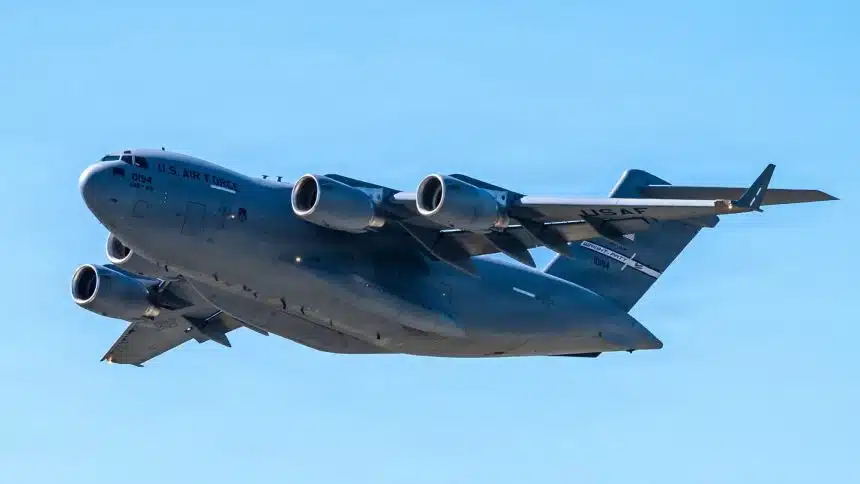
A C-17 of the 445th Airlift Wing extensively damaged in March 2025 was repaired by using new technologies of the Rapid Sustainment Office, after no vendors were able to provide the needed parts.
The Air Force Rapid Sustainment Office (RSO) helped put a C-17 Globemaster III back in the air with the first use of a new manufacturing technology after it has been grounded since March 2025. The RSO’s Advanced Manufacturing Program Office Automation and Robotics (A&R) team employed the Incremental Sheet Forming (ISF) system to repair damaged airframe panels of tail ‘0194’ from the 445th Airlift Wing (445th AW)
The Globemaster III took its first flight after the repairs on Jul. 30, 2026 from Wright-Patterson AFB, images on the DVIDS network showed. The Aug. 4, 2026 press release from the Air Force Life-Cycle Management Center (AFLCMC) said the first such successful effort has also spurred the RSO to produce parts for a KC-135 and an F-15.
With Boeing’s interest in resuming the C-17’s production being reported since last year yet to translate into a formal decision, such innovations will greatly benefit the roughly 220 C-17s in service with the U.S. and the smaller fleets of India, United Arab Emirates, Qatar, Kuwait, Canada, Australia and the United Kingdom. The company closed its production line at Long Beach in California after putting together the 279th Globemaster III on Feb. 26, 2015.
The Rapid Sustainment Office is redefining aircraft readiness by delivering a first-of-its-kind repair solution, proving that innovation, advanced manufacturing, and rapid problem-solving keep our warfighters mission ready when it matters most. #OneAFMChttps://t.co/7imJdbQqZB pic.twitter.com/ASZ1xzVwbA
— U.S. Air Force Materiel Command ✈️ (@HQ_AFMC) August 6, 2026
The initiative also comes as the U.S government wrests greater state control on repair and upgrade rights from contractors and Original Equipment Manufacturers (OEM) in its weapons contracts. However, the U.S. Air Force and armed forces in general have a rich history of other in-house innovations solving both simple routine equipment problems and other high-end repairs of fifth-generation platforms.
The damaged C-17 of the 445th Airlift Wing
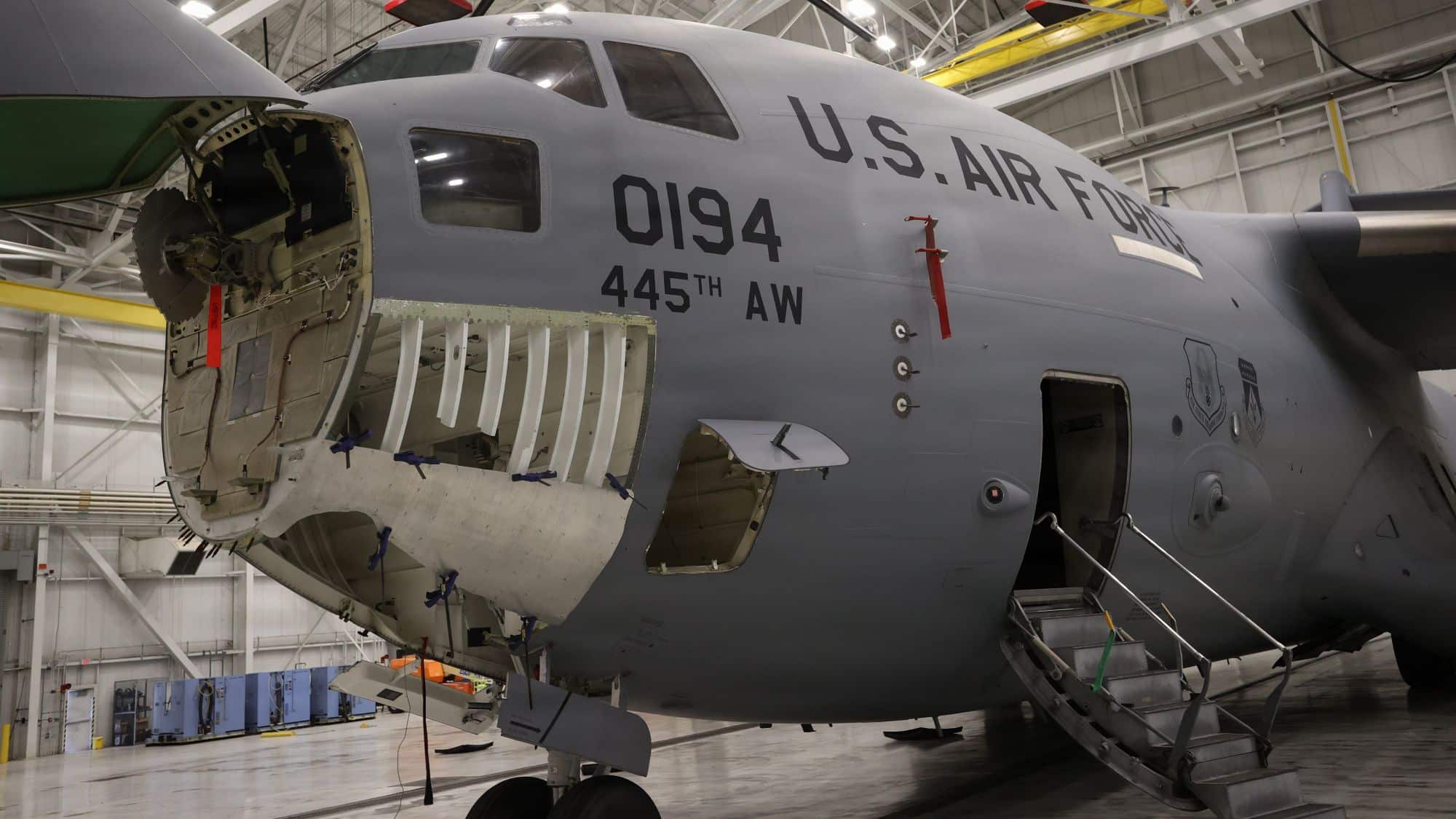
The AFLCMC said that tail 0914, assigned to the 445th AW based at Wright-Patterson Air Force Base (AFB), was parked overnight on the tarmac of Perot Field Fort Worth Alliance Airport on Mar. 4, 2025. As “strong winds, large hail, and severe thunderstorms whipped through the Dallas-Fort Worth, Texas area,” the C-17 sustained extensive damage to the airframe panels on the “left side door, fuselage and nose area” when “two private Bombardier Challenger jets were blown into the aircraft.”
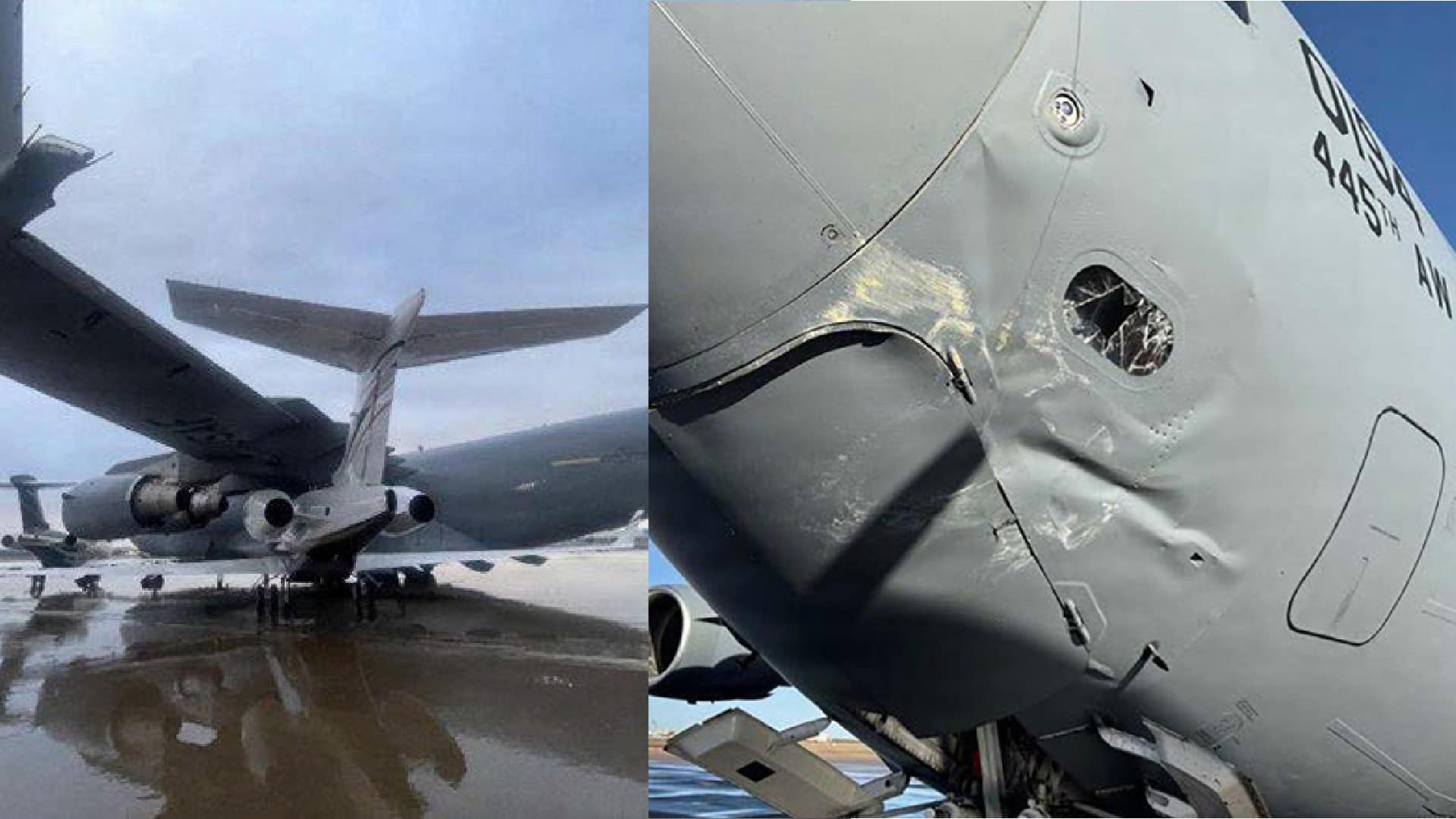
Wind microbursts of up to 80 miles/hour “ravaged buildings and trees” and “left considerable destruction.” The C-17 was forced to fly home to Dayton, Ohio with interim fixes, including a Boeing-approved temporary left-nose panel repair and its landing gear down throughout the flight.
The AFLCMC explained: “Upon its return to Wright-Patterson AFB, the 445th Maintenance Group (445 MXG) was able to repair the damaged door and fuselage but determined the left nose panel would require replacement.” Boeing however communicated that such a panel would not be available and would have to be produced afresh. Worse, no vendor would invest in the tooling and machining equipment for just an isolated part for a single aircraft.
“After an unsuccessful repair attempt, the C-17 seemed doomed to sit in storage for at least a year, with repair work requiring an additional year to complete,” said the AFLCMC. Deeming unacceptable that “one of only nine mission-essential C-17s” would risk being grounded for years, the 445th MXG reached out to the Air Force Rapid Sustainment Office (RSO) for a solution.
Sheet forming system
The RSO’s Automation and Robotics (A&R) team decided that the panel was an “ideal candidate” for its Incremental Sheet Forming (ISF) system, “a robotic technology that progressively deforms metal sheets into functional parts.” Collaborating with engineers from the University of Dayton Research Institute (UDRI), the A&R team began production of the panel in January 2026.
The team moved rapidly through the production process, “advancing from formation on the ISF, located at the RSO’s Integrated Technology Operations Center, to an initial fit check and panel testing to ensure the part was flightworthy.” Following a final fit check in April, Boeing and the 445 MXG installed the completed panel on the C-17 in July, and the repair was finally ground-validated through a “front landing gear test and some minor adjustments to the nose area.”
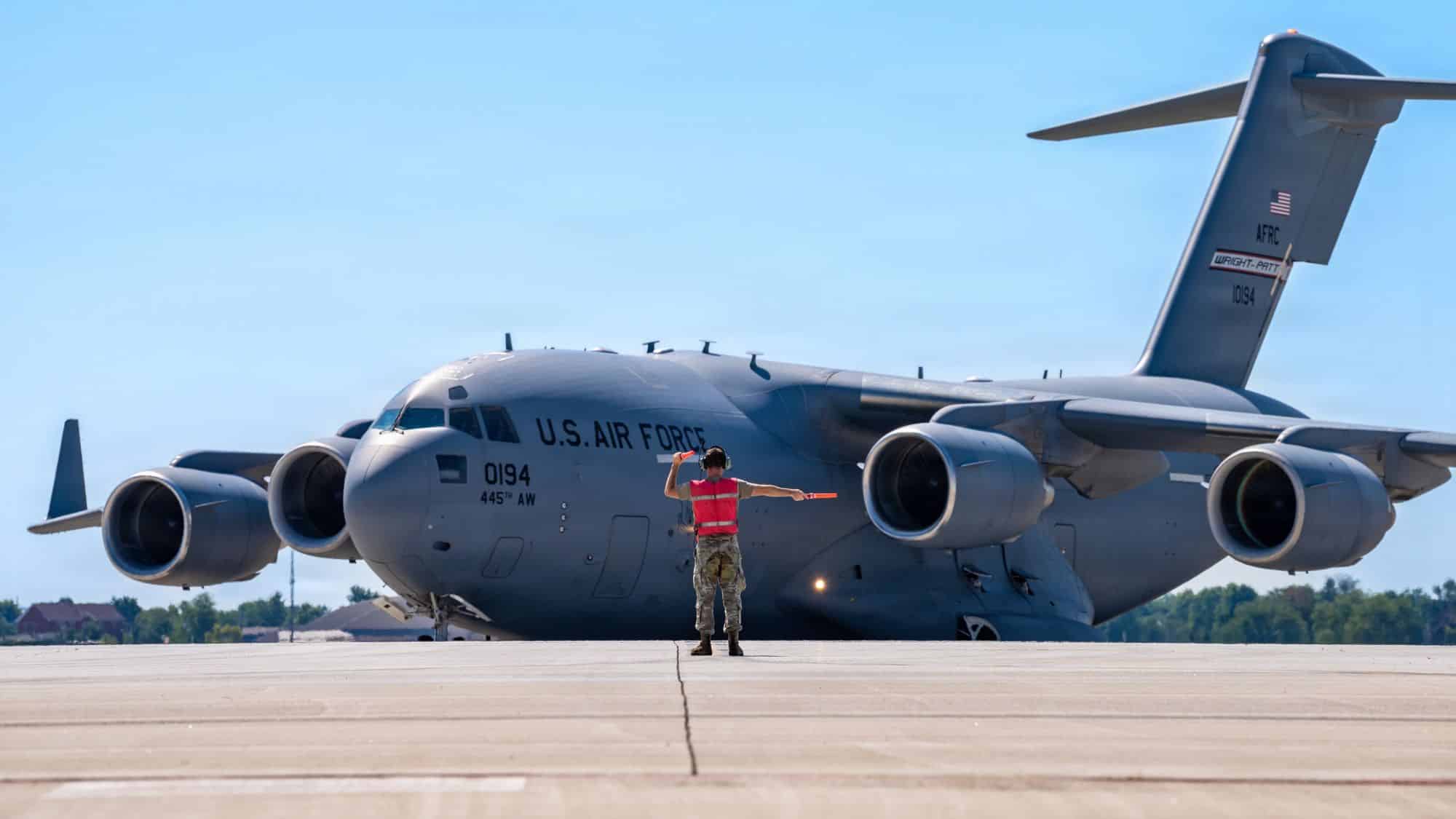
“The C-17 returned to the skies July 30, resuming support of the 445 AW’s essential mission,” said the press release. RSO A&R lead program manager Mary Schuler said “leveraging the ISF, with critical support from UDRI” shortened the repair timeline “from years to only a few months.”
Col. Karen Gharst, 445 MXG commander, said using the ISF technology to rapidly produce an “otherwise unobtainable part allowed us to avoid a prolonged work stoppage.” She further said “The RSO was exceptionally responsive, delivering a part for fit check in just over a month.”
The AFLCMC added: “This panel is the first part produced via ISF to be flown on an Air Force platform, but it won’t be the last. The RSO is also working to produce parts for a KC-135 and an F-15.”
No parts? No problem! 🛠️✈️
The 809th Maintenance Support Squadron (MSS)’s RAPID Lab at Hill Air Force Base, Utah, used 3D printing to reverse-engineer F-35 Lightning II canopy frames, closing a critical training gap and bypassing supplier delays.
This in-house innovation… pic.twitter.com/t81xye3zGD
— F-35 Lightning II Joint Program Office (@theF35JPO) June 15, 2026
Another recent manufacturing and repair innovation was fielded by the 809th Maintenance Support Squadron’s (809th MSS) RAPID Lab at Hill AFB, Utah, which used 3D printing to reverse engineer F-35 canopy frames. The in-house innovation bypassed “supplier delays […] accelerates timelines, cuts costs, and boosts readiness for the F-35 and our warfighters,” the F-35 Joint Program Office (JPO) said.