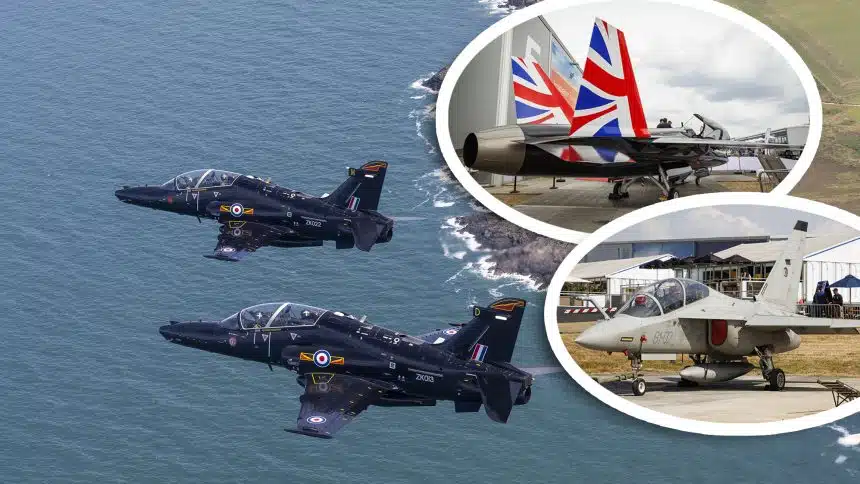
A request for information (RFI) has been released to gather industry responses ahead of the replacement of the Hawk T1 and Hawk T2 in Royal Air Force service.
With the planned early retirement of the Hawk T2 and the 2030 sundown of the Red Arrows’ Hawk T1 confirmed in the recently released Defence Investment Plan (DIP), the race to select and procure a new Jet Training System (JTS) has begun in earnest.
Ahead of the release of a full tender, this RFI seeks to gather information from interested industry partners. Though only in its second decade of service, senior members of the Royal Air Force have repeatedly expressed a desire to move away from the Hawk T2 as quickly as possible due to longstanding availability and reliability issues.
6/ However, the Hawk T2 has had issues that have impacted availability throughout its life. The most recent engine problem has seriously curtailed aircraft availability, and the head of the RAF has also stated that the aircraft won’t meet the needs of future GCAP training.
— Greg Bagwell (@gregbagwell) December 9, 2024
Most of the expected key contenders are already well known, having staked out their bids quite clearly over the last few years. This was particularly notable at this year’s Farnborough International Airshow, where multiple vendors put a significant emphasis on their proposals for the role.
BAE Systems, the manufacturer of the current Hawk aircraft, is partnering with Boeing and Saab to offer the T-7 Red Hawk which was developed to replace the T-38 Talon in U.S. service. Although it doesn’t keep the T-38’s supersonic capability, the Red Hawk’s afterburning GE F404 turbofan would represent a significant step-up in performance over the Hawk’s non-afterburning Rolls-Royce Adour. The bid has been said to include plans for UK-based final assembly, almost certain to take place at BAE’s Warton plant.
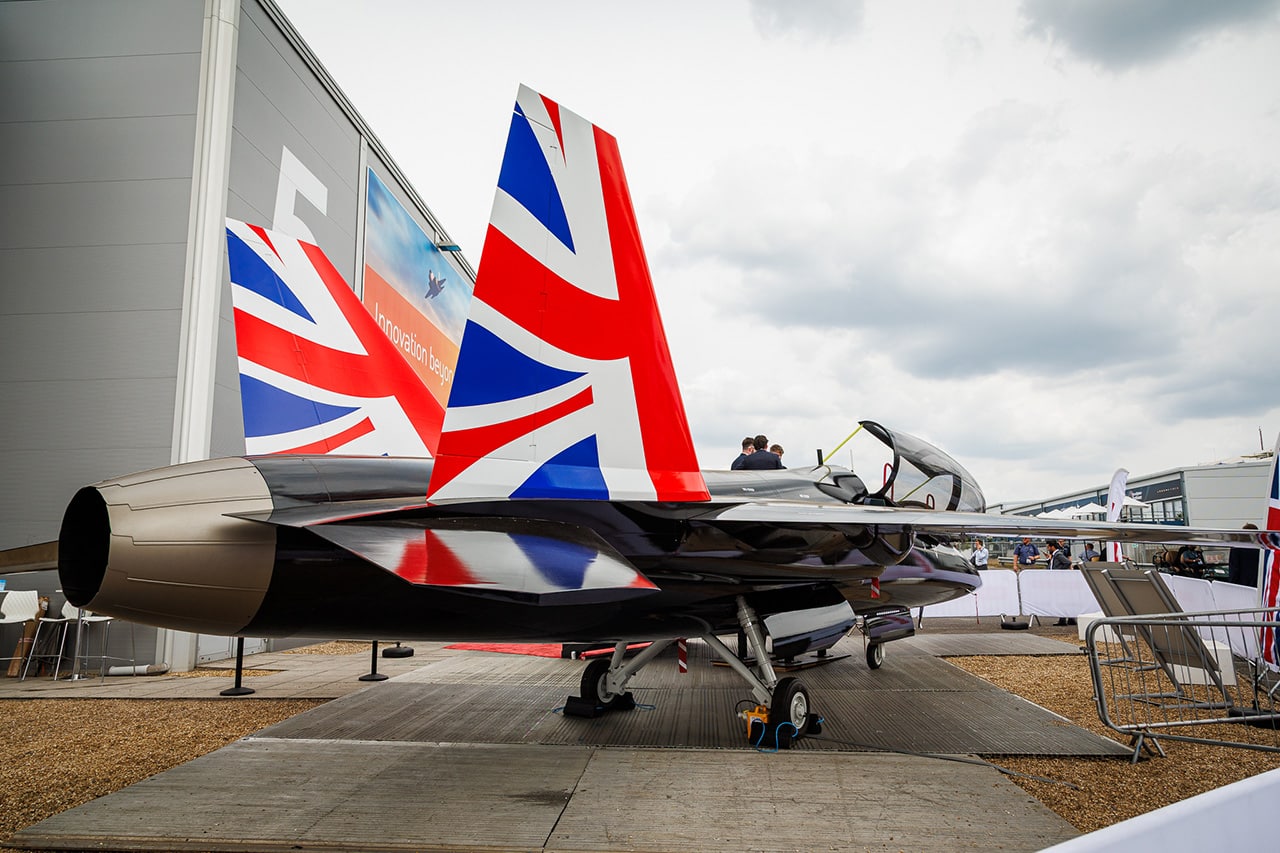
A representative mock-up of the T-7, marked with the UK flag and painted in the high visibility black favored by UK training aircraft, was displayed prominently outside the BAE Systems hall at Farnborough. The aircraft is advertised as ‘fourth and fifth generation ready’ and ‘sixth generation enabled.
Across at Leonardo, though there was notably less emphasis on the UK bid, both of the company’s potential options were featured at the airshow in the flesh. Leonardo’s own stand featured one of its M-345 jet trainers, while an Italian Air Force example of the more advanced M-346 was shown off in the static display park.
Nigel Colman, Managing Director of Leonardo Helicopters UK, ruled out the possibility of the company’s Yeovil site being used as the local manufacture element of any bid made, but Leonardo’s significant UK presence would almost certainly see local industrial involvement regardless of where final assembly takes place. The RFI calls for a “significant UK workshare”.
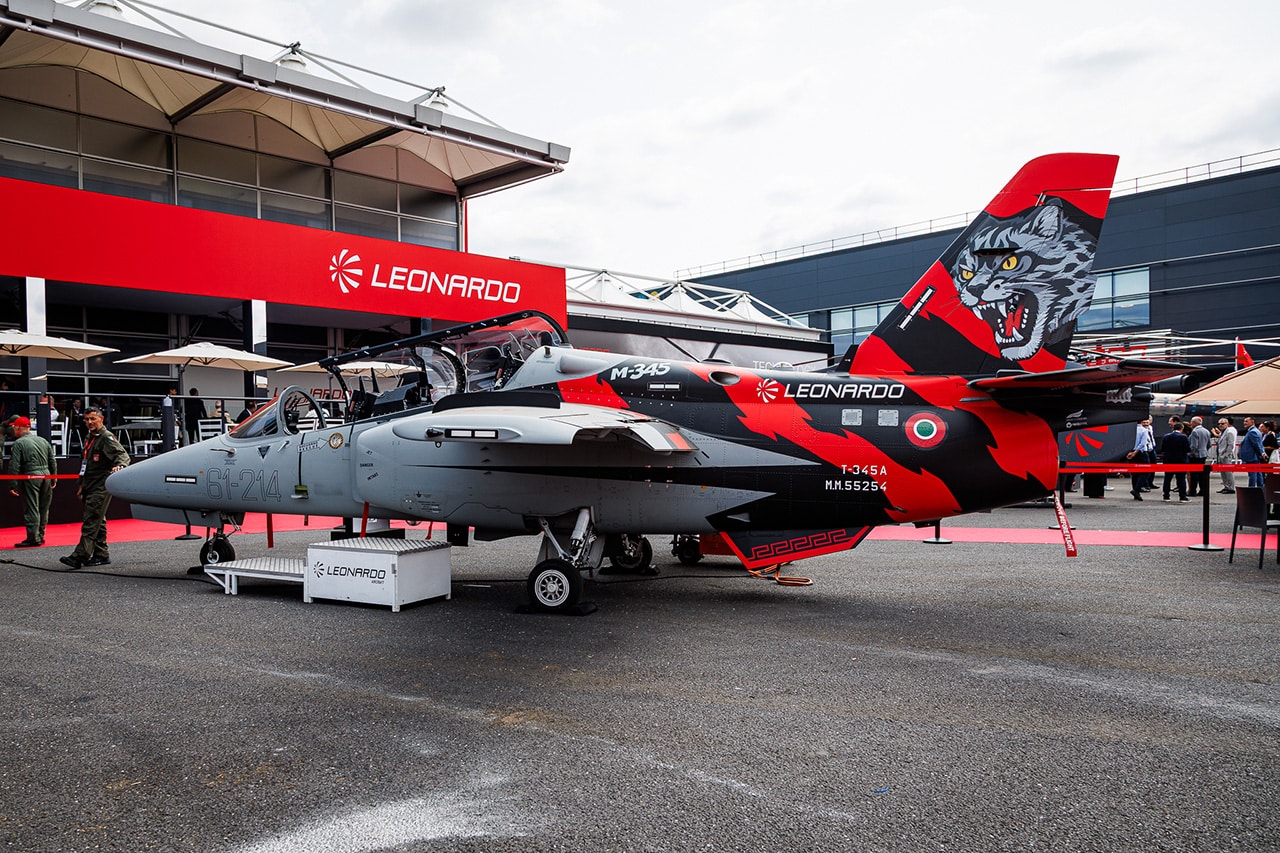
The M-345 is, perhaps, the most direct analogue to the Hawk aircraft. It is based on the SIAI-Marchetti S.211, introduced in the 1980s, and is powered by a single non-afterburning Williams FJ44 turbofan. However, its suitability for the range of performance levels needed for a future UK jet trainer is called into question by the Frecce Tricolori display team’s decision to abandon its move to the M-345 in favor of the M-346.
Its place in the Italian training system takes the place usually covered by a turboprop aircraft, offering a rare case of ab initio training on a jet aircraft. As such, the M-345 and M-346 are best thought of as a combined system rather than competitors with each other. It is uncertain, though, whether the UK’s budget could expand to cover two individual aircraft types.
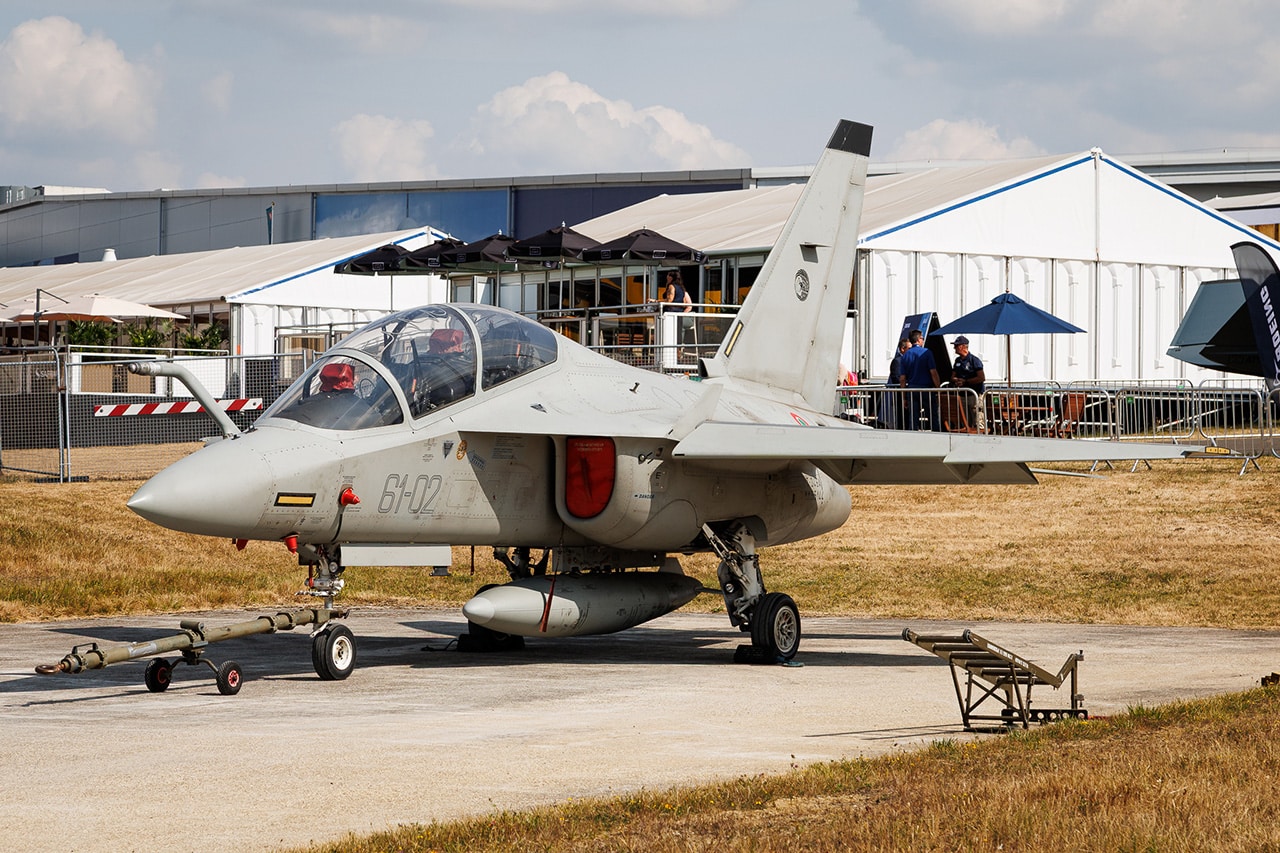
With two Honeywell/ITEC F124 engines and baked-in weapons capabilities, the M-346 is more of a hybrid between a jet trainer and a light fighter. It was initially developed in tandem with the Yakovlev Yak-130. Though the programs eventually diverged, both aircraft share significant similarities. Royal Air Force pilots have already spent many hours on the M-346 with Decimomannu’s International Flight Training School.
Outside Contenders
With less firm prospects of UK worksharing, the Turkish Aerospace Industries Hürjet – which has seen NATO export success with Spain – is being angled as another possibility for the UK. Unlike the above aircraft, the Hürjet is supersonic.
Day 4 and still finding new stuff here at the show – TAI Hurjet trainer mock-up here on the chalet line #FIA26 #FIA2026 pic.twitter.com/y9zVeYzo5d
— Tim Robinson (@RAeSTimR) July 23, 2026
The Hürjet’s best chance would have been as part of an alignment with BAE Systems, acting as a reciprocal deal for the supply of UK-built Typhoons to Turkey. However, this has been quashed by BAE Systems’ choice to partner with Boeing and Saab. Additionally, though both the Hürjet and Red Hawk are in their prototype and initial production stages, there is likely to be a higher degree of confidence on the latter thanks to its U.S. backing.
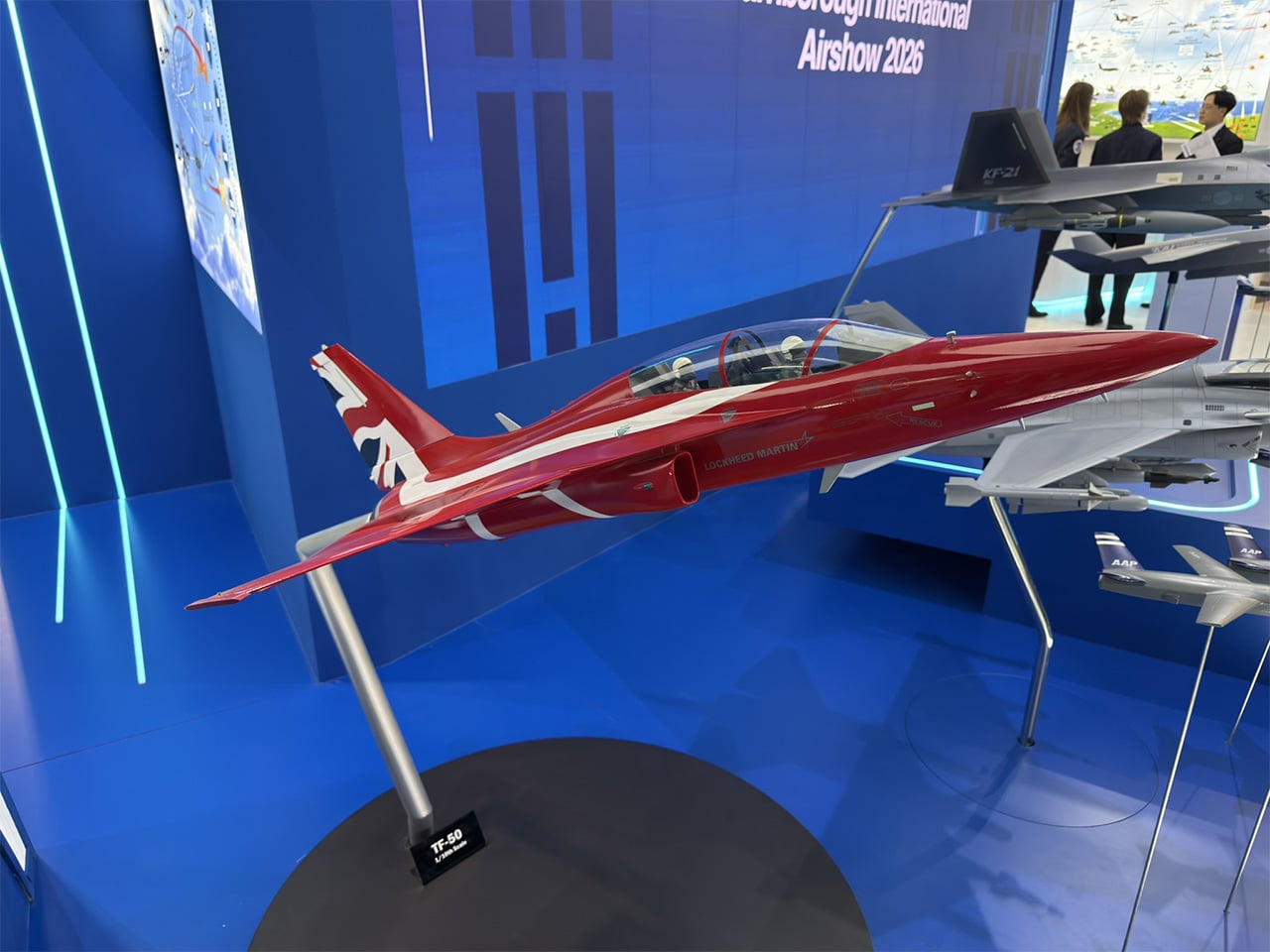
Contending as a more mature option, with hundreds of aircraft already in service, the Korean Aerospace Industries (KAI) T-50 Golden Eagle has also been put forward. This is comparable in role to the M-346, offering both a jet trainer and a light fighter. It has seen export success in Asia, and has now broken through to NATO in Poland, but the potential for high UK worksharing is low.
No full-scale mock-up was shown off at Farnborough, though KAI’s stand included a model in a scheme designed to represent the Red Arrows display team.
An all-UK option with Aeralis and its unbuilt concept for a modular jet trainer has now fallen through with the company’s collapse.