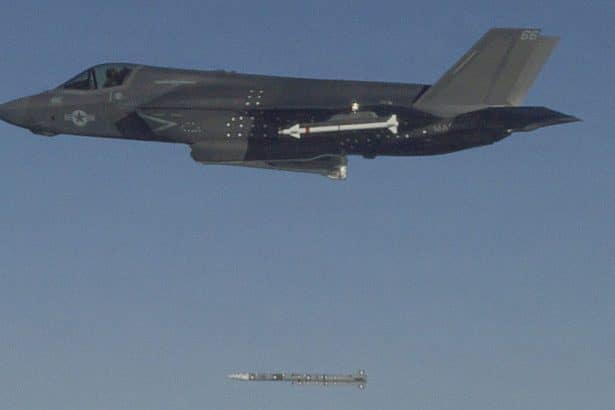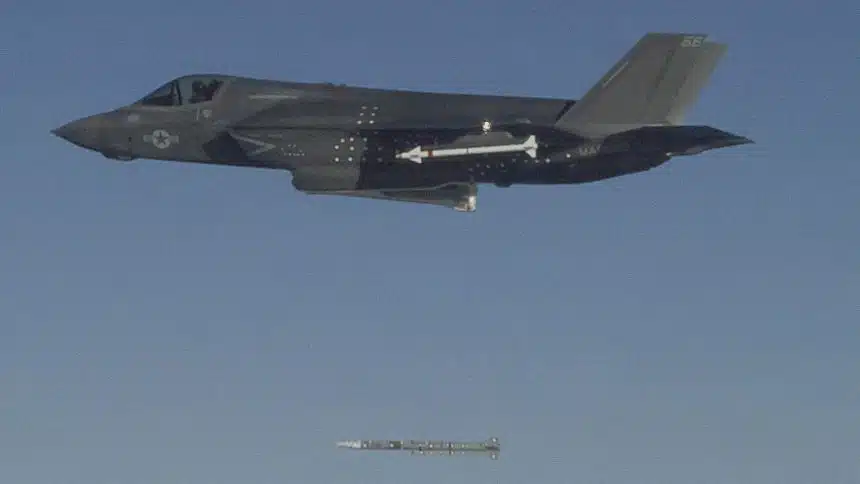
The Oct. 7 trial saw the release of an inert Meteor test asset from an F-35B’s internal weapons bay, demonstrating safe separation and providing data for further release tests ahead of live firings.
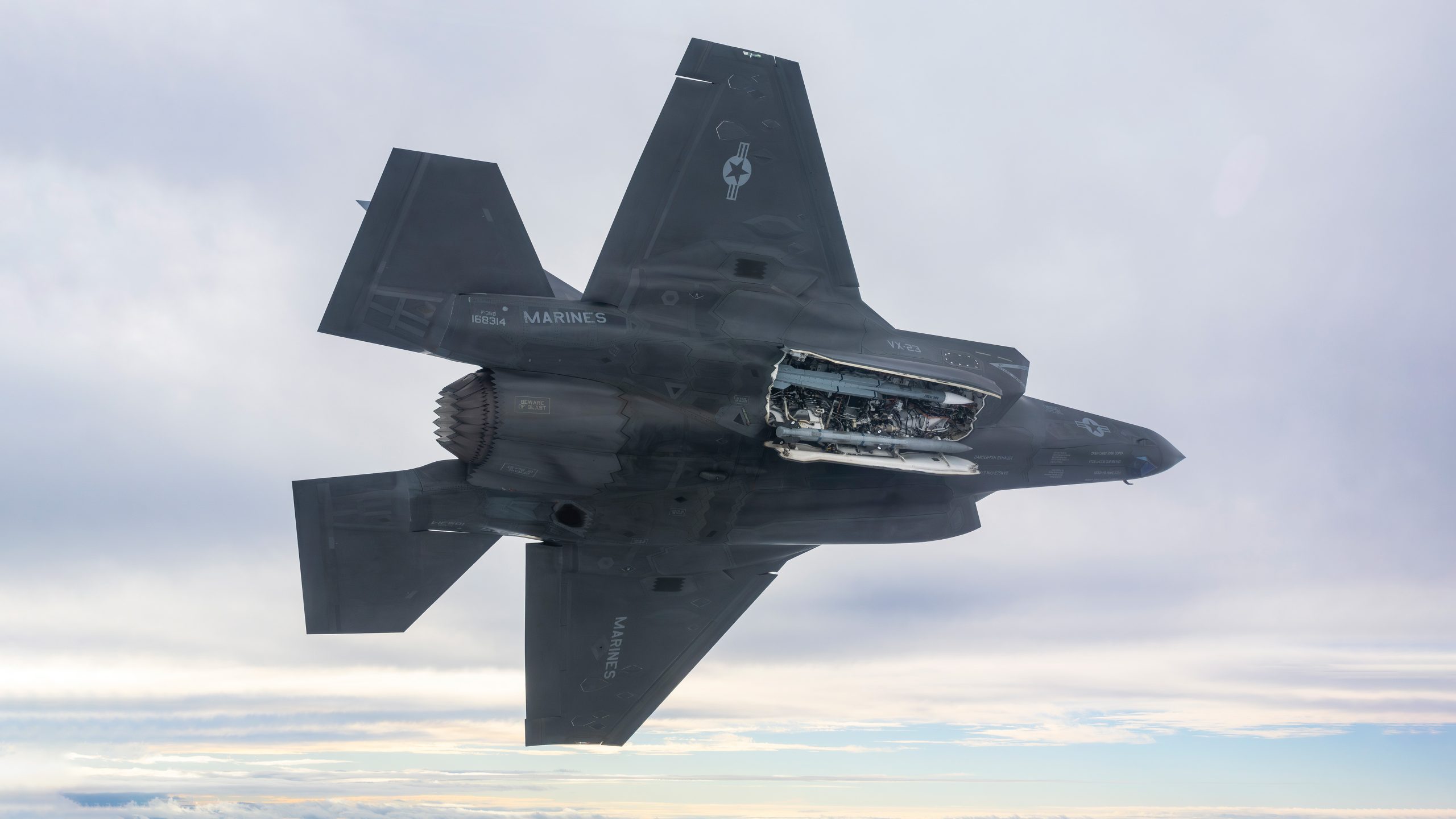
An F-35B Short Take-Off Vertical Landing (STOVL) fighter jettisoned an MBDA Meteor Beyond Visual-Range Air-to-Air Missile (BVRAAM) for the first time from its internal weapons bay (IWB) as part of the ongoing campaign to integrate the weapon on Italian and British Lightning IIs.
The F-35 Joint Program Office (JPO) and MBDA announced the milestone on Nov. 5, 2026, although it happened on Oct. 7 at Naval Air Station (NAS) Patuxent River (Pax River), Maryland. The statement described this as the first in a series of jettison trials.
Forthcoming tests will see the missile being released in more expansive flight profiles to ensure safe separation from the aircraft, before the campaign progresses to live-fire tests. The image released by the JPO and MBDA shows a specially instrumented U.S. Marine Corps F-35B releasing the inert Meteor test asset while in level flight.
The F-35B used in the test is attached to the Air Test and Evaluation Squadron Two Three (VX-23), whose F-35Bs have already flown captive carry trials at NAS Pax River with the Meteor in February 2025. The trials are conducted by a joint U.S./UK team attached to the F-35 Integrated Test Force (ITF), composed of personnel from the Royal Navy, Royal Air Force and Lockheed Martin.
Broader support comes from the U.S. Department of War, the UK’s Ministry of Defence and Italy’s Ministero della Difesa. Lockheed Martin, BAE Systems, MBDA and Northrop Grumman are also involved in the trials.
Another milestone in expanding the F-35’s combat air capabilities as METEOR completes its first jettison from the F-35B. ⚡
— F-35 Lightning II (@thef35) November 5, 2026
The test sortie itself was flown by a Royal Navy test pilot from the Air and Space Warfare Centre (ASWC). The Meteor is the UK’s primary BVRAAM for the RAF Typhoons, and Italy declared the weapon operational on its F-2000As (Italian Air Force designation for the Eurofighter Typhoon) in 2025.
The UK is leading the Meteor integration campaign for the F-35B, while Italy is sponsoring the integration onto the F-35A model. Previously, the UK integrated the British AIM-132 ASRAAM (Advanced Short-Range Air-to-Air Missile) onto its F-35Bs.
The Italian Air Force (Aeronautica Militare – ItAF) operates both the F-35A and F-35B, while the Italian Navy (Marina Militare), the RAF and the Royal Navy operate only the F-35B STOVL variant. However, the RAF is in the process of acquiring also a number of F-35As.
First jettison
The F-35 JPO said the jettison trial “successfully demonstrated the safe separation of the missile from the F-35B’s internal weapons bay in a complex aerodynamic environment.” The test will now validate and refine “aerodynamic digital models used to assess weapons-release characteristics” before live firings.
As mentioned earlier, the missile was an inert test article, which after the safe separation did not ignite its rocket motor. The fuel and explosive warhead are usually replaced by test instrumentation and ballast to replicate the exact weight of the live variant.
Expanding the arsenal. 🎯
An F-35B Lightning II, attached to the F-35 Integrated Test Force, releases a Meteor weapon test asset during a jettison flight trial at Naval Air Station Patuxent River, Maryland.
This milestone trial marks the first Meteor release from an internal weapons bay, verifying safe separation, validating aerodynamic models and advancing long-range strike capabilities.
Learn more about the Meteor milestone at:
https://t.co/zQqizQFEkG
— F-35 Lightning II Joint Program Office (@theF35JPO) November 5, 2026
MBDA explained that jettison testing “evaluates how cleanly and safely a missile detaches from a host aircraft or launch platform under normal operating conditions or during an emergency abort.” The company further explained that “these tests ensure the weapon separates cleanly without impacting the fuselage, damaging wing structures, or disrupting the vehicle’s flight dynamics.”
Like the F-35 JPO, the company highlighted the use of predictive digital models to simulate weapon release characteristics. These will be further improved thanks to the data generated during the release trial.
Over the coming months, the Meteor will be put through “a series of release profiles […] to validate safe separation across the F 35’s operational envelope.” The company said that “these developmental releases will culminate in live firings to confirm both separation and weapon fly-out performance under varying release conditions.”
Both MBDA and the JPO emphasized that the integration will expand the long-range air-to-air weapon options available to UK and Italian F-35 operators, enhancing their future combat capabilities. The tests are also likely to inform at a later stage the operational concepts and tactics for the employment of Meteor by the F-35.
Meteor BVRAAM
Meteor distinguishes itself from missiles such as the AIM-120 AMRAAM through its propulsion system, which combines a solid-rocket booster with a throttleable ramjet sustainer. Unlike a conventional solid-rocket motor, which typically provides a short period of thrust after launch, the ramjet can maintain propulsion throughout much of the missile’s flight.
The throttleable propulsion system allows Meteor to manage its energy throughout the engagement, retaining substantial thrust during the terminal phase and improving its ability to engage maneuvering targets at long range. As a result, the weapon has a larger no-escape zone and higher kill probability.
MBDA has also said the Meteor has a two-way data link used to receive updated target information from the launch platform. The missile can also receive mid-course updates based on information supplied by third-party platforms, enabling network-enabled engagements.