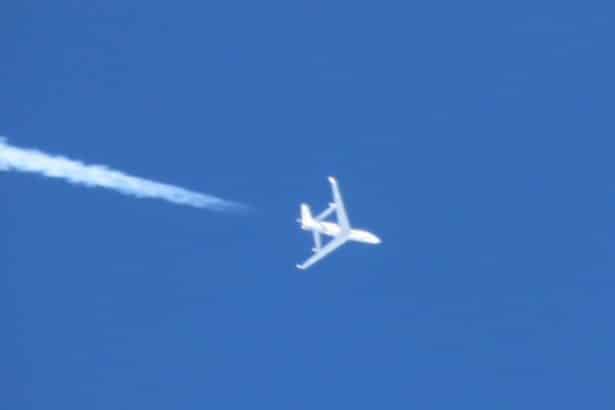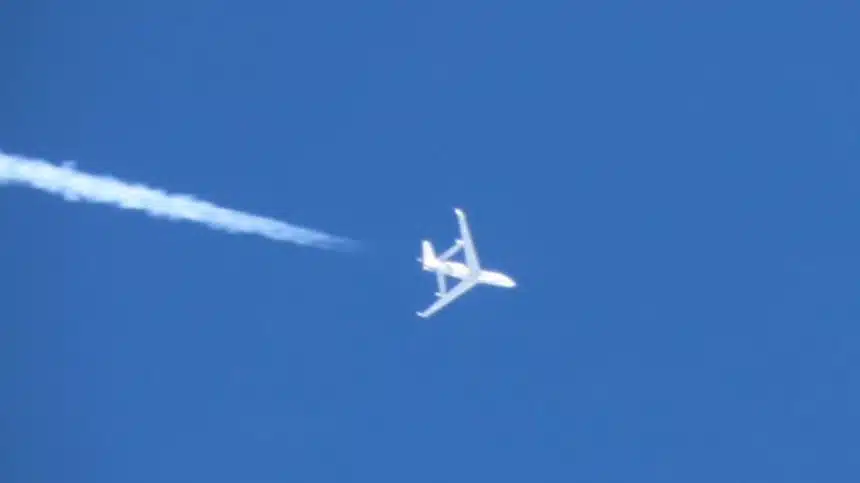
Chinese state media recently featured the WZ-7 alongside other PLA reconnaissance drones, describing the platforms as providing reconnaissance and targeting support to the PLA Army, Navy and Rocket Force.
Japan reported on Nov. 2, 2026 that its air force intercepted once again China’s WZ-7 high-altitude reconnaissance jet drone as it was flying around Japanese airspace for two times in the same day. These events represent the second and third time within a month the drone appeared in the region after a long hiatus.
The WZ-7 was intercepted and photographed for the first time by Japan Air Self Defense Force (JASDF) fighter jets in 2023, followed by another instance in 2024. In the latest development, the Japanese MoD’s Joint Staff said it tracked the jet twice, after it flew largely the same route from the East China Sea (ECS) through the strait between Okinawa and Miyako Island toward the Pacific Ocean and back.
It is unclear whether both events saw the involvement of the same drone or two different airframes. What makes the interception interesting is that the WZ-7 has been figuring persistently in Chinese state media of late, which described it as central to the PLA’s Army, Navy’s and Rocket Force’s surveillance, targeting and situational awareness architecture.
A report by Global Times in response to the Japanese MoD’s release on the WZ-7 described the flights as “completely normal,” as the Miyako strait is an important passage for both aircraft and ships. The report further said the drone may have been supporting the Liaoning carrier strike group that is currently exercising in the western Pacific.
A recent report shared officially by the Chinese military a few days before the intercepts mentioned that Chinese aircraft “may be providing situational awareness and intelligence support […] against the backdrop of a US-Japan joint exercise.” The exercise in question was Keen Sword 27, held from Oct. 19 to 29.
令和8年11月2日(月)午前から午後にかけて、中国軍の偵察型無人機(WZ-7)×1機が東シナ海から飛来し、沖縄本島と宮古島の間を通過して太平洋に至り、宮古島の南方沖から沖縄本島の南方沖にかけて飛行を行った後、再び沖縄本島と宮古島の間を通過して、大陸方面に向けて飛行したことを確認した。
また、同日午後、中国軍の偵察型無人機(WZ-7)×1機が東シナ海から飛来し、沖縄本島と宮古島の間を通過して太平洋に至り、宮古島の南方沖から沖縄本島の南方沖にかけて飛行を行った後、再び沖縄本島と宮古島の間を通過して、大陸方面に向けて飛行したことを確認した。
これらに対し、航空自衛隊の南西航空方面隊の戦闘機を緊急発進させ対応した。
— 防衛省・自衛隊 (@ModJapan_jp) November 2, 2026
The GT report also quoted official Japanese MoD figures, saying the Japan Air Self-Defence Force (JASDF) had scrambled fighters 442 times in response to Chinese and Russian military aircraft from April to September 2026, including 285 scrambles for Chinese military aircraft and 152 against Russian planes. This represents an increase of nearly 70 percent from the same period last year.
Japan intercepts WZ-7s
Here is a machine translation of the statement released by the Japanese Joint Staff on X:
“On Monday, November 2, 2026, between the morning and afternoon, a Chinese military reconnaissance-type unmanned aerial vehicle (WZ-7) was observed flying from the East China Sea, passing between the main island of Okinawa and Miyako Island to reach the Pacific Ocean. After flying through the area south of Miyako Island and the main island of Okinawa, the aircraft again passed between the main island of Okinawa and Miyako Island, heading back toward the Asian mainland.
Additionally, on the afternoon of the same day, another Chinese military reconnaissance-type unmanned aerial vehicle (WZ-7) was observed following the same flight path: arriving from the East China Sea, passing between the main island of Okinawa and Miyako Island to reach the Pacific Ocean, flying through the area south of Miyako Island and the main island of Okinawa, and subsequently passing between the main island of Okinawa and Miyako Island once more while heading toward the Asian mainland.
In response to these incidents, the Japan Air Self-Defense Force’s Southwestern Air Defense Force scrambled fighter jets.”
Among all drones at #Airshowchina2024, Chinese military’s #WZ-7 and #WZ-10 reconnaissance drones are the most advanced ones. Especially the WZ-10 unmanned electronic reconnaissance aircraft, it is capable of recognizing and locating enemy radars. https://t.co/oVKJx6LhA3
— China Military Bugle (@ChinaMilBugle) November 19, 2024
Japan intercepted the WZ-7 for the first time on Jan. 1, 2023, followed by the second a day later. On those occasions, the Japanese MoD said the WZ-7 was observed flying from the East China Sea to the Pacific Ocean, passing the Miyako Strait, orbiting south of the Sakishima Islands before flying back on the same route.
The MoD confirmed that these events represented “the first time that this specific type of reconnaissance unmanned aerial vehicle (WZ-7) has been identified during measures taken against airspace incursions.” The JASDF scrambled fighters from the Southwestern Air Defense Force to track and photograph the drone.
中国軍機の動向について(WZー7)
https://t.co/G6Go81IBwr https://t.co/DUu8oyM7Rf
— 防衛省統合幕僚監部 (@jointstaffpa) January 1, 2023
On Mar. 26, 2024, the WZ-7 was intercepted again, this time over the Sea of Japan. “After circling over the Sea of Japan, the aircraft proceeded in a northwesterly direction back toward the mainland,” said on that occasion the MoD.
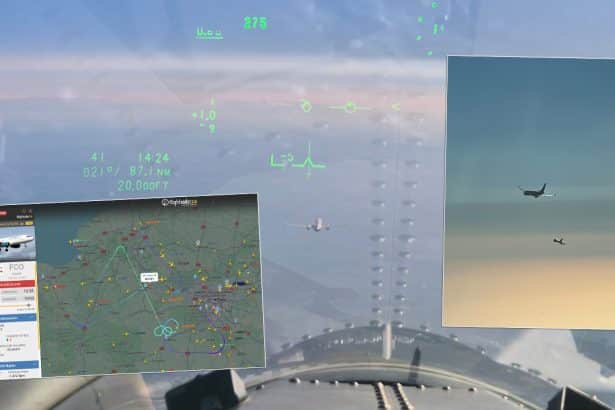
No intercepts of WZ-7 were reported in the remainder of 2024 and in 2025. On Oct. 14, 2026, the drone was intercepted again, this time while flying near a Y-9 Signal Intelligence (SIGINT) aircraft.
令和8年10月14日(水)午前、推定中国無人機×1機(推定)が東シナ海から飛来し、与那国島と台湾との間を通過し、太平洋に至ったことを確認した。
また、同日午後、中国軍の情報収集機(Y-9)×1機が大陸方面から飛来し、東シナ海上の長崎県男女群島の南西沖から沖縄本島の北西沖にかけて往復飛行を行った後、大陸方面に向けて飛行したことを確認したほか、中国軍の偵察型無人機(WZ-7)×1機が大陸方面から飛来し、東シナ海上を飛行した後、大陸方面に向けて飛行したことを確認した。
これに対し、航空自衛隊の南西航空方面隊等の戦闘機を緊急発進させ対応した。
— 防衛省統合幕僚監部 (@jointstaffpa) October 14, 2026
WZ-7 in Chinese media
The WZ-7 was among the assets officially featured in the footage released to mark the 99th anniversary of the People’s Liberation Army (PLA). The highlight was the nuclear-capable H-6N bomber shown for the first time carrying the JL-1 Air-Launched Ballistic Missile (ALBM) in “a coordinated strike exercise.”
The release at the time had said that the WZ-7, along with the WZ-10/Wing Loong-10 and the smaller GJ-3A ISR-strike UCAV, “provide intelligence support to the PLA Army, Navy and Rocket Force.” CCTV and CGTN shared a clip of PLAAF officer Li Zhengwei who said the drones are capable of “intelligent data processing” and “wide-area search over key locations including airports, ports and major transportation hubs.”
The drones are critical for targeting information for the PLARF, situational awareness for the PLAN and support for the PLA ground force’s long-range tube rocket artillery systems. The secretive system had hardly been featured in official Chinese releases, with the last coverage being on the official China Military Bugle profile in November 2024, during that month’s edition of the Airshow China, better known as Zhuhai Airshow.
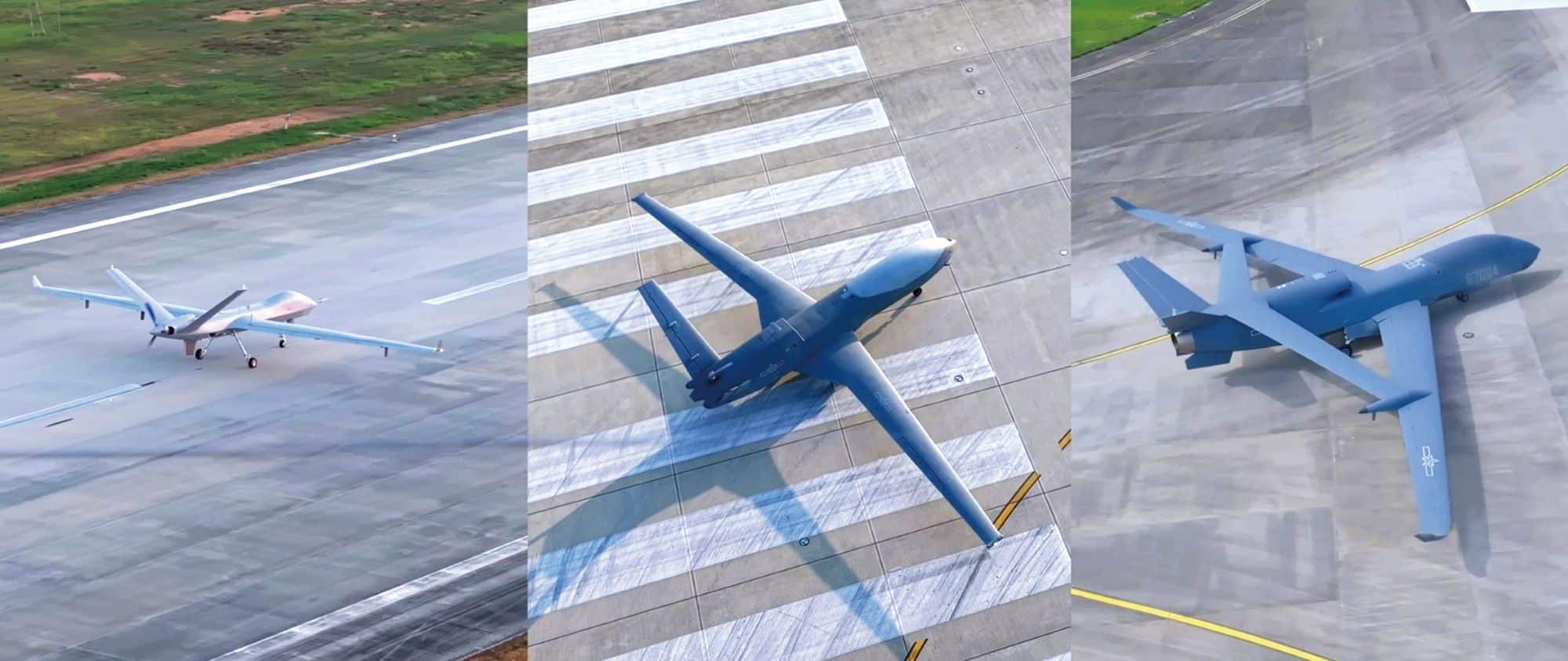
That report described the WZ-7 as a “high-altitude reconnaissance drone designed for border patrol, monitoring, battlefield reconnaissance target damage effect evaluation,” or battle damage assessment – as known in Western military parlance. These official reports suggested that it was only a matter of time until the WZ-7, which had until then been captured in satellite images at airbases and displays at airshows, would start to be spotted more often during operational flights.
WZ-7 capabilities and role
The drone is odd yet futuristic-looking, featuring a distinctive joined-wing configuration, with forward and rear wing surfaces connected near their tips. It is powered by a single jet engine fed by a dorsal air intake.
The WZ-7 is claimed to have an optical sensor, a maritime radar and synthetic aperture radar (SAR) imaging payloads, as a part of its surveillance suite. Flying at high speed, the drone can sweep up adversary electronic, radar and optical data of a large sector in a theater and beam back the situational picture over long-range data links.
Unmanned operations and smart technologies are reshaping China’s army for the modern battlefield, according to an episode of CMG’s six-part documentary, The Road to Victory, released on August 4 to mark the 99th anniversary of the founding of the Chinese People’s Liberation Army (PLA).
https://t.co/MEKhXBxFKh
— CCTV+ (@CCTV_Plus) August 5, 2026
The GT report further quoted military expert Du Wenlong from a CCTV feature, who claimed the WZ-7’s maximum service ceiling is between 19,000 and 20,000 meters.