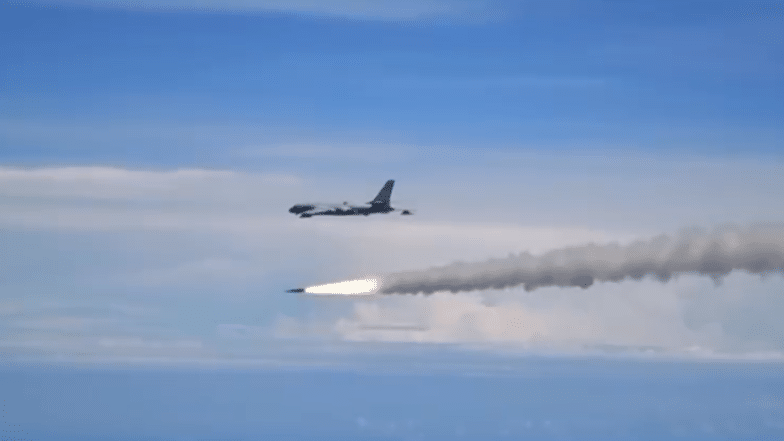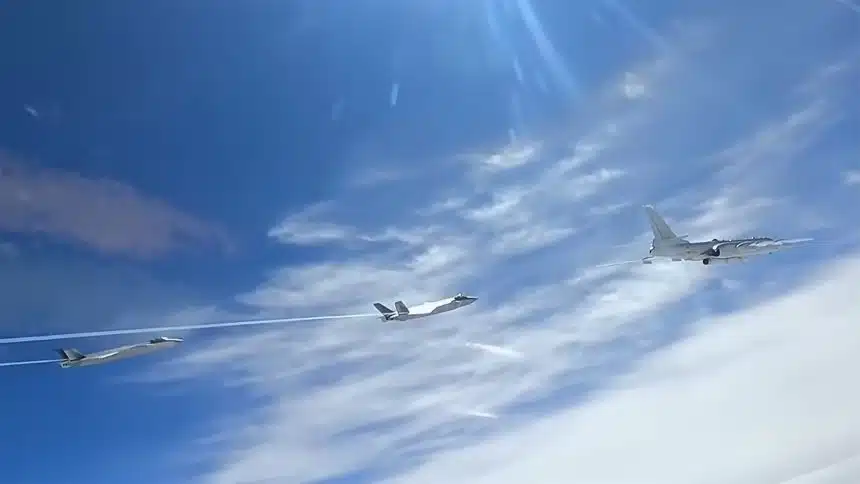
China released images of the H-6 bomber carrying the JL-1 air-launched ballistic missile as part of promotional features marking the 99th anniversary of the People’s Liberation Army (PLA).
China released for the first time official footage showing a PLA Air Force H-6N bomber carrying the massive JL-1 air-launched ballistic missile (ALBM). The bomber was also accompanied by two J-20 fighters.
The missile, unveiled for the first time during the Sep. 3, 2025 Victory Day parade in Beijing, is strikingly similar to the ALBM system previously unofficially captured under the H-6. At the time, we had identified the missile as the CH-AS-X-13 ALBM, with some earlier assessments believing it to be an air-launched version of China’s DF-21D Anti-Ship Ballistic Missile (AShBM).
It is not clear whether the JL-1 is related to the CH-AS-X-13 as a final improved derivative or is the missile’s official designation. However, the fact that the missile was carried under the ‘N’ variant of the H-6, which is part of the aerial triad of China’s nuclear arsenal, does suggest an atomic role.
H-6N carrying JL-1 ALBM on a nuclear patrol escorted by J-20s https://t.co/cbLNkfTaY0 pic.twitter.com/f338dXDSKF
— Hûrin (@Hurin92) August 4, 2026
The video was a part of a series of promotional features released since Aug. 4, 2026 to mark the 99th anniversary of the Chinese People’s Liberation Army (PLA). The full video shows a joint operation involving the PLA Air Force, PLA Navy, and PLA Rocket Forces conducting a coordinated combined arms strike operation in the western Pacific by trading targeting and situational awareness data.
Situation for JL-1’s use
Chinese military observers stated that the JL-1 can also be carried under the H-6KG, thus suggesting that the JL-1 might also have a conventional strategic-strike role, with the nuclear warhead swapped out. This suggestion would work under the assumption that the H-6N has an exclusive nuclear strike role, and the implication that the H-6KG carries dual-role non-nuclear conventional delivery missiles.
China also has an avowed no-first use nuclear policy and less than 600 warheads, unlike Russia and the U.S. whose respective stockpiles of roughly 5,500 and 3,700 nukes are backed by active first strike nuclear postures. A retaliatory attack after sustaining a strike would likely see an H-6N launching a nuclear JL-1.
C-AS-X-13というやつか
結局YJ-21と関係無いのかどうかが分からん https://t.co/8nMLf7KK4h pic.twitter.com/r8IsshG2ZE
— MIKOYaN☆🕷️ (@mikovlev130) April 5, 2025
Without announcements from Beijing regarding a change in its nuclear posture, a possible interpretation is that the H-6KG could be used to launch a conventionally-armed variant of the JL-1, although this remains unconfirmed.The weapon could be potentially employed against large static targets or, depending on the guidance and targeting capabilities (including satellite), even slow-moving targets such as high-value naval vessels.
Either way, as shown in the clip, the H-6 would be accompanied by J-20s, the PLAAF’s most advanced fighter. This highlights the importance given to the protection of the bomber during the high-value mission profile.
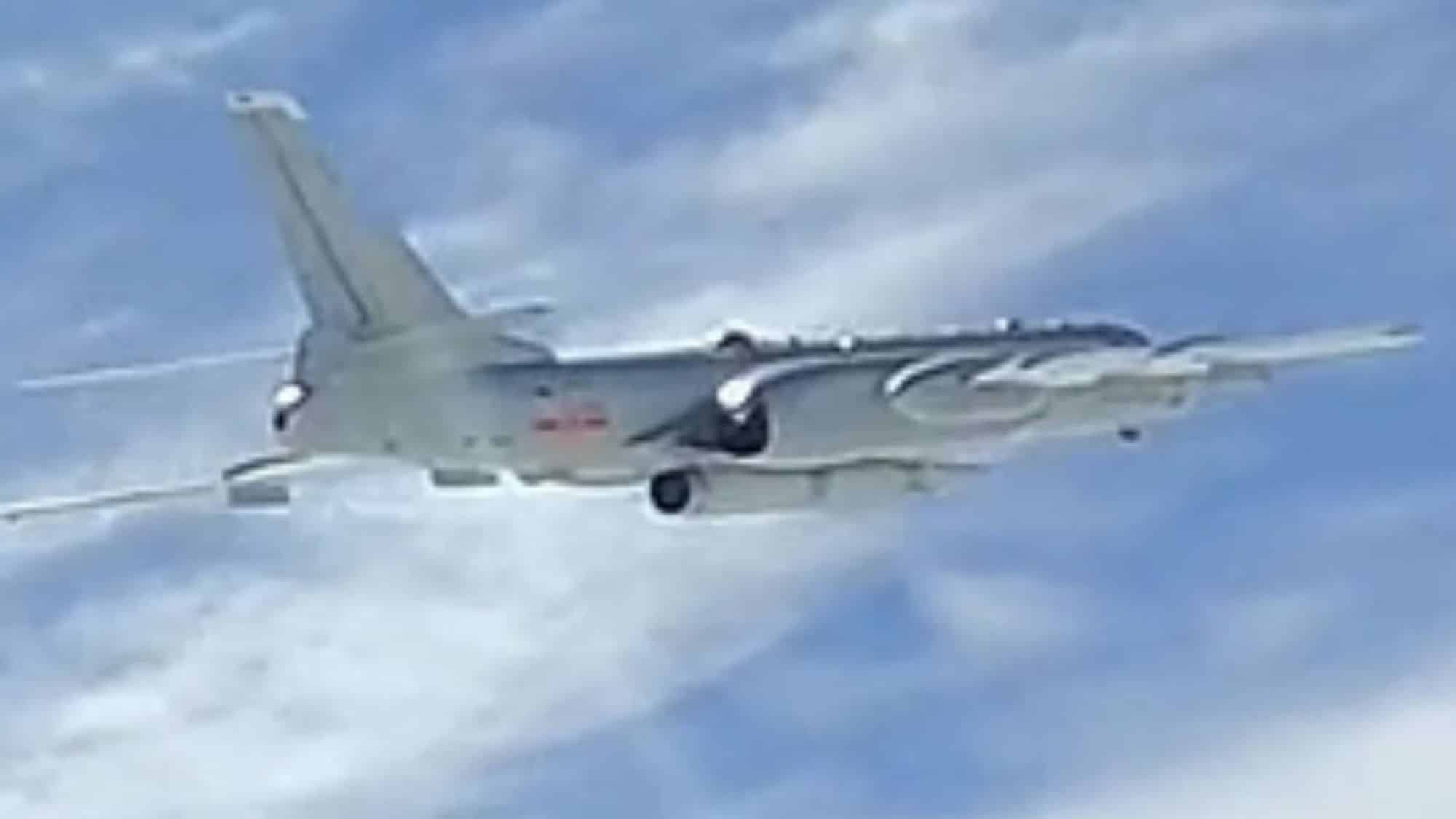
With the JL-1 now shown officially paired with the H-6, it is possible that soon there will be images of the weapon being released from the bomber. The H-6K in general has been captured unofficially carrying other large weapons like the YJ-21/KD-21 anti-ship missile.
PLAAF’s drones supporting Army, Navy and Rocket Force
Interestingly, China’s state media showed on Aug. 5 the PLA Air Force’s unmanned aerial reconnaissance fleet, which currently includes the GJ-3A, the Wing Loong-10/WZ-10, and the WZ-7. The aircraft provide intelligence support to the PLA Army, Navy and Rocket Force.
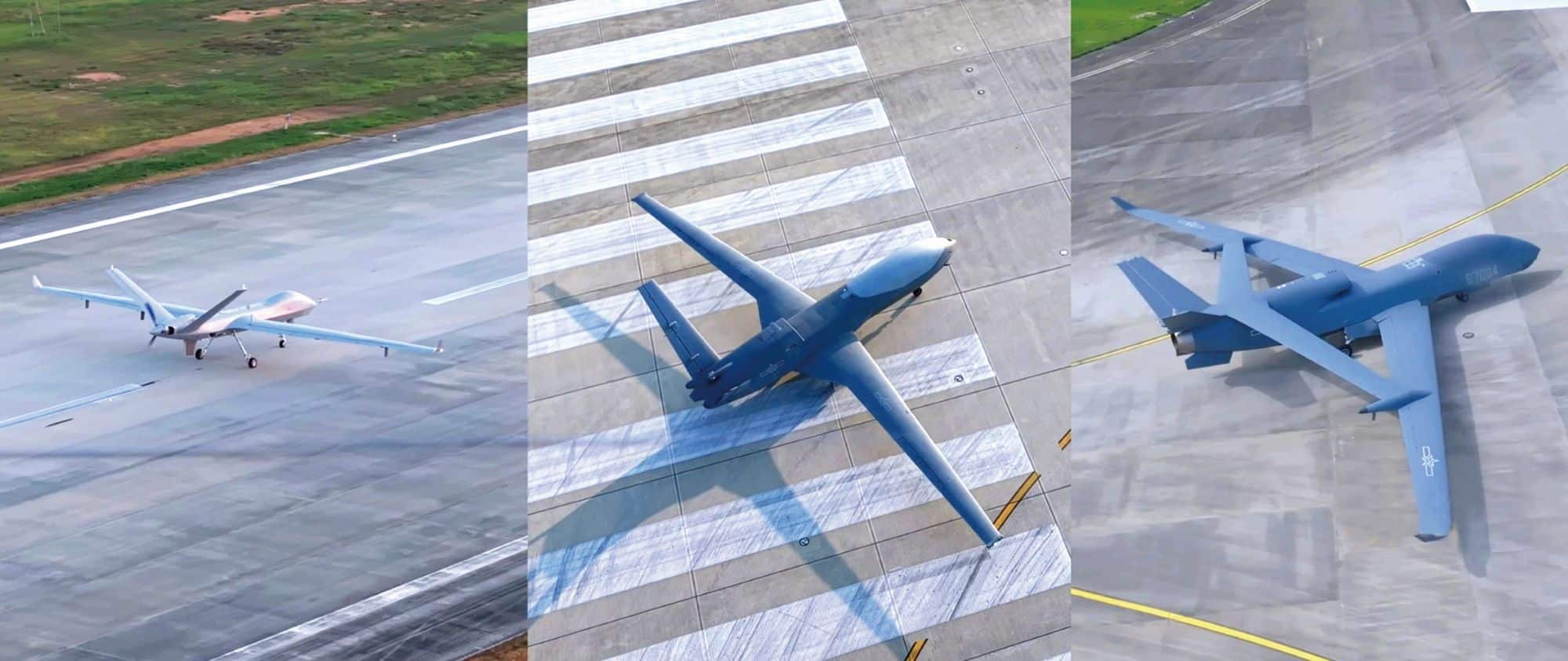
While the GJ-3A is a Medium-Altitude Long-Endurance (MALE) ISR-strike drone, the WZ-10 and the WZ-7 roughly perform the same role as the MQ-4C Triton. These are believed to have optical, maritime search radar and synthetic aperture radar imaging payloads.
Unmanned operations and smart technologies are reshaping China’s army for the modern battlefield, according to an episode of CMG’s six-part documentary, The Road to Victory, released on August 4 to mark the 99th anniversary of the founding of the Chinese People’s Liberation Army… pic.twitter.com/hdC31j9g5W
— CCTV+ (@CCTV_Plus) August 5, 2026
CCTV and CGTN shared a clip of Li Zhengwei, an officer from an unspecified PLAAF Aviation Brigade in the Southern Theater Command (STC), and drone operators saying they are working on “intelligent data processing” and “wide-area search over key locations including airports, ports and major transportation hubs.” Zhengwei added the drones are critical for targeting information for the PLARF, situational awareness for the PLAN and support for the PLA ground force’s long-range tube rocket artillery systems.
Other official Chinese missile unveilings
These developments also come after China has officially unveiled other surface-fired strategic missiles. Late in December 2025, its military media showed the YJ-20 hypersonic aeroballistic missile being fired from the PLAN’s Type 055 destroyer, its most advanced surface combatant.
Type 055 Destroyer Wuxi conducted the YJ-20 AShM type approval test. pic.twitter.com/RA3b3kyVYi
— dafeng cao (@dafengcao) December 28, 2025
Then, on Jun. 22, 2026, China officially showed for the first time the DF-17 aeroballistic-Hypersonic Glide Vehicle (HGV) missile being launched by a PLA Rocket Force (PLARF) road mobile Transporter-Erector Launcher (TEL).
Chinese official media has publicly shown the launch of the Chinese People’s Liberation Army (PLA) Rocket Force’s DF-17 hypersonic missile for the first time, accompanied by the first official disclosure of what a military commentator said could be an upgraded variant of the… pic.twitter.com/zJSLbrDuYO
— Global Times (@globaltimesnews) June 22, 2026
A media wing’s promotional video then emerged on Jun. 29, 2026, showing the YJ-20 now being fired from the older Type 052D destroyer, showing commonality in Vertical Launch Silos (VLS) and expanded launch platform options.
The first footage of Chinese YJ-20 hypersonic anti-ship ballistic missile being launched from a Type 052D destroyer.
The YJ-20 is estimated to fly at Mach 6+ with terminal speeds up to Mach 10 and a range of 1,000–1,500 km, designed to threaten large surface combatants like US… pic.twitter.com/NW7mbKd4Ow
— Clash Report (@clashreport) July 29, 2026
Lastly, on Aug. 1, China showed officially, possibly for the first time, H-6Ks armed with four YJ-15 supersonic anti-ship missiles in a “joint naval-air training exercise” under the Southern Theater Command (STC) over the disputed Scarborough Shoal (or Huangyan Dao in Mandarin) in the SCS.
The Chinese military’s joint training exercise of navy and air force in the territorial sea and airspace of China’s Huangyan Dao and its surrounding areas is a necessary action taken in light of the current situation in the South China Sea and in response to the acts of certain… pic.twitter.com/D4boVff9do
— China Military Bugle (@ChinaMilBugle) August 1, 2026
The latest promotional video released on Aug. 4 shows the H-6K firing the YJ-15. Both the YJ-15 and the YJ-20 were officially unveiled in the September 2025 military parade in Beijing.