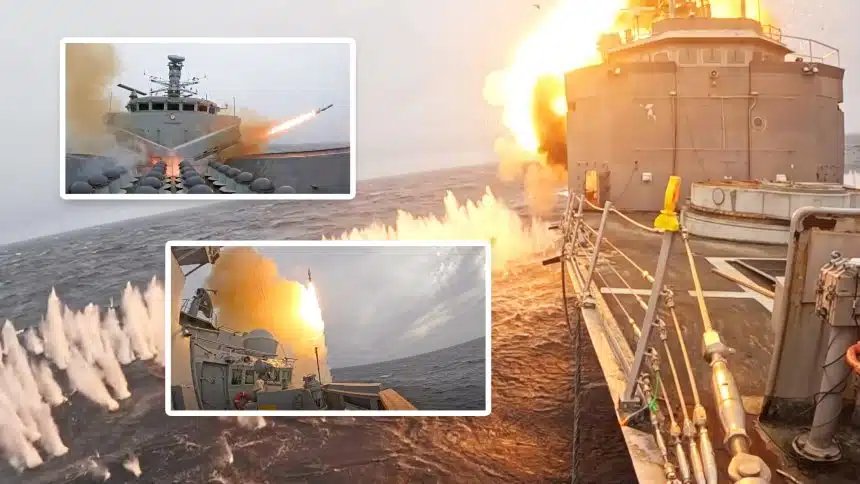
SM-6, Sea Venom, and Naval Strike Missile munitions were paired alongside a Mark 48 ADCAP torpedo to send the decommissioned Oliver Hazard Perry class frigate to the bottom of the Atlantic Ocean.
Concluding Exercise Atlantic Thunder 2026, the sink exercise (SINKEX) was conducted in the Northern Atlantic off the Outer Hebrides in Northern Scotland. The former USS Klakring, an Oliver Hazard Perry class frigate commissioned in 1983 and decommissioned in 2013, was specially prepared for the exercise with extensive cleaning and hazard removal.
The SINKEX was used to validate the capabilities of a number of new munitions which have entered service in recent years. Arleigh Burke class guided missile destroyer USS Paul Ignatius (DDG 117) fired an SM-6 missile in its secondary role as an anti-ship weapon, testing the performance of the missile towards the upper end of its range.
Decommissioned Oliver Hazard Perry-class frigate USS Klakring (FFG-42) being towed out of Philadelphia Naval Inactive Ship Maintenance Facility (NISMF) for SINKEX reportedly around Scotland – August 12, 2026 SRC: FB- Delaware River Shipping / John Curdy 📸 pic.twitter.com/y5JIvPBLVu
— WarshipCam (@WarshipCam) August 13, 2026
“Atlantic Thunder demonstrates the unmatched lethality and interoperability of the United States and United Kingdom,” said Captain Kelechi Ndukwe, Commander, U.S. Task Force 65. “This sinking exercise not only validated the power behind U.S.-UK offensive weapons but delivers a clear message to adversaries that the U.S. Navy and Royal Navy remain a ready allied force.”
New onboard SINKEX views — including some wild slo-mo
US-UK forces send the decommissioned guided-missile frigate USS Klakring to the bottom of the Atlantic
Blows delivered by USS Paul Ignatius, the newly commissioned USS Massachusetts, others
(Compiled by MC1 Austin Ingram) pic.twitter.com/cS8Ok1O3Nc
— J.D. Simkins (@simkins_jd) September 29, 2026
Royal Navy Type 23 frigate HMS Portland (F79) used the opportunity to conduct the service’s first ever ‘warshot’ launch of the Norwegian-built Naval Strike Missile (NSM) that has replaced the Harpoon in UK service. Petty Officer James Kenyon, an Above Water Warfare specialist on HMS Portland, said: “Being the first person to fire war-shot NSM and achieve a hit is a very proud moment, and one that will stay with me for the rest of my career. This was the culmination of over a year’s effort in planning and bringing the drills into service, and I am glad that I was able to contribute.”
Lieutenant Commander Louise Kirkaldy, Portland’s Principal Warfare Officer (PWO), said: “The successful firing of NSM marks a significant milestone for the Royal Navy, demonstrating our ability to deliver credible, modern maritime strike capability.”
HMS Portland launches a Naval Strike Missile during Exercise Atlantic Thunder off Scotland, striking the decommissioned USS Klakring in the Royal Navy’s first operational firing of NSM.
📸 LPhot Henry Parks / Royal Navy pic.twitter.com/mvZUh7NLSU
— UK Defence Journal (@UKDefJournal) September 29, 2026
Portland’s contribution was added to by the ship’s embarked Wildcat helicopter, hailing from 815 Naval Air Squadron. In another first, the Wildcat fired a Sea Venom anti-ship missile at the Klakring in the first operational live firing of the weapon type against a realistic target.
A Wildcat helicopter can carry as many as four Sea Venom missiles per sortie, with each weapon packing a 120 kilogram warhead. Though much smaller than ship-killing weapons like NSM and Harpoon, the Sea Venom is designed to deliver enough destructive capability to destroy smaller naval vessels, or using multiple finely targeted missiles complete a successful mission kill against larger frigate or destroyer sized targets.
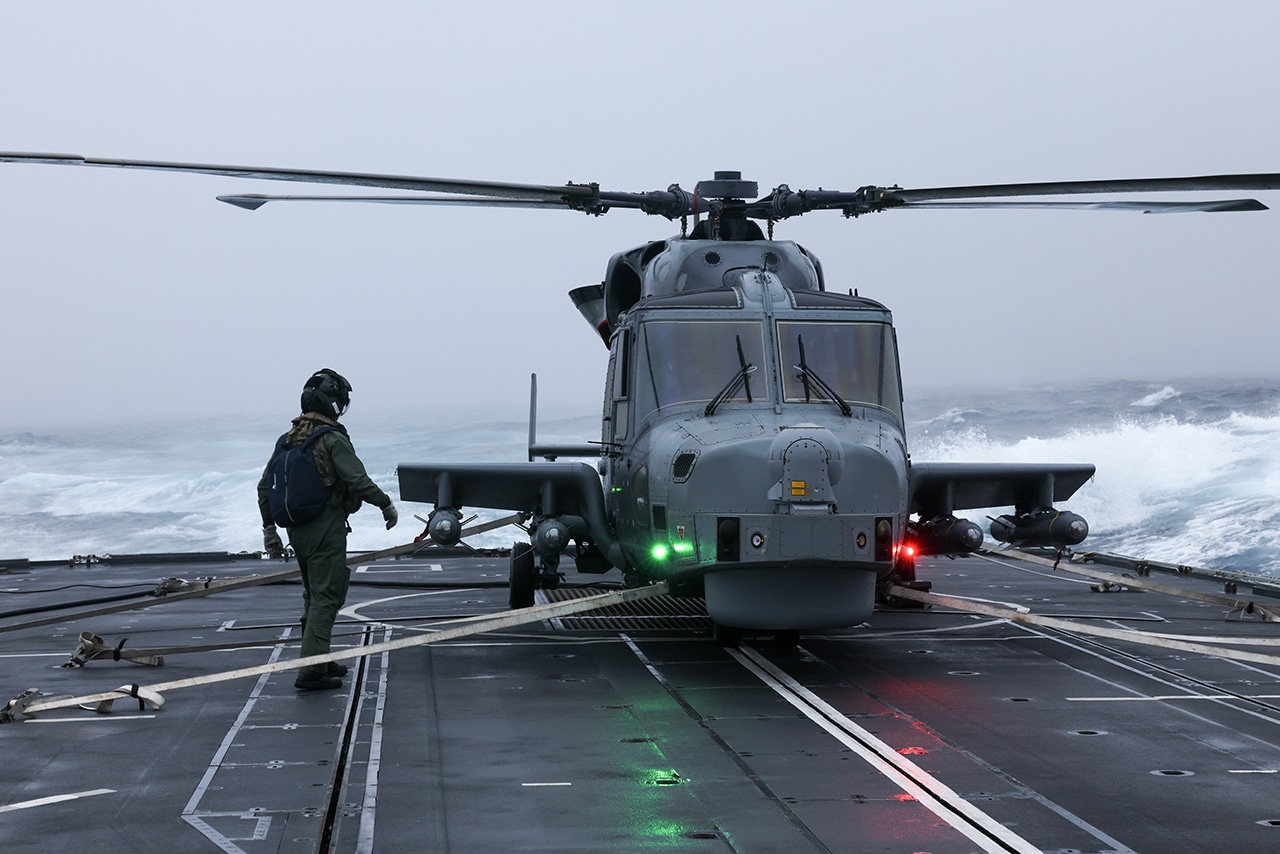
Lieutenant Commander Rhydian Edwards, Test & Evaluation Commander, Maritime Aviation Strike Operational Advantage Group, said: “This was a landmark moment for the Wildcat Force. For the first time we demonstrated the live firing of an operational Sea Venom missile against a representative maritime target. More importantly, we proved our ability to execute the full maritime strike kill chain under realistic operational conditions.”
“This was about giving commanders confidence that Wildcat can find, fix and strike maritime targets using Sea Venom as part of a wider task group. The lessons learned from this activity will directly inform future tactics, training and operational capability development, ensuring Maritime Aviation Strike remains ready to fight and win when called upon.”
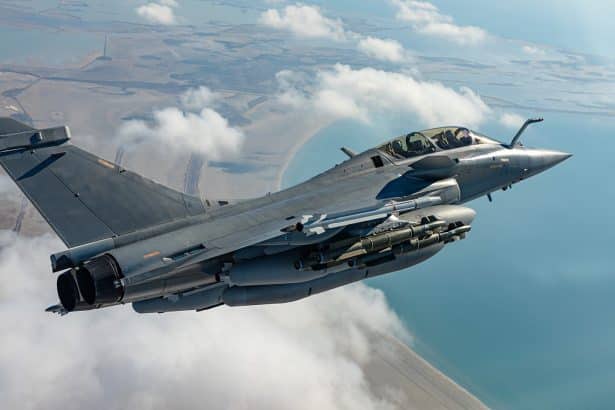
More air-launched munitions came in the form of guided bombs dropped by F-15E Strike Eagles based with the 48th Fighter Wing (FW) at RAF Lakenheath. P-8 Poseidon maritime patrol aircraft from the U.S. and UK also took part in the SINKEX, though no weapon launches have been attributed to them and their contribution may have simply been as surveillance platforms.
Finishing off the Klakring, the USS Massachusetts (SSN 798), commissioned into the U.S. Navy in March 2026, targeted the frigate with a Mark 48 Advanced Capability (ADCAP) torpedo.
USS Massachusetts (SSN 798) Virginia-class Block IV attack submarine leaving Faslane, Scotland – September 11, 2026 SRC: FB- Argyll Sea Glass pic.twitter.com/Ba4k7jzjyJ
— WarshipCam (@WarshipCam) September 11, 2026
Massachusetts, the 25th Virginia class submarine, was pushed into service without the traditional post-commissioning shakedown period in order to mitigate current shortfalls in U.S. attack submarine availability. The decision has been described as a ‘calculated risk’. The submarine was noted at the Royal Navy’s Faslane base earlier in September.