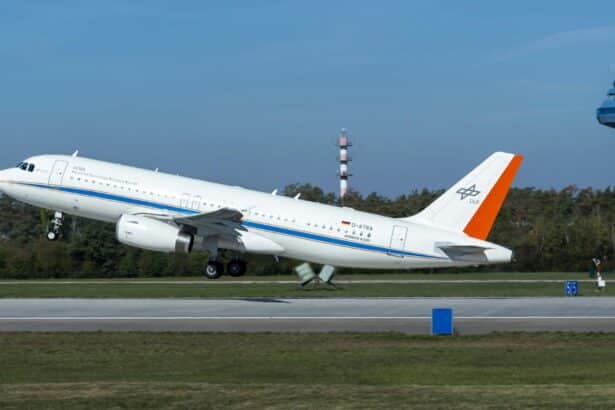
The Airbus A320 ATRA has received the Eurofighter’s ECRS Mk1 AESA radar, together with the necessary structural modifications, cooling systems, data cabling and workstations, and has completed its commissioning flights.
The Airbus A320 ATRA (Advanced Technology Research Aircraft), the specialized testbed aircraft of the German Aerospace Center (DLR), has now completed the commissioning flights following the modifications for the testing of the Eurofighter Typhoon’s new radar. The aircraft will now be used to test the European Common Radar System (ECRS) Mk1 radar that will equip German and Spanish Typhoons.
Airbus Defence and Space announced the milestone on Nov. 6, 2026, and said the commissioning flights have also included a final validation of the new configuration. The aircraft has received the representative ECRS Mk1 radar and avionics meant to be installed on the Eurofighter, as well as test instrumentation and airframe modifications required to carry the new hardware.
The A320 ATRA made its maiden flight in January 2025. In the latest press release, Airbus confirmed that at the time the A320 ATRA was “still without an active radar,” with the first flight only intended “to test its basic airworthiness.”
Following this first milestone, the aircraft underwent “extensive ground tests where the radar was put through its paces.” Airbus then reported the Initial Operational Capability (IOC) of the ATRA’s new configuration in September 2025.
An airliner with the nose of a fighter jet? ✈️👀
This is the @Airbus A320 ATRA. Fitted with the unmistakable Eurofighter radome, this flying laboratory has now commenced flight operations in Manching to further develop the fighter jet’s new E-Scan radar.
Get all the details here: https://t.co/zhpJjQPTpy
— Airbus Defence (@AirbusDefence) November 6, 2026
The A320 ATRA is the largest aircraft in the fleet of the German Aerospace Center (Deutsches Zentrum für Luft- und Raumfahrt, DLR). The modifications and the test campaign for the new radar are part of a collaborative project between Airbus – manufacturer for both the A320 and Eurofighter, as well as Germany’s Hensoldt and Spain’s Indra – the ECRS Mk1’s developers.
Testing the new radar
In the press release announcing the latest milestone, Airbus has provided additional details about the modifications required by the A320 ATRA for its new role. The most visible modification is a replica of the Eurofighter’s radome installed on the A320’s nose, which required reinforcements to the forward fuselage, as well as “hundreds of metres of data cables.”
The aircraft has also been equipped with a liquid and air cooling system to manage the temperature of the radar and dissipate the heat produced by the AESA modules. The cabin has been equipped with several workstations where engineers receive real-time data which allows them not only to see “everything the radar provides to the pilot, but also get a full view of what is happening ‘under the nose’.”

“We can monitor how the hardware performs and also test new software versions or features,” said Sebastian Ritz, who leads the A320 Flying Test Bed Programme at Airbus Defence and Space. “The insights we generate will inform and accelerate the maturation and further development of the system.”
Ritz added that the recent commissioning flights confirmed that the aircraft and the radar “performed effectively in the air.” He further confirmed that “this was the final step in the validation phase, and the E-Scan Mk1 flying test bed is now operational.”
When you and your bestie show up to the party in the same outfit 👀
We hope you didn’t fall for our little clickbait 😉 This is of course the hybrid of the @DLR_EN #A320 Advanced Technology Research Aircraft (ATRA) and a #Eurofighter. Following the first flight earlier this year, it recently completed its first flight in Initial Operational Capability (IOC) configuration to gather data in order to validate the airframe design. During this flight, it met up mid-air with a German Eurofighter from Taktisches Luftwaffengeschwader 73 “Steinhoff”.
Operated by @Airbus and the DLR in close cooperation with the @bundeswehrInfo and engineered across Airbus divisions and partners, the modified #A320 ATRA will be used to test and mature the new AESA (active electronically scanned array) MK1 radar which will be integrated, for example, into the latest generation Eurofighters. The radar will ultimately enhance the Eurofighter’s capabilities in multimode air-to-air and air-to-ground operations with features to also complement electronic warfare capabilities in the future.
The modified A320 ATRA was retrofitted with a Eurofighter nose which was designed, built and mounted on the aircraft by Airbus teams. The nose section will host the AESA MK1 radar.
©️ Luftwaffe
@BaainBw
— Airbus Defence (@AirbusDefence) September 23, 2025
ECRS radars and capability
The new ECRS has three variants: Mk0, Mk1 and Mk2. These would replace the Eurofighter’s legacy Captor-M mechanically scanned radar, offering expanded air-to-air, air-to-ground, and electronic warfare capabilities.
The ECRS Mk0 currently equips Kuwaiti and Qatari Eurofighter Typhoons. The ECRS Mk1 is planned to equip Germany’s Tranche 4 Eurofighters under Project Quadriga, the future Tranche 5 jets, and the Spanish Halcon variants. The ECRS Mk.2 is being developed for the United Kingdom’s Royal Air Force, and features electronic warfare and electronic attack capabilities.
While the ECRS Mk1 is being developed by Hensoldt and Indra, BAE Systems and Leonardo are developing the ECRS Mk2. The latter will be tested on an Avro RJ100 being modified by BAE Systems and QinetiQ as a testbed.
In addition to flying testbeds, Eurofighter Typhoon aircraft are also being used to test the new radars. In December 2024, a Spanish Typhoon flew for the time with the ECRS Mk1 from Airbus’s Getafe facility, few months after a RAF Typhoon flew with the ECRS Mk2.

The Mk1 variant features technologies like a new digital multichannel receiver and advanced radar antenna and processing systems from Hensoldt. The new radar is also equipped with a repositionable swashplate that allows it to swivel the antenna, further expanding the field of view.
The AESA architecture allows the radar beam to be steered electronically, while the mechanically repositionable antenna provides a wider field of view. Combined with improved target detection and tracking and the ability to perform multiple radar functions concurrently, these features provide greater tactical flexibility in contested environments.
BAE Systems had previously described the broader E-Scan family as “more responsive, more agile, and with a greater capability,” compared to the Captor-M.
Trials on testbeds
Trials on a larger flying testbed help to accelerate the maturation of the technology and identify issues earlier. The large A320 ATRA aircraft has a shorter clearance time than the Eurofighter Typhoon, offers greater airborne endurance, and is complete with teams of engineers, workstations and sensors gathering vital data to test the radar’s performance.
ESCAN radar takes to the skies in a Spanish #Eurofighter in a first test flight, conducted in close collaboration with the @EjercitoAire and @Defensagob.
Enhancing the Eurofighter’s capabilities in multimode air-to-air and air-to-ground operations, the electronically scanned radar will be integrated into the latest generation Eurofighters of Spain’s ‘Halcón’ and Germany’s ‘Quadriga’ orders.
— Airbus Defence (@AirbusDefence) December 2, 2024
As mentioned earlier, after the first Initial Operational Capability (IOC) in September 2025 and the subsequent testing phases, Airbus and DLR planned to install additional Eurofighter representative equipment on the A320 ATRA. This would include a Eurofighter avionic test rig, cooling and power systems, and cockpit interfaces largely replicating the ones on the Typhoon.
This would enable complete integrated end-to-end testing of the radar, software, the concerned avionics, electronics, and pilot displays and displays. The faster development would aid rapid rollout on prototype and production fighters.