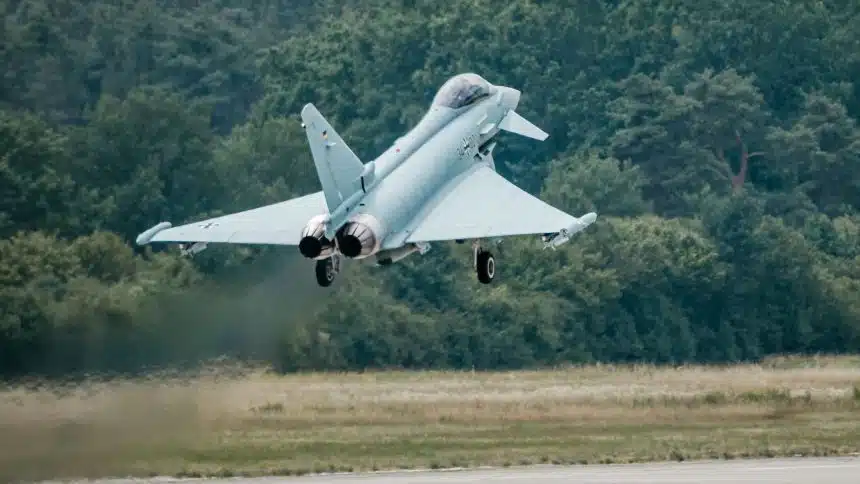
Airbus announced the maiden flight of the first Eurofighter acquired by the German Air Force under Project Quadriga, which will procure 38 Tranche 4 jets to replace the oldest aircraft in service.
The first Tranche 4 Eurofighter Typhoon for the German Air Force (Luftwaffe) made its maiden flight from Airbus’ facility in Manching, Germany, the company announced on Jul. 15, 2026. Airbus is now looking at the delivery of the jet, the first procured under the Quadriga program, later this year.
As part of Project Quadriga, the service announced in November 2020 that it would acquire 38 new Tranche 4 Eurofighters, meant to replace an equal number of the Luftwaffe’s older Tranche 1 jets. Airbus now described the first flight of the new Tranche of Eurofighters as “a huge step forward for European defense and sovereignty.”
Work is already ongoing also for the Tranche 5, set to be delivered between 2031 and 2034, and replace part of the Luftwaffe’s Tornado ECR (Electronic Combat and Reconnaissance) fleet. The rest of the fleet will be replaced by the dedicated Suppression of Enemy Air Defense (SEAD) Eurofighter EK (Elektronischer Kampf), with Airbus converting 15 of the Luftwaffe’s older Eurofighters to that standard.
The first Airbus Quadriga Eurofighter (Tranche4) for Team Luftwaffe has officially completed its maiden flight! 🛫
This isn’t just a milestone for the programme — taking this new build standard to the sky is a huge step forward for European defense and sovereignty. Featuring… pic.twitter.com/QWpc4szEfx
— Airbus Defence (@AirbusDefence) July 15, 2026
Luftwaffe Eurofighter Tranche 4 first flight
German defense news portal Hartpunkt, quoting Airbus officials, said the aircraft that participated in the Production Flight Acceptance Test (PFAT) bore registration 34+02 and was piloted by Airbus test pilot Stefan Auer. The flight lasted for little more than an hour, and Auer “pushed […] the fighter to its limits” evaluating its “basic flight characteristics, engine performance, flight control system, hydraulics, and electrical systems.”
Other systems that were tested include cockpit instrumentation, navigation and communication systems. Airbus’ Military Aircraft Center in Manching is currently manufacturing 58 Eurofighters, including Germany’s aforementioned 38 Tranche 4 and 20 Tranche 5 airframes, whose contract was signed in October 2025.
Of the 38 Quadriga fighters, 30 would be single-seaters while eight are twin-seater. Hartpunkt added that the deliveries of the 38 fighters will be completed by 2030.
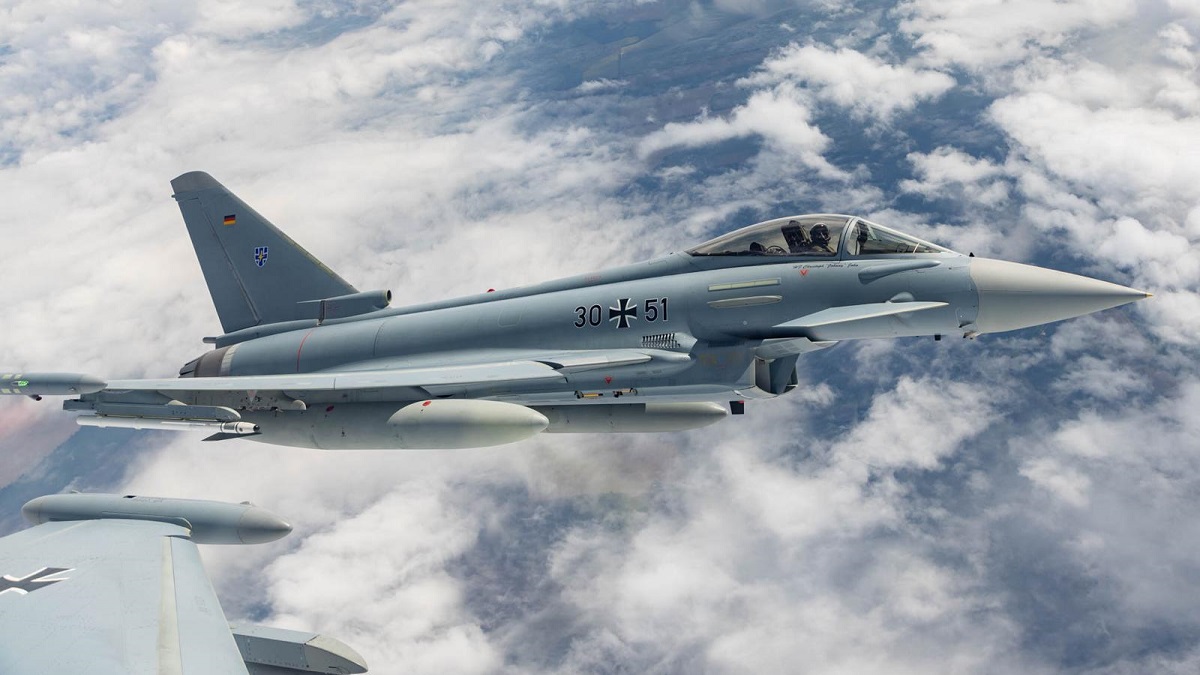
Airbus has long stressed upon the economic dimension of the project, pointing out that the German Quadriga and Spanish Halcon programs create 7,800 direct jobs in both countries, add Euro 6.5 billion to their GDPs and earn Euro 3.6 billion in tax revenue. The corresponding figures for the Tranche 5 and Halcon II programs stand at 19,500 jobs, Euro 15.3 billion and Euro 8.2 billion, respectively.
ECRS radar on Tranche 4 and Tranche 5 jets
The flight of the first Quadriga jet comes alongside the testing of the European Common Radar System (ECRS) Mk 1 Active Electronically Scanned Array (AESA) radar – also known as the E-Scan – on the Airbus A320 Advanced Technology Research Aircraft (ATRA) testbed. The radar is also being tested independently by Spain, with a Spanish Air and Space Force (SASF) Typhoon flying for the first time with the new radar in December 2024.
The ECRS has three variants: ECRS Mk.0, which currently equips Kuwaiti and Qatari Eurofighter Typhoons; ECRS Mk.1, meant for the Eurofighter under Germany’s Project Quadriga, Tranche 5 and the Spanish Halcon variants; and the ECRS Mk.2, featuring a electronic warfare and electronic attack capacity, being developed for the United Kingdom’s Royal Air Force.
When you and your bestie show up to the party in the same outfit 👀
We hope you didn’t fall for our little clickbait 😉 This is of course the hybrid of the @DLR_EN #A320 Advanced Technology Research Aircraft (ATRA) and a #Eurofighter. Following the first flight earlier this year,… pic.twitter.com/toNdN1GFjb
— Airbus Defence (@AirbusDefence) September 23, 2025
Indra and Hensoldt, which are working together on the Mk 1 variant, reported in June 2025 that they completed the production of the “advanced processor and antenna power supply and control (APSC) subsystems” of the first ECRS Mk1 radar units. Hensoldt had said that the first radar models will undergo extensive qualification and flight tests in the Mk1 Step 1 stage on the ATRA, with series production planned in the summer of 2025.
The ECRS Mk.1 features like electronic warfare capabilities, a multi-channel receiver, a wider field of scanning, improved target recognition, and an enhanced detection range.