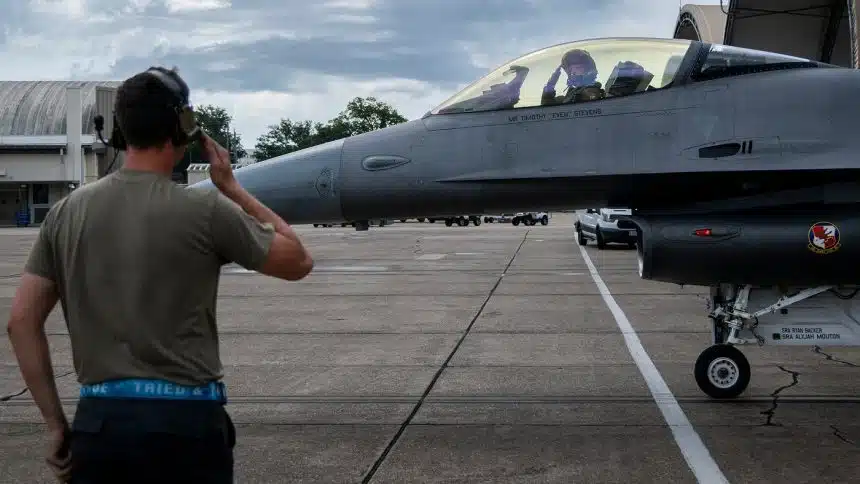
The DARPA and U.S. Air Force are conducting human-on-the-loop in-air testing of AI-capable F-16s modified with the VENOM Autonomy Kit as part of DARPA’s Artificial Intelligence Reinforcements program.
Two years after the beginning of the modifications, the first U.S. Air Force F-16 equipped with DARPA’s Viper Experimentation and Next-gen Operations Model (VENOM) Autonomy Kit (VAK) has flown. The modified jet will serve as an autonomous flying testbed with using an artificial intelligence (AI) agent to control flight.
The program is a joint effort between the U.S. Air Force and DARPA, initiated under the Air Combat Evolution (ACE) program and part of the Artificial Intelligence Reinforcements (AIR) program. The ACE program also previously involved the X-62 Variable In-flight Simulator Aircraft (VISTA), which proved an AI agent could autonomously pilot a fighter jet in a dogfight.
The future of flight is here.
Check out this VENOM-modified F-16. As part of the Artificial Intelligence Reinforcements (AIR) program, AI takes the controls to advance combat tech while a human pilot stays “on-the-loop.”
📸 U.S. Air Force | Samuel King Jr., 96th Test Wing pic.twitter.com/Y6CxJEBMNl
— DARPA (@DARPA) July 16, 2026
“These groundbreaking flight tests of VENOM-modified F-16s advance the infrastructure needed to develop trusted, autonomous air combat capabilities,” said Brig. Gen. James “Fangs” Valpiani, DARPA program manager. “The Air Force and DARPA team has automated flight controls and sensors on a standard F-16 without changing the jet’s core software. This enables an efficient pipeline for developing dominant AI for aerial combat, allowing us to rapidly innovate for the warfighter.”
The VAK utilizes a novel interface with the aircraft’s flight controls and mission systems, allowing a pilot to toggle between traditional human control and AI control with the flip of a switch, explained the press release. The goal is to ensure a safe, reliable environment for human-on-the-loop experimentation.
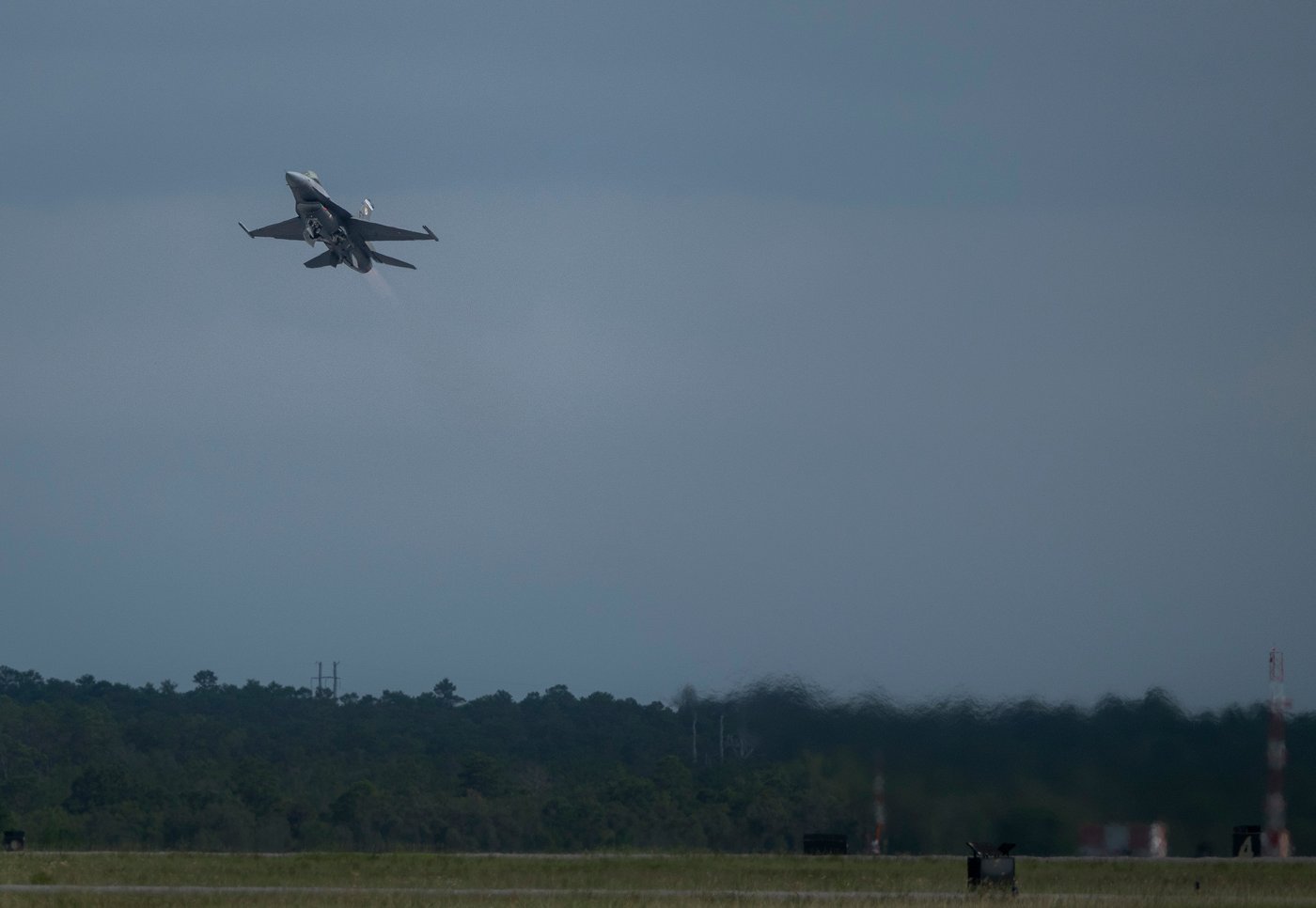
As part of the AIR program, the VENOM fleet will be used to test multiple AI agents in live-flight scenarios, paving the way for human pilots to seamlessly command and orchestrate teams of autonomous, uncrewed aircraft, continues the statement. The lessons learned will also be used for the including Collaborative Combat Aircraft (CCA) program.
“The emerging threat environment, especially as it relates to aerial combat, is growing increasingly complex,” added Valpiani. “AI has tremendous potential to help humans manage this complexity in beyond-visual-range combat, but many hard questions remain concerning the performance and trustworthiness of combat AI in the extreme fog and friction of modern warfare. The AIR program aims to apply cutting-edge combat agents to operationally relevant scenarios to address these questions and field war-deterring, war-winning capabilities to our warfighters.”
What is VENOM
VENOM-AFT, or Viper Experimentation and Next-gen Operations Model – Autonomy Flying Testbed, is a program designed and funded to accelerate testing of autonomy software on crewed and uncrewed aircraft, complementing the Autonomy Data and AI Experimentation proving ground at Eglin and informing the Collaborative Combat Aircraft program and other autonomy developers.
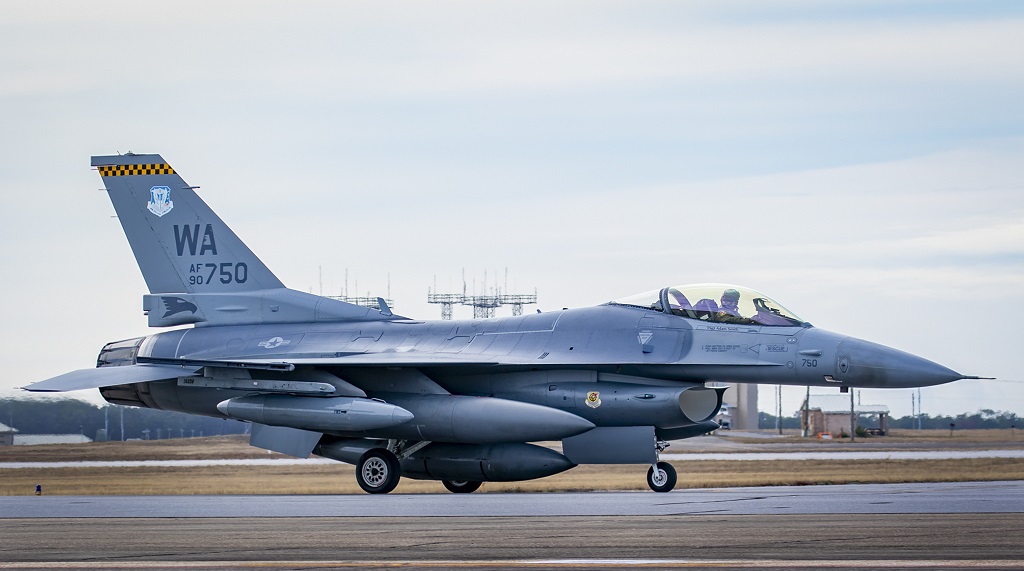
“The VENOM program marks a pivotal chapter in the advancement of aerial combat capabilities. This transformative program holds the potential to redefine air combat paradigms by fostering novel autonomous functions for current and future crewed and uncrewed platforms,” said in 2024 Maj. Ross Elder, VENOM developmental test lead. “We look forward to the culmination of years of engineering and collaboration, as VENOM leads a measured step towards a new age of aviation.”
A total of six F-16Cs will be modified into test platforms to rapidly evaluate autonomous capabilities and undergo developmental and operational testing via the 40th Flight Test Squadron and the 85th Test and Evaluation Squadron. The aircraft, however, will not be a crewless drone like the QF-16, as pilots will always be in the cockpit to monitor the autonomy and ensure flight and mission systems test objectives are met.
“It’s important to understand the ‘human-on-the-loop’ aspect of this type of testing, meaning that a pilot will be involved in the autonomy in real time and maintain the ability to start and stop specific algorithms,” said Lt. Col. Joe Gagnon, 85th TES commander when the first aircraft arrived at Eglin in 2024. “There will never be a time where the VENOM aircraft will solely ‘fly by itself’ without a human component.”
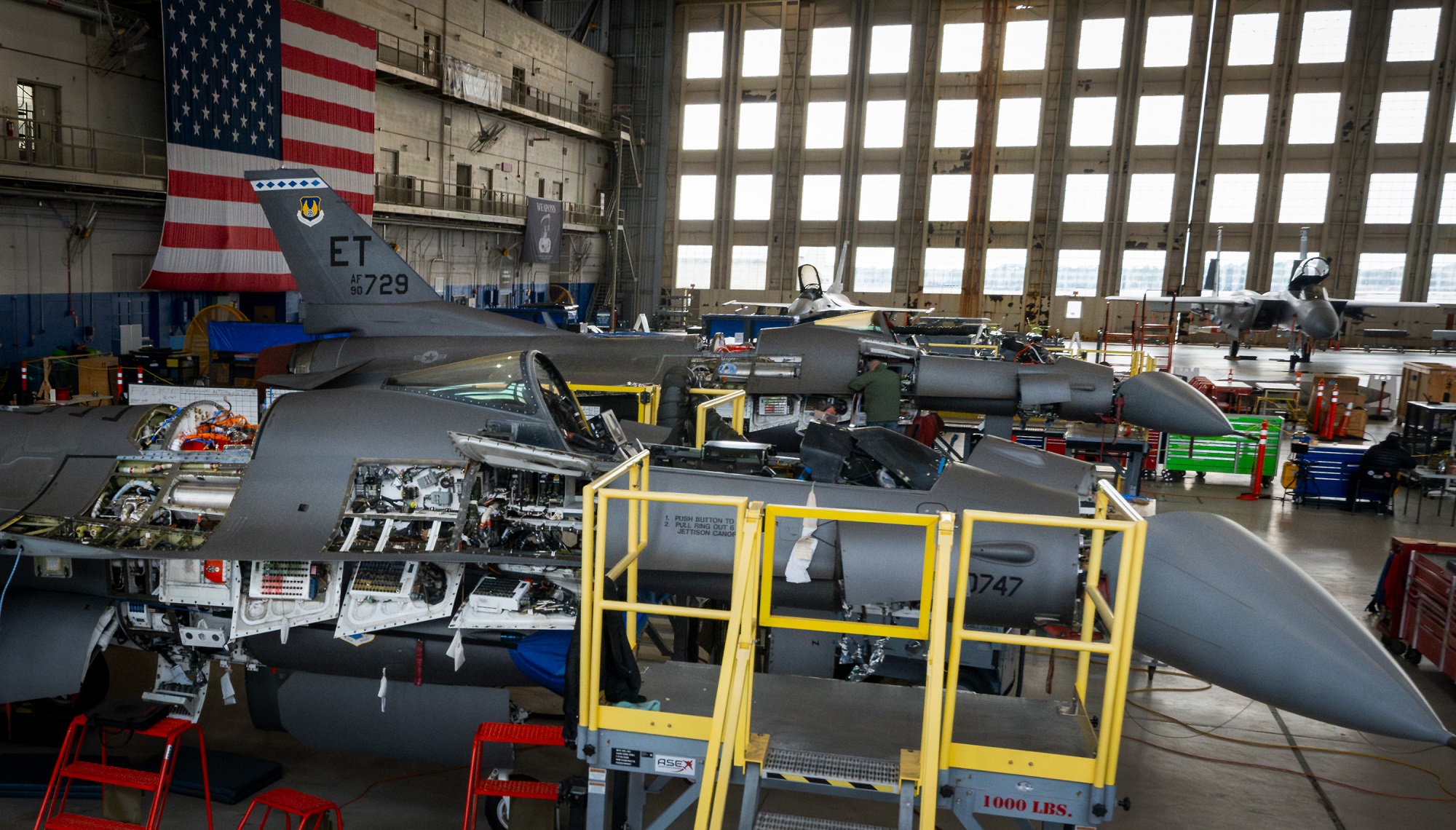
The first three Vipers arrived at Eglin in April 2024 to undergo software, hardware and instrumentation modifications that will eventually allow the autonomy agents to fly the aircraft. These were followed by the last aircraft in April 2025, for a total of six F-16s.
A physical change mentioned by the service is the inclusion of an auto-throttle, which would allow the autonomy to regulate the thrust, while the flight control surfaces would be handled by the Flight Control System’s computer. For the software, the goal is to ensure the VENOM autonomy connects to and communicates with the aircraft’s system, while the goal for the hardware is to ensure the autonomy can’t go past its limits or exceed its flight envelope, thus ensuring the safety.
In fact, during flight testing a test pilot will be on board to oversee the flight with the ability to start and stop the autonomy in real time. To expedite the program, similarly to most F-16 and F-15 testing at Eglin, officials previously said the VENOM program will undergo simultaneous developmental and operational testing.