Michigan ANG pilot Tom Froling was airborne on a routine training mission when America came under attack. Hours later, his squadron was loading live missiles and ammunition for combat air patrols over the United States. We spoke with him 25 years later about that day and what followed.
“It was surrealistic. In all my training and career, I could have never imagined something like this happening. In a matter of hours, what I was doing changed so dramatically.”
After an 08:50 hrs local takeoff from Selfridge Air National Guard Base in Harrison Township, Michigan, Air National Guard F-16C pilot Lt Col (Ret.) Tom Froling and his flight lead Maj Doug Champagne are flying north along low-level Military Training Route (MTR) VR1624 over the little town of Peck in Michigan’s thumb area. His F-16C tracks up toward Bad Axe, across Lake Huron and to the ground targets at Grayling Range, near Grayling Michigan. September 11, 2001 dawns bright and clear. The trees have not yet begun to change to autumn colors. Froling and Champagne will conduct a series of practice bombing and strafing runs on targets at the range, then return to Selfridge. A routine training mission.

Fifty minutes before, at 07:59 hrs local, American Airlines Flight 11, a Boeing 767-223ER, departs Logan International Airport in Boston Massachusetts bound for Los Angeles.
Then, thirty minutes before Lt Col Froling’s departure from Selfridge, at 0819 hrs, American Airlines Flight 11 flight attendant Betty Ann Ong uses a seatback AT&T air-phone to call the American Airlines reservation desk. Ong reaches customer service agent Winston Sadler at American Airlines’ Southeastern Reservations Office in Cary, North Carolina. Betty Ann Ong tells Sadler over the air-phone, “Um, the cockpit’s not answering. Somebody’s stabbed in business class, and, um, I think there is mace… that we can’t breathe. I don’t know, I think we are getting hijacked.” Moments later Ong tells Sadler, “The cockpit is not answering their phone”.
The 9/11 terror attacks have begun.
“We entered the range high and did a 30-degree dive bombing run,” Lt Col Tom Froling told The Aviationist about his training mission that day. “Coming in high and working our way down. The emphasis was on weapons release and hitting the parameters for altitude, dive angle, and air speed. Once we worked down to lower altitude we started strafing runs with the cannon.”
Recounting his flight from that day over the phone to us 25 years later, Froling continues in the disciplined monotone of an experienced fighter pilot:
“We did our range ride, it’s going good. We’re going home via Saginaw. Cleveland center gave us a Demon Watch call that requires us to report in to our Operations. Strangely, we were asked by our commander what the status of our ordnance is. We called in at 100 miles out. We fly on UHF communications for both military and nonmilitary, and we have a VHF frequency for interflight communications. Two radios going all the time.”
Froling’s voice over the phone with me slows. Trails off.
“We’re on Cleveland center frequency. Something starts to sound a little bizarre to me. ATC talks on both radios simultaneously. Airlines are on VHF.”
Only minutes later, Lt Col Froling, flying south over Michigan, has the first indication that something is different about today’s mission.
“We started hearing strange radio transmissions from Air Traffic Control,” Froling says. “We heard a divert call. Conditions that day were really beautiful.”
It isn’t completely abnormal for air traffic control to issue a divert call to an aircraft in good weather conditions, but in rare circumstances, it may suggest that something unusual is happening.
“It got really strange when we called into operations at 100-miles [from Selfridge ANGB] for our Demon Watch. Right away the commander came on the radio.” The commander of Froling’s 107th Fighter Squadron was Col Michael L. Peplinski.
“Did you fire the gun?” Col Peplinkski asked Froling over the radio in his F-16. Froling replied that he had. It was part of the mission as briefed.
“Did you fire it out?” Col Peplinski was asking Froling if his F-16 had any live ammunition left on board.
“I thought I missed something on the maintenance forms that said we weren’t supposed to shoot the gun out,” Froling told The Aviationist. But Froling had flown his range mission exactly as briefed.
Lt Col Froling’s F-16 was loaded with 20mm practice rounds for his training mission over the Grayling range that day. Although the practice rounds have no high-explosive incendiary warhead on them, the solid, inert metal cannon rounds match the ballistic trajectory of live combat ammunition. While not designed for this purpose, these solid metal 20mm practice rounds could do significant damage to a commercial airliner.
Across the eastern U.S., Air Force commanders were trying to understand what assets they had to respond to a developing and unprecedented threat: civilian airliners hijacked to be used as guided missiles against civilian and military targets.
As Lt Col Froling continued on his return flight, United Airlines flight attendant Betty Ann Ong in the hijacked flight 11 Boeing 767 along with 86 passengers and crew had already been killed when their aircraft slammed into the North Tower of the World Trade Center. The 5 hijackers died in the suicide attack. An unknown number of people above the 93rd floor of the North Tower were also dead, and more were trapped above the explosion and fires. It was just after 08:46 hrs that morning. The 9/11 terror attacks were only starting.
Lt Col Froling approached the landing pattern over Selfridge ANGB in his F-16. Beneath him, Lake St. Clair shined brightly under the morning sun. Froling recalls that over his radio, “I could hear them diverting to Toronto, Milwaukee, Cleveland. ATC Cleveland center may have said ‘bomb threat’ or some equivalent warning. Standard code for something bad that is happening. I could not put it all together. I was more focused on if we had made a mistake.”
Froling asked Operations earlier if he could do some SFO or “Simulated Flame Out” approaches, a technique single engine tactical pilots practice routinely in case their engine loses power. His commander told him, “Negative” and directed him to make it a “full stop”, after landing. Selfridge tower instructed him to switch to ground frequency once he landed.
Usually aircraft landing to the south at Selfridge ANGB on runway 19 make a right turn off the runway to the de-arm area to make the aircraft’s gun safe. But Champagne and Froling were directed to turn left with hot guns into an area where they were marshalled to parking spots they don’t normally use. This was unusual.

About 240 miles above and hundreds of miles west of Lt Col Froling, who had now landed in his F-16, and Col Peplinski also on the ground at Selfridge ANGB, NASA astronaut Frank Culbertson was in orbit above the earth on the International Space Station. He had just come over the horizon and would have a good view of Manhattan from orbit in moments.
Lt Col Froling rolled to the end of runway 19 at Selfridge where he turns off and shuts down. His crew chief places a ladder on his F-16 and climbs up. Then his crew chief tells him, “You’re not going to believe this, the Pentagon and the World Trade Center have just been hit.”
NASA Astronaut Frank Culbertson, onboard the International Space Station over the United States, looks down on New York City as the ISS orbits west to east toward the U.S. east coast. He sees a massive black tendril of smoke trailing from Manhattan. The smoke is streaming with the prevailing winds out over the Atlantic. As Culbertson watches from space, he, “…saw this great big gray blob basically enveloping the southern part of Manhattan”. Culbertson is watching the second tower of the World Trade Center collapse from earth orbit. It is 10:28 hrs.
“I was kind of in shock,” Froling told The Aviationist. When he reached squadron operations, pilots and other Wing members were watching the aftermath of the attacks on television. “Go home and come back in eight hours,” they told Froling. “We’ll probably be put on alert status”.
Froling later learned that he had been asked about the ammunition remaining in his aircraft’s gun because NORAD had contacted his wing commander for a possible intercept of United Airlines flight 93. This was the final hijacked aircraft during the 9/11 attack. Flight 93 crashed during an attempt by passengers to retake the cockpit from hijackers. When The Aviationist asked Froling if his unit had ever trained for a scenario where hijacked airliners would be used as flying bombs, he told us, “No. Never. Nothing like this. We trained to intercept MiGs over Iraq.”
When Froling returned to his squadron operations room eight hours later, “Our aircraft were getting armed with live AMRAAMS, AIM-9s and 505 rounds of high explosive incendiary 20mm depleted uranium ammunition. You would fly that over Iraq, but to have that over the continental United States was bizarre.”

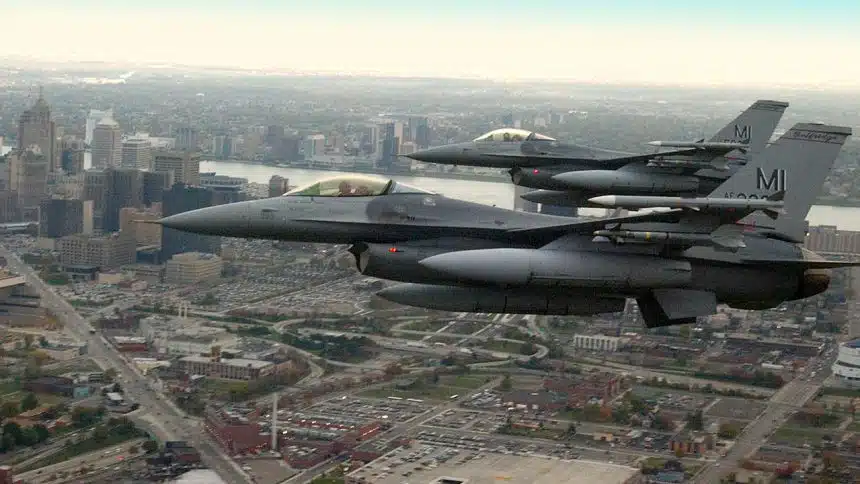
Photos from the alert show Selfridge F-16s on the tarmac carrying four live radar guided AIM-120 AMRAAMS, two heat seeking AIM-9 Sidewinders and three external fuel tanks, a heavy load for an extended, operational combat air patrol. Maintenance crews put up tents to sleep out on the tarmac near the parked aircraft. After all civilian air traffic was grounded on 9/11, the 127th Wing flew operational patrols over the U.S. to secure the airspace.
The next morning on September 12, 2001, an E-3 Sentry AWACS aircraft was aloft over the eastern U.S. The aircraft used its powerful radar to scan the empty skies for airspace violations.
“Somebody woke me up about 4:00 AM. They told me you need to do CAP (combat air patrol) over the Midwest. We got ready really quick. Briefed. Went through the ROE (rules of engagement). The maintenance guys were still sleeping out by the airplanes. We took off at 6:00 AM. Very bizarre.”
Once Froling was airborne over southeastern Michigan, the scene was haunting. “Nobody else was flying. No other aircraft flying. We were cleared to all air space, any heading, all altitudes. It was like the craziest thing.”
The flight of F-16s, “Flew a loose formation at 350 knots. We flew over DTW (Detroit’s Wayne County Metro Airport), It was probably 8,000 feet. You could see all these airliners parked on the ground. It was like a giant puzzle. They diverted so many aircraft. This is the most insane thing.”
“All of a sudden AWACS checks in and says, ‘We got a bogey at three zero-zero, 82 miles. You’re clear to intercept.’ We went to [after]burners now. Went supersonic. What’s the bogey dope? We can’t get ahold of this bogey. No squawk. No talking. Only 30 miles out, they ID’d the bogey as a military helicopter from Grand Ledge. We were minutes away with live missiles. He was on an unannounced VIP flight. But for the rest of that patrol, other than AWACS, we were the only planes in the sky that day.”
Back on the ground the local community was rallying around the service members at Selfridge ANGB. “People are bringing in food for us. All these restaurants. There’s a stream of cars trying to get in, retired guys coming back. People trying to deliver food. People are showing up to do whatever, especially the old maintenance guys. We got this crazy smorgasbord of food. We’ve got more food than we need to eat.”
In the hours that followed the Pentagon, World Trade Center attacks and the crash of flight 93 in Pennsylvania, Frohling and the 127th Wing continued to secure the airspace over the U.S.
“Somebody woke me up at 3AM. They said, ‘You need to take off as soon as possible. The F-15s on the East coast are weathered in. You need to do CAP (Combat Air Patrol) over New York City.’ Somebody had already built all the information for me. They said, ‘AWACS is going to tell you where to CAP, where to refuel.’ It was raining that morning. We took off in the pouring rain. Got on top of the weather. We were clear to all altitudes and all airspeeds. We had local bases, divert bases, etc. flight plan, data loaded in the aircraft data cartridge (CAN). We flew to NY pretty quick. Climbed up to 30,000ft. direct to NY. Then we descended down to get below the weather at 12,000ft. It was still dark out. I looked down, and the whole ground zero was lit up with stadium lights as they went through the rubble looking for survivors. I’ll never forget that.”
While it was very quiet, Froling’s patrol still carried the latent tension of an unprecedented historical event.
“It was just the two of us, AWACS and the tanker. We were going to be there about 4-6 hours. It was a NATO AWACS. They had a bit of an accent over the radio. There was AWACS 24/7 over Washington DC and NYC.”
After his flight from Selfridge to patrol over New York City, Froling’s flight needed to refuel. “The tanker was 50 miles off the coast on their designated refueling track. Now we’re starting to get in some nasty weather. Lightning. We’re flying fingertip formation (close). I said to AWACS, ‘We can’t refuel like this. You guys need to move that tanker.’ They moved the tanker.”
“In the following days as ROE and procedures were refined we had a bunch of discussions about how to intercept the airliners. Those are some pretty heavy conversations. Let’s say they scramble you and its 0-0. If they give you the order to scramble, you’re going even if it’s a quarter mile visibility and zero ceiling. I could be rolling down the runway, couldn’t even see 100-ft. It was bizarre. What it all comes down to, we’re soldiers. We’re trained to take orders. We’ve been trained to take orders. It is not up to you to debate this. We fly airplanes but we’re soldiers. We’re supposed to take orders and execute those orders.”
There is a pause over the phone as Tom Froling reflects on the days following 9/11, now a quarter century distant but still as vivid to him as yesterday.
“They always taught us that flexibility is the key to airpower. Plans change. The thing about war is, everybody has a plan until they get punched in the face.”

The Aviationist asked Tom Froling if he thought the United States was safer from a 9/11 style terror attack today. He told us, “Yeah, from that kind of attack. I think they knew they had one shot at this.” But when I asked him what other vulnerabilities may exist, his answer was chilling.
“If they launched a thousand drones, our weapons aren’t prepared for that. There’s electronic warfare. EMP (electromagnetic pulse). No electricity. Vulnerabilities to our infrastructure. That’s the new threat.”
Only the December 7, 1941 Japanese attack on Pearl Harbor approaches the 9/11 terror attacks in loss of American lives from a foreign attack on the U.S. homeland. But unlike Pearl Harbor, where most of those killed were U.S. military, the 9/11 attacks killed almost entirely civilians. And more people died in the 9/11 attacks than in the WWII Japanese attack on Pearl Harbor.
“9/11”, as it has become known in modern language, was the pinnacle of the military concept called “asymmetric warfare”. Asymmetric warfare takes place between adversaries with vastly different mass and resources. One side has stealth bombers, the other side has box cutters. Asymmetric warfare exploits vulnerabilities. Where those vulnerabilities exist in national security today is the constantly elusive answer to the question of securing a nation. F-16 pilot Tom Froling’s historic insights into the 9/11 terror attacks a quarter century ago provide a vivid reminder of this constantly evolving and always present threat.
Author’s note: Thank you to Michigan Air National Guard Lt Col (Ret.) Tom Froling for the detailed recollections and research of his unit’s response to the 9/11 terror attacks. The account of NASA Astronaut Frank Culbertson on the International Space Station is from the 25th Anniversary edition of the book, The Only Plane in the Sky: An Oral History of 9/11 by Garrett M. Graff (Avid Reader Press, hardcover edition, 2026). In his book, Graff provides a meticulous and precious historical record of the chaotic events on 9/11/2001 and the days that followed. Graff’s book and careful research of the 9/11 attacks and the American experience following them are a vital piece of global history.