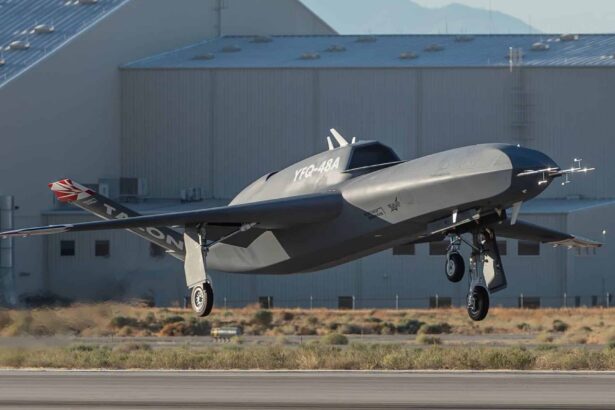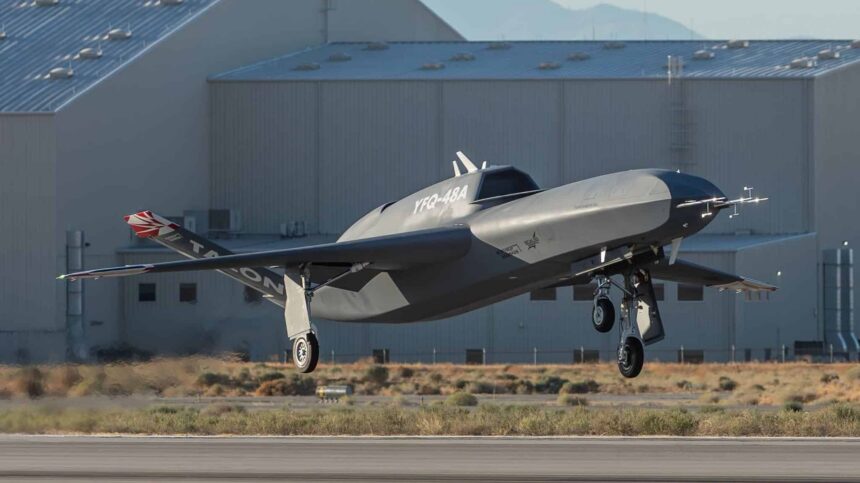
The Royal Navy plans to demonstrate Northrop Grumman’s YFQ-48A Talon Blue CCA from a Queen Elizabeth-class aircraft carrier in 2027, as part of efforts to develop a future Hybrid Air Wing combining crewed and uncrewed aircraft.
The Royal Navy is planning to launch Northrop Grumman’s YFQ-48A Talon Blue Collaborative Combat Aircraft (CCA) from one of its aircraft carriers in 2027, says First Sea Lord General Sir Gwyn Jenkins. According to Navy Lookout, which first reported the development on Nov. 10, 2026, Jenkins disclosed the plan in his address during the International Sea Power Conference (ISPC), held aboard HMS Prince of Wales in Oslo, Norway.
Jenkins announced that he intends to sign a Statement of Intent with Northrop Grumman on Nov. 12, establishing cooperation to prepare the aircraft for trials under Project VANQUISH. The demonstration is expected to take place in UK waters, and will mark an important step towards the development of the Royal Navy’s future Hybrid Air Wing.
Latest news commentary
Royal Navy plans to launch Talon jet drone from carrier in 2027
https://t.co/6Mikfv9wVc https://t.co/ClWd1TraJ7
— Navy Lookout (@NavyLookout) November 10, 2026
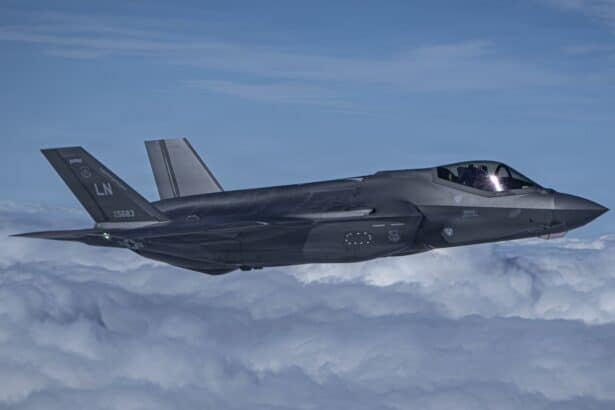
The initiative aims to provide the Royal Navy with practical evidence of how jet-powered uncrewed combat aircraft could operate alongside the F-35B Lightning II and the service’s existing helicopter fleet as part of the broader Maritime Aviation Transformation (MATX) program. In the past, the service conducted trials which saw a GA-ASI Mojave take off and land aboard the HMS Prince of Wales.
That aircraft, however, was powered by a turboprop engine and remotely powered, compared to the jet-powered and autonomous Talon Blue. According to Jenkins, the trials will help the service understand how autonomous combat aircraft can operate safely and effectively alongside the existing carrier air wing.

The test will not immediately lead to the acquisition of the YFQ-48 by the UK. In fact, the goal of the test is to inform future requirements for the progressive integration of crewed and uncrewed platforms into the Fleet Air Arm.
The YFQ-48A Talon Blue
Northrop Grumman first unveiled its new unmanned platform on Dec. 3, 2025, at the Mojave Air and Space Port, after developing it largely in secrecy. On Dec. 22, the U.S. Air Force has announced that it has assigned the Mission Design Series (MDS) YFQ-48A to the aircraft, which was initially known only as Project Talon.
.@GenGJenkinsRM speaking at ISPC 2026 with one-third scale mock up of Talon CCA
https://t.co/1YJresx2mS https://t.co/FyDY7WuHV2
— Navy Lookout (@NavyLookout) November 10, 2026
The aircraft flew for the first time in October 2026 flew the Mojave Air and Space Port, home Northrop Grumman’s subsidiary Scaled Composites, which developed and built the aircraft. The company said the flight was fully autonomous, including taxi, takeoff, in-flight maneuvers, and landing.
Northrop Grumman initially defined the YFQ-48A as a new autonomous aircraft demonstrator built to validate faster and more affordable manufacturing methods for large uncrewed platforms. The company also described the program as a response to lessons learned from its unsuccessful bid for the U.S. Air Force’s Collaborative Combat Aircraft (CCA) Increment 1.
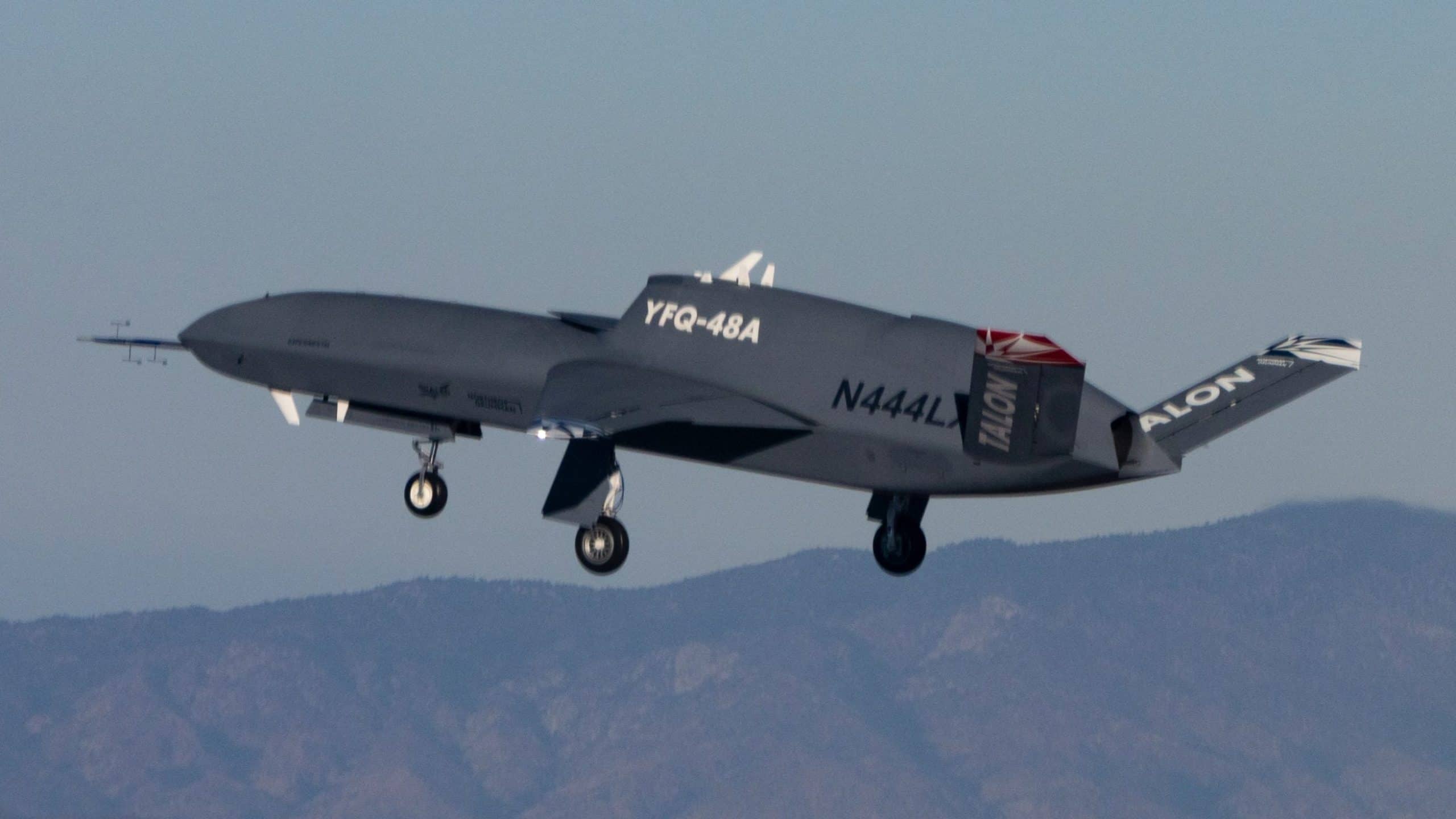
Talon aimed to find the right balance between capability and cost, with Tom Jones, president of Northrop’s aeronautics systems division, saying the result was a design that is both cheaper and more capable. The aircraft features a shovel-shaped nose, long slender fuselage, low aspect ratio lambda wing planform, top mounted engine air inlet and exhaust, and canted twin tails.
The design appears optimized for high performance and agility, with low-observable characteristics also visible. Talon uses a single turbofan engine, the commercial Pratt & Whitney PW500, that was subjected to an extensive test program to expand its limits for operational conditions unique to CCA missions.
The engine is supplied air by a trapezoidal dorsal inlet mounted above the aft fuselage, while the exhaust is positioned between the canted tail surfaces. The nose section features test instrumentation typical of early flight-test articles, including three air data probes extending forward of the radome.
Project VANQUISH
The Talon demonstration falls under Project VANQUISH, an initiative launched by the Royal Navy in 2025 to accelerate the development of a fixed-wing, jet-powered Autonomous Collaborative Platform (ACP) capable of operating from its aircraft carriers. The original Ministry of Defence Request for Information (RFI) sought proposals for a high-subsonic, short take-off and landing aircraft with credible endurance and payload capacity.

The platform was expected to embark and operate autonomously from a Queen Elizabeth-class carrier without requiring catapults or conventional arresting gear. The RFI also identified several potential mission areas, including intelligence, surveillance and reconnaissance (ISR), strike and air-to-air refueling.
One of the most challenging aspects of the program will be the Talon’s recovery aboard the carrier. The Queen Elizabeth-class ships employ a ski-jump-assisted short take-off and vertical landing (STOVL) configuration, without catapults or arresting wires.
At this time, it is unclear whether the 2027 demonstration will include an actual recovery aboard the carrier or focus primarily on launching the aircraft from the flight deck. Additionally, since the YFQ-48’s doesn’t feature a rugged landing gear designed for demanding austere environments like Mojave, it is unclear if landing gear may also require modifications to withstand the stresses associated with carrier operations.