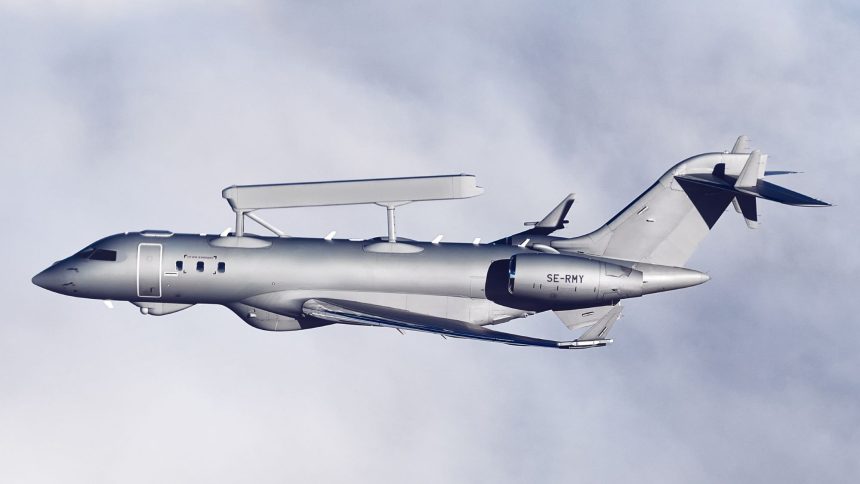
The Swedish and Dutch defense ministers signed a Letter of Intent for the GlobalEye AEW&C aircraft, with a formal contract yet to be signed.
The Netherlands will acquire a Saab GlobalEye Airborne Early Warning and Control (AEW&C) aircraft, giving the country its first national airborne surveillance and command capability. To that effect, the country signed a Letter of Intent (LoI) with Sweden on Sep. 10, 2026.
According to the Dutch Ministry of Defense (MoD), the Royal Netherlands Air Force’s (RNLAF) will be part of a joint pool with three Swedish Air Force (SwAF – Flygvapnet) GlobalEyes. This allows both SwAF and RNLAF to jointly operate the aircraft through common logistics, maintenance, and possibly mixed crew missions, should a model similar to the NATO Airborne Early Warning and Control Force be adopted.
Access for Dutch personnel is expected to begin by 2028, with the aircraft expected to be delivered by 2031. Saab, while noting that a formal contract has yet to be signed, said it “stands prepared and awaits the next steps of the procurement process.”
Swedish defense minister Pål Jonson and Dutch Deputy Prime Minister and Minister of Defense Dilan Yeşilgöz-Zegerius signed the LoI, with Jonson saying “it strengthens the defense of both our countries and Europe.”
“GlobalEye provides an advanced situational picture and the capability to detect and track, among other things, drones, robots, and other threats in the air, at sea, and on land,” Jonson added. “The Netherlands now gains its own airborne surveillance and command capability, closely integrated with Sweden and NATO.”
Nederländerna köper GlobalEye. Undertecknade tillsammans med Nederländernas vice premiärminister och försvarsminister Dilan Yeşilgöz-Zegerius en avsiktsförklaring om ett långsiktigt samarbete kring systemet. Det stärker både våra länders och Europas försvar. (1/3) pic.twitter.com/WDxPW1u7lT
— Pål Jonson (@PlJonson) September 10, 2026
The President and CEO of Saab, Micael Johansson, said in the company’s release:
“We welcome today’s announcement by the Netherlands of its intention to procure GlobalEye. The system will provide enhanced situational awareness and early warning capabilities across multiple domains, while also strengthening NATO’s ability to operate in an increasingly complex security environment. GlobalEye will enable the Netherlands to detect threats earlier, respond faster, and strengthen both national and collective defence. We stand ready to support this capability with Swedish innovation and expertise.”
GlobalEye’s growing popularity
The Dutch selection of the GlobalEye reflects the broader popularity of the aircraft among North Atlantic Treaty Organization (NATO) member states, who have also chosen the aircraft both for national and multinational requirements. In July, NATO announced the joint procurement of up to ten GlobalEye aircraft.
Notably, at the time, NATO identified the Netherlands among the allies participating in the procurement program, with the others being Belgium, Canada, Denmark, Germany, Latvia, Lithuania, Luxembourg, Norway, Romania, and Sweden. The new platform will not replace NATO’s ageing E-3 Airborne Warning and Control System (AWACS) fleet, which currently counts 14 aircraft, on a one-to-one basis.
Detect early.
Identify with precision.
Act with confidence.
GlobalEye. pic.twitter.com/mU3dxMmTE8
— Saab (@Saab) September 9, 2026
Previously, in May, Canada announced it would begin negotiations with Saab for the acquisition of the GlobalEye, beating the proposals of U.S. companies Boeing and L3Harris. France first selected the GlobalEye in June 2025, signing on for two systems with an option for two more.
Joint security of NATO and Europe
The Dutch MoD stressed upon the absence of an organic AEW&C capability in the country’s armed forces and the reliance on NATO’s old and overburdened E-3 AWACS fleet:
“The Netherlands currently does not possess its own aircraft capable of performing these tasks. To this end, it relies on, among other things, the outdated NATO AWACS aircraft. Together with 10 other NATO allies, the Netherlands is investing in replacing the NATO fleet with the GlobalEye. This will enable it to determine more independently where and when the aircraft is deployed.”
The common training pipeline for the shared system also offers operational and logistical benefits. “[The joint pool] will allow Dutch crews to gain experience with the aircraft and the associated procedures sooner. The Netherlands will also be able to deploy the aircraft by then.”
The release also added: “Both countries are also working together on the further development of the system. In doing so, the Netherlands and Sweden, as NATO allies, strengthen their mutual ties and European defense cooperation. They are also jointly assuming greater responsibility for the collective security of the European continent.”
Nederland heeft met Zweden 🇸🇪 een intentieverklaring ondertekend voor de aanschaf van een Saab GlobalEye. Dit is een geavanceerd militair verkenningsvliegtuig.
Lees meer 👇 https://t.co/KrsH1yKNMr
— Koninklijke Luchtmacht (@Kon_Luchtmacht) September 10, 2026
The Swedish MoD, in its statement, said: “Together with NATO, the Netherlands and Sweden will contribute to a complete surveillance capability for Europe and other parts of the alliance. Through their own advanced capabilities in surveillance and command in all domains – land, sea and air – the countries take on greater responsibility for NATO’s collective defense.”
It added that the common system also opens up the possibility where the “GlobalEye plan can be jointly utilized and the capability can be better utilized where and when the need arises.”
Saab GlobalEye
The GlobalEye platform is essentially a multi-domain ISR AEW&C platform, based on the Bombardier Global 6000/6500 business jet. Its primary sensor is the Erieye ER radar, an improved variant of the radar carried on the Saab 340 AEW, Saab 2000 AEW, and Embraer E-99 aerial platforms.
The original Erieye is based around the PS-890 AESA (Active Electronically Scanned Array) radar, mounted on a distinctive ‘plank’ above the carrier aircraft’s fuselage. The ER variant introduced an extended detection range and GaN technology.
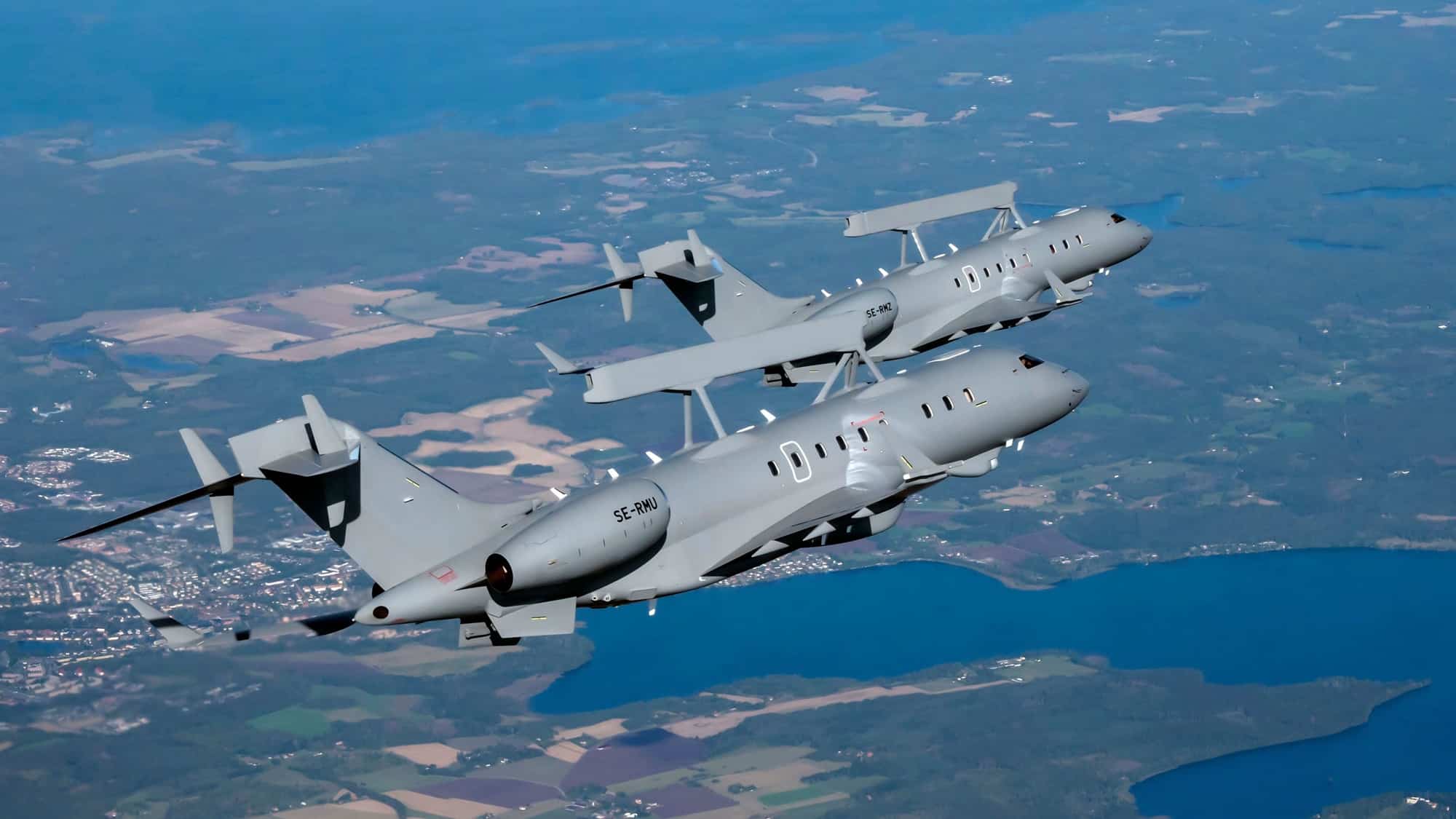
According to Jane’s, the radar enables a detection range of up to 450 km for fighter-sized aircraft, depending on altitude and the radar cross section. It also has a GMTI (Ground Moving Target Indication) capability.
The upgraded Erieye ER system offers maritime surveillance with a Leonardo SeaSpray 7500E radar, assisted by a FLIR Systems Star Safire 380-HD EO/IR turret.