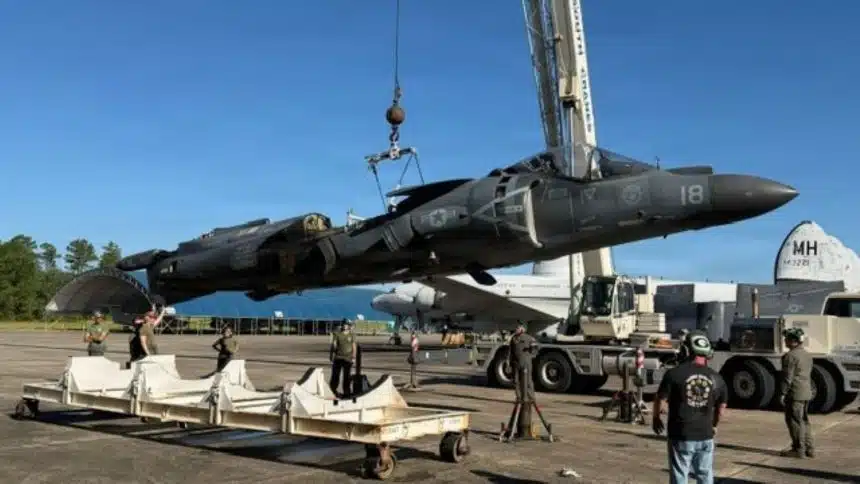
A Harrier from the VMA-223 “Bulldogs,” the last built for the USMC, was demilitarized and transported to the National Naval Aviation Museum in Pensacola.
Another event marked the bittersweet retirement of the AV-8B Harrier II Vertical/Short Take-Off Landing (V/STOL) jet that took place in June 2026. The last Harrier built for the U.S. Marine Corps, BuNo 166288, which was assigned to Marine Attack Squadron 223 (VMA-223) “Bulldogs,” travelled to Naval Air Station (NAS) Pensacola, Florida, where it was retired as a static display at the National Naval Aviation Museum.
The aircraft was demilitarized, with all critical equipment removed and its wings detached for the journey to Pensacola by truck, before being reassembled for display. The process was overseen by Pablo “Louie” Sanchez, the AV-8B V/STOL Attack Program Office (PMA-257) Assistant Program Manager for Logistics (APML) and Harrier Museum Task Force Lead.
The Specialized and Proven Aircraft (PMA-226) office released images of this process which were taken on Jul. 22, 2026. However, they were released only on Sep. 9 on the DVIDS network.
On Jun. 3, the Harrier retired from U.S. Marine Corps service when VMA-223, the last squadron to fly the ‘jump jet,’ conducted its final flight in a sundown ceremony at Marine Corps Air Station (MCAS) Cherry Point, North Carolina. The Corps operated Harriers for nearly 55 years, beginning in 1971 with the British-built AV-8A and later the McDonnell Douglas AV-8B Harrier II in 1985.

In the following four decades, the Harrier II became a versatile component of the Marine Expeditionary Unit’s Aviation Combat Element, operating afloat from amphibious assault ships and ashore from austere forward bases, and providing vital close air support for Marines on the ground worldwide, the press release said. The former Harrier squadrons are now transitioning to the F-35B Lightning II, the STOVL variant of the stealth fighter, while ex-F/A-18C/D Hornet units are adopting the F-35C carrier-based variant.
Demilitarization of BuNo 166288
According to the release by PMA-226, Boeing delivered BuNo 166288, Modex WP-18, in September 2003, and flew over 5,800 hours in multiple missions aboard L-class amphibious assault ships of the U.S. Navy. Images showed the demilitarization underway at MCAS Cherry Point, with the aircraft mounted on hydraulic jigs, its main wings being lifted by a crane, and the entire jet itself being lifted to be placed on a flatbed truck.
This process made the aircraft safe for static display prior to its departure by truck to Pensacola. No visuals of the aircraft inside the museum after being reassembled are yet available.
Once at the museum, the jet’s previously removed F402-RR-408 engine will be displayed on a separate stand. The axial-flow, twin-spool turbofan engine features counter-rotating compressors and was engineered to vector thrust, enabling V/STOL capabilities and in-flight power nozzle breaking, explains the service.
“The arrival of the final produced AV-8B Harrier II+ at the National Naval Aviation Museum marks the end of an extraordinary chapter in Marine Corps aviation,” said Bonnie Town of the National Naval Aviation Museum. “The National Naval Aviation Museum is deeply honored to preserve this historic aircraft as a lasting tribute to the extraordinary chapter of Marine Corps aviation history it represents.”
The release also quoted VMA-223’s commanding officer, Lt. Col. John Cumbie, who described the Pensacola museum display as a tribute to the Harrier community. The USMC’s aviators, maintainers and support Marines gave their “tireless dedication” and “the highest professional standards” to keep the Harrier flying, Cumbie said.
Staff Sgt. Christian Regueira and Gunnery Sgt. Bradley Birchfield, who reassembled BuNo 166288 at Pensacola, viewed it as a bittersweet personal moment in their Harrier careers before they transition to modern jets.
Harriers’ service and VMA-223
VMA-223 deactivated on Jun. 3, 2026. The unit was based at MCAS Cherry Point together with VMA-231, and part of the 2nd Marine Aircraft Wing (2nd MAW), and together they collectively counted for a fleet of 39 AV-8Bs.
VMA-223’s Harriers were deployed until shortly before they retired, assigned to the Iwo Jima Amphibious Ready Group (ARG) within the 22nd Marine Expeditionary Unit (MEU) during Operation Southern Spear. The deployment targeted maritime narcotics trafficking in the region.

The Harrier, despite its troubled history, had advantages that went much beyond its ability to hover. The ability to operate from short runways reduced its vulnerability to an adversary targeting conventional air bases in the opening stages of a conflict, also allowing it to be based closer to the frontline, reducing response time to urgent strike and Close Air Support (CAS) missions.
Harriers assigned to MEUs and flying from amphibious assault ships reduced the dependence on conventional airfields and large aircraft carriers. After 9/11, Marine Harriers were a leading ground-strike and CAS platform in Iraq and Afghanistan.
Subsequent upgrades, like the AN/APG-65 radar and night attack capabilities integrated in the AV-8B+ standard, offered a significantly improved air-to-air and air-to-ground capability. This also included the ability to employ beyond visual range air-to-air missiles.
#MarineCorps AV-8B Harrier II aircraft with Marine Aircraft Group 14, 2nd Marine Aircraft Wing fly near the coast of North Carolina.
The “sundown” of the AV-8B Harrier II, an iconic aircraft that has supported joint and Marine Corps operations for over 40 years, also represents… pic.twitter.com/cb9Im8QwdO
— U.S. Marines (@USMC) May 24, 2026
The AVPLAN, released before the Harrier sundown, said this about the V/STOL fighter:
“The AV-8B Harrier is a Vertical/Short Takeoff and Landing (V/STOL) aircraft designed to support the MAGTF commander by destroying surface targets and escorting friendly aircraft.
The AV-8B’s lethality and V/STOL capability, combined with the Amphibious Ready Group’s (ARG) proximity to coastal targets, rapid turnaround time, and hot weapons reloading, make it uniquely suited for deployment on MEUs.
The AV-8B is equipped with precision-guided standoff weapons, an advanced LITENING targeting pod, LINK-16 capabilities, and beyond-visual-range air-to-air missiles, providing the Marine Corps with relevant, survivable, and fight tonight capability.”