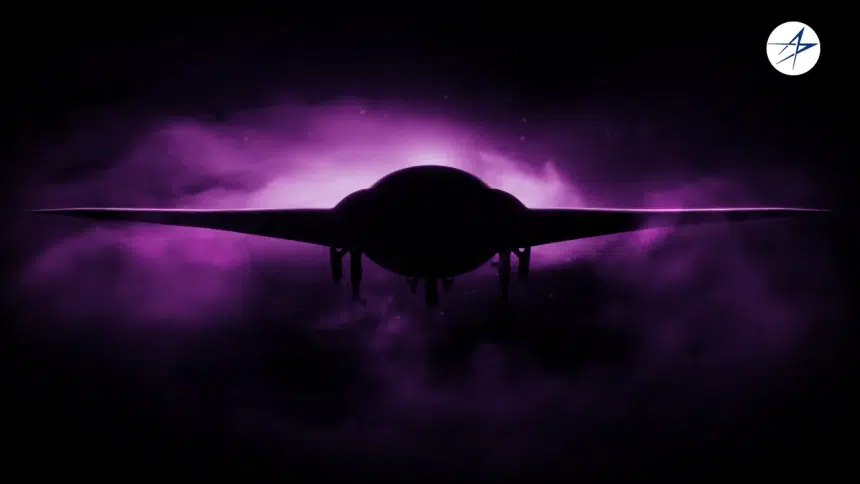
A shadowy aircraft in Lockheed Martin’s latest teaser appears consistent with published Vectis designs, hinting at a possible update on the Skunk Works Collaborative Combat Aircraft.
Lockheed Martin is teasing a new announcement concerning Vectis, its Group 5 Collaborative Combat Aircraft (CCA) being developed by the Skunk Works division. The announcement comes as the company continues work on the prototype, which is targeting its first flight in 2027.
The company has posted on its social media channels a short video of a silhouette of what most certainly is Vectis, accompanied by the caption “Next level unlocked. More to come.” Lockheed Martin has not yet disclosed what the forthcoming announcement will cover, nor it has explicitly mentioned Vectis.
Next level unlocked. 🦨🔓
More to come… pic.twitter.com/BAR8XEmtDb
— Lockheed Martin (@LockheedMartin) September 12, 2026
Notably, other than the public images already shared by the company, the silhouette visible in the short video appears to match the one on Vectis keychains with were gifted at Farnborough International Airshow 2026. The keychain is currently the only official representation of the aircraft seen from the front, the same angle shown in the teaser video.
The timing is particularly interesting because Vectis has progressed considerably since it was first publicly revealed in September 2025. What initially appeared as a new aircraft concept is now an internally funded program with a prototype under development and possibly already being manufactured.
Visualizza questo post su Instagram
Internally funded project
Lockheed Martin unveiled Vectis on Sept. 21, 2025, describing it as a Group 5 survivable and lethal Collaborative Combat Aircraft. The company’s Skunk Works division, which is in charge of the project, described it as a clean-sheet, internally funded effort.
At the time of the announcement, Lockheed Martin said that development was already underway, with parts ordered and a dedicated team working on the aircraft. The company set an aggressive objective for the program, with a first flight within two years, thus by 2027.
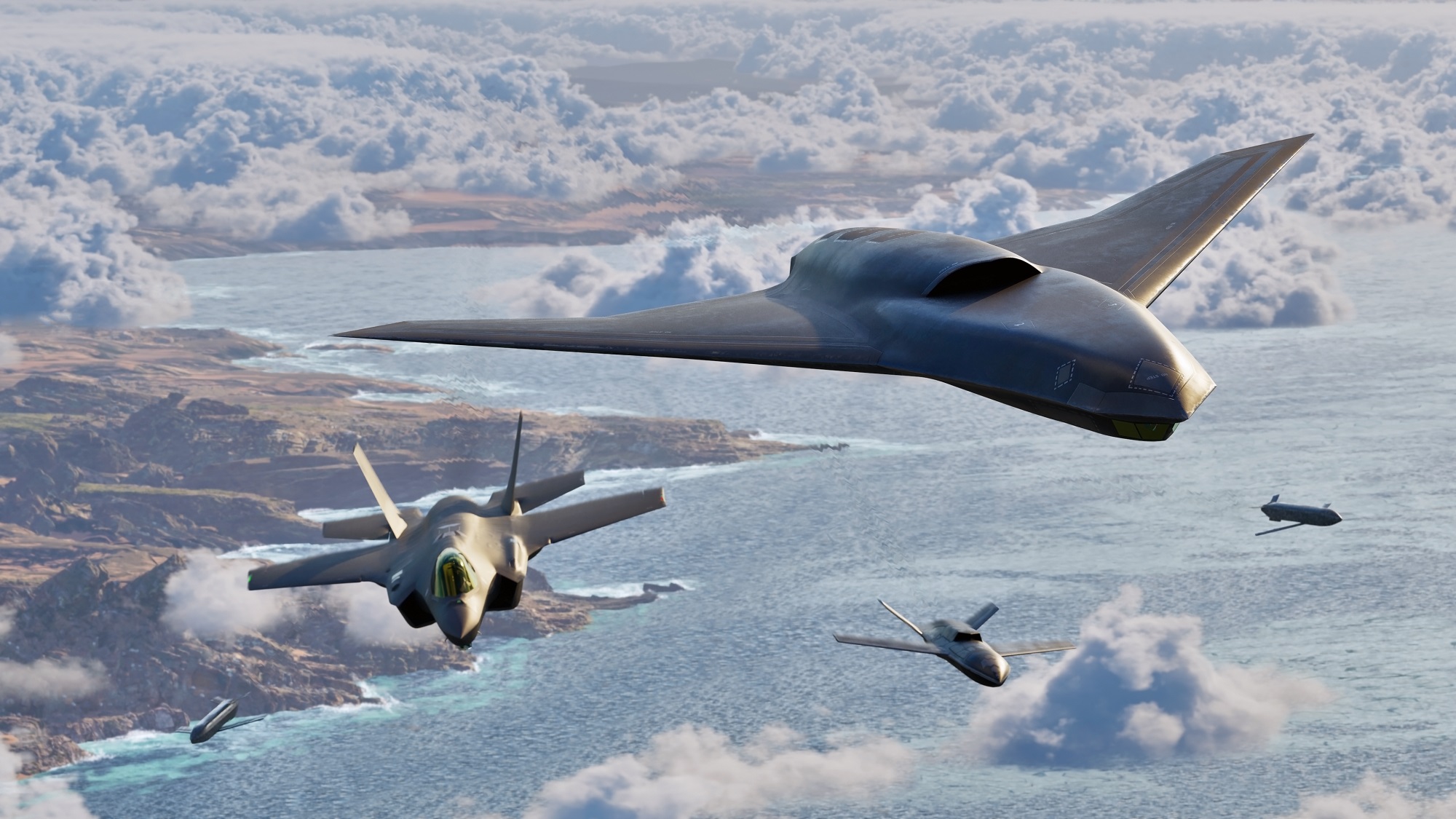
Vectis is being positioned as a relatively affordable but highly survivable autonomous aircraft capable of operating in contested environments. Rather than being designed around a single mission, the platform is intended to provide a flexible framework that can be adapted to different operational requirements.
The company says the aircraft is designed to operate alongside crewed with fifth- and next-generation crewed aircraft, supporting the “Family of Systems” vision. Vectis would contribute to missions ranging from precision strike to Electronic Warfare (EW), Intelligence, Surveillance and Reconnaissance (ISR), and both offensive and defensive counter-air.
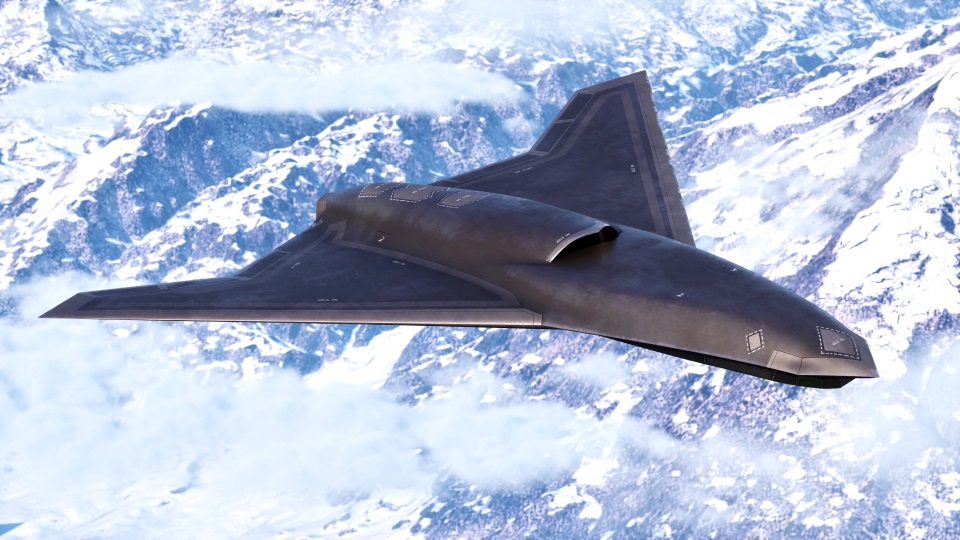
However, many of the aircraft’s actual performance specifications remain classified or undisclosed. For instance, Lockheed Martin has not published Vectis‘ maximum takeoff weight, range, combat radius, endurance in hours, maximum speed, payload capacity or detailed sensor and weapons configuration.
The only hint at dimensions comes from its Group 5 classification, which places it in the largest U.S. military UAS category. Group 5 includes aircraft with a maximum takeoff weight (MTOW) of over 1,320 lb and a nominal operating altitude of over 18,000 ft, according to the definitions provided by the Department of War.
O.J. Sanchez, Lockheed Martin Vice President and General Manager of Skunk Works, previously said Vectis was smaller than an F-16 Fighting Falcon. At the Farnborough International Airshow 2026, scale models allowed a comparison with the F-35 Lightning II.
Scale model of @LockheedMartin Vectis allows comparison withF-35. The thing appears to be huge. pic.twitter.com/kfZsYiCB5n
— The Aviationist (@TheAviationist) July 22, 2026
The company mentioned that Vectis’ endurance is compatible with Indo-Pacific, European and Central Command theaters. To improve integration with other assets, Vectis will use open systems aligned with Government Reference Architecture, as well as advanced manufacturing and digital engineering to lower the cost.
Survivability is arguably the most prominent characteristic Lockheed Martin has associated with Vectis. The company says the aircraft draws upon Skunk Works‘ experience in low-observable aircraft and combines shape, advanced materials, speed and altitude to provide survivability in highly contested environments.
Powered by Williams FJ44-4
One of the most significant technical disclosures came in December 2025, when Lockheed Martin revealed the propulsion system selected for the Vectis prototype. The aircraft will be powered by a Williams International FJ44-4 turbofan, which can produce more than 3,600 pounds of thrust.
The selection is consistent with Skunk Works’ emphasis on moving quickly. “By leveraging a mature, rugged turbofan, we can accelerate our timeline and demonstrate a game‑changing capability quickly, said Peter McArdle, Integrated Systems program director, Lockheed Martin Skunk Works.
Lockheed has not established publicly whether the same engine would power a future production version of Vectis. Variants of the FJ44-4 are also used by other similar uncrewed aircraft, such as the MQ-28 Ghost Bat and the FQ-44 Fury.
The engine, developed around a compact, twin‑spool architecture, was initially produced for the light business jets market, equipping aircraft such as the Cessna Citation and the Pilatus PC-24. Lockheed Martin said the FJ44-4 will enable Vectis to achieve the speed, range and endurance required for next‑generation missions.