Iran conducted a retaliatory attack with ballistic missiles and drones against Muwaffaq Salti Air Base in Jordan, with two U.S. service members killed and one more still missing.
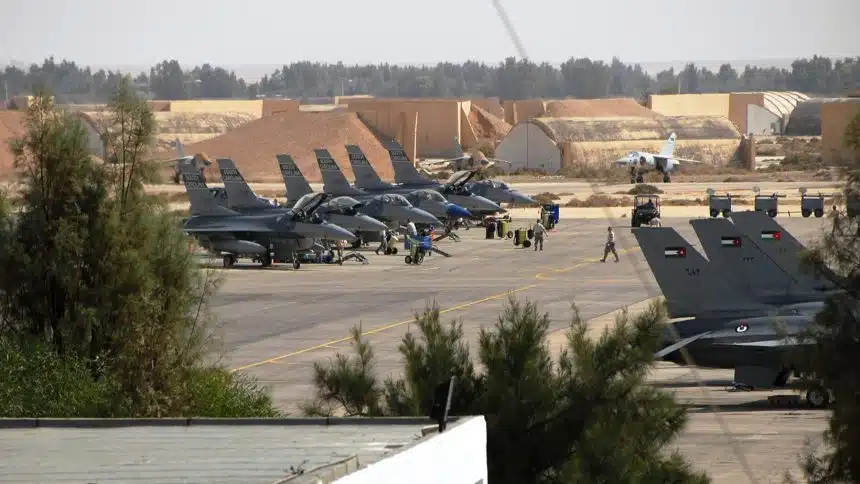
In a retaliatory strike for the recent U.S. bombing campaign, Iran has attacked Muwaffaq Salti Air Base in Jordan with ballistic missiles and drones on July 17, 2026. The base is known to host a large presence of U.S. forces.
In a statement on July 18, the U.S. Central Command (CENTCOM) confirmed the attack, saying that it caused the death of two U.S. service members while one more is still missing. Several others were injured but now returned to duty, says CENTCOM, including four that were evacuated to Jordanian hospitals.
CENTCOM Statement on Recently Fallen, Missing U.S. Service Members
TAMPA, Fla. — On July 17, two U.S. service members in Jordan were killed in action as U.S. Central Command (CENTCOM) and partner forces defended against Iranian ballistic missile and drone attacks. Additionally,…
— U.S. Central Command (@CENTCOM) July 18, 2026
The strike against the Jordanian base comes after a weeklong exchange of strikes between the U.S. and Iran. As of July 17, U.S. forces conducted seven consecutive nights of strikes, with Iran responding by attacking nearby countries, including Kuwait, Jordan and Qatar.
Strikes on Muwaffaq Salti Air Base
The strikes on Muwaffaq Salti Air Base happened in the intervening night between July 17 and 18. At least two missiles impacted the base, according to open source reports.
NASA’s Fire Information for Resource Management System (FIRMS) satellites reported two heat sources at the base around 2:00 AM local time. The area signaled by FIRMS appeared to be where the living quarters for personnel were located.
A fire is burning at the USAF-utilized Muwaffaq Salti Air Base in Jordan after an Iranian ballistic missile attack earlier tonight.
NASA’s FIRMS detected two heat sources around 2:00 AM local time. pic.twitter.com/j6ViIsSkkn
— OSINTtechnical (@Osinttechnical) July 18, 2026
A video, seemingly captured from the living quarter’s area, shows the moment a missile impacted the ground.
📍Muwaffaq Salti Air Base last night, Jordan, moment of direct hit by an Iranian Ballistic Missiles. https://t.co/5n1ePfd3Qk pic.twitter.com/SQMRtD7klZ
— MenchOsint (@MenchOsint) July 18, 2026
Currently there is no information about the extent of the damage, with CENTCOM’s statement in the afternoon of July 18 being the first confirmation of damage and casualties at the base.
Large plumes of smoke are billowing from Jordan’s Muwaffaq al-Salti Air Base after it was hit once again by Iranian ballistic missiles this afternoon. https://t.co/ihq4cSN6wn pic.twitter.com/7q6wsPu0LB
— Egypt’s Intel Observer (@EGYOSINT) July 18, 2026
As happened on previous occasions, the attack on the Jordanian base is likely to trike a new wave of U.S. attacks. At the time of writing there are yet no reactions or statements from the U.S. leadership.
U.S.-Iran exchanges
While a large part of the contingent of U.S. aircraft deployed to the Middle East returned home in the first days of July, U.S. forces racked up strike after strike on Iranian targets, showing the effective collapse of the fragile ceasefire.
CENTCOM launched a round of strikes against Iran at 3 p.m. ET today for the seventh consecutive night. The strikes are designed to continue degrading Iranian military capabilities at the Commander in Chief’s direction.
— U.S. Central Command (@CENTCOM) July 17, 2026
As mentioned in the opening, CENTCOM confirmed that the strikes were conducted on seven consecutive nights. Targets included surveillance sites, military logistics infrastructure, underground weapons storage, and maritime capabilities.
CENTCOM said the goal was to “further degrade Iranian military capabilities,” and especially the “military capabilities used to threaten vessels freely transiting through the Strait of Hormuz.” Iran called this an unjustified act of aggression.
The Islamic Revolutionary Guard Corps (IRGC) warned that any country hosting U.S. bases involved in the attacks against Iran should expect a response. The IRGC also claimed it only struck military facilities.
The Islamic Revolutionary Guard Corps (IRGC) released a statement claiming its latest strikes were carried out in direct response to recent U.S. attacks on Iranian infrastructure.
The IRGC warned that any country hosting U.S. forces used to conduct operations against Iran should… pic.twitter.com/LhfICUFQbJ
— OSINTdefender (@sentdefender) July 18, 2026
However, countries around the Gulf reported that the Iranian attacks struck civilian infrastructure, including water and electricity. Kuwait confirmed that there were injuries among emergency responders and civilians, while other countries reported intercepts of Iranian attacks.
Overnight, Iran launched strikes against U.S. assets and regional partners across the Gulf following reported U.S. attacks on Iranian infrastructure.
Iran had previously warned it would target the infrastructure of any Gulf nation hosting U.S. forces involved in operations… https://t.co/PN86NRNVdc
— TheIntelFrog (@TheIntelFrog) July 18, 2026
Meanwhile, the U.S. is deploying again additional fighters to the region. Among these are reportedly included aircraft from RAF Lakenheath, UK, and Spangdahlem Air Base, Germany.