France and Germany conducted their first joint air activity as part of the forward deterrence initiative, a day before announcing new programs as part of an increased defense cooperation.
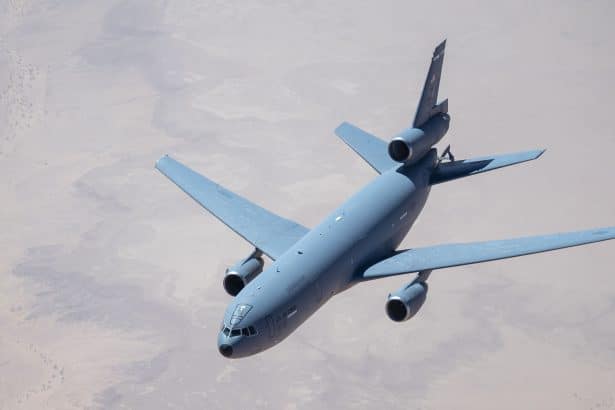
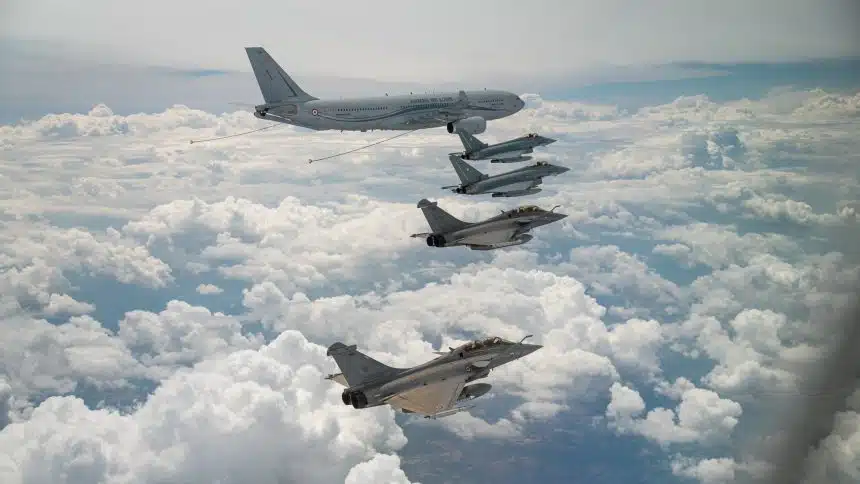
Two Armée de l’Air et de l’Espace (French Air and Space Force – FASF) Dassault Rafales and two Luftwaffe (German Air Force) Eurofighter Typhoons conducted their first “joint air activity” on Jul. 16, 2026, supporting Paris’ “forward deterrence” initiative. During the flight the fighters were refueled by a French A330 ‘Phenix’ MRTT.
The drill, that saw the involvement of two twin-seater Rafale Bs from France’s Strategic Air Forces (Forces Aériennes Stratégiques – FAS) at Saint-Dizier air base (BA 113) and two Eurofighters of the Luftwaffe’s 31st Tactical Air Wing, came a day prior to the Franco-German Defense and Security Council summit held in Nörvenich, Germany.
French President Emmanuel Macron and German Chancellor Friedrich Merz, accompanied by their respective cabinets, announced on Jul. 17 a series of military strategic and defense industrial collaborations. Among these there is a “German conventional participation in a French nuclear exercise,” as per a separate statement from the Élysée Palace.
This is a reference to the recurring Poker nuclear exercise, France’s flagship nuclear deterrence drill, of which the first iteration in 2026 was held between Mar. 16 and 17. The latest moves also build upon a Mar. 2, 2026 joint declaration, with which the two countries laid the foundation for the joint strategic military collaboration.
📍Dissuasion nucléaire | Déclaration commune des forces armées allemandes et françaises. pic.twitter.com/leQcACgC2o
— Armée française – Opérations militaires (@EtatMajorFR) July 17, 2026
Joint air exercise
Specifying that the latest joint air activity “did not involve nuclear weapons,” France’s Ministry of the Armed Forces said that the fighters conducted “specific maneuvers.” The aircraft then proceeded to the Luftwaffe’s Nörvenich air base, which hosted the Council meeting the next day, on Jul. 17.
The sole image released by the French Joint Staff shows the two Eurofighters and two Rafale Bs to the A330’s starboard (right-side), with the tanker flying with both its underwing refuelling hoses extended.
The Rafales are carrying two MICA-IR air-to-air missiles on the wing tips, as well as four MICA-RFs on the outermost weapons stations and the fuselage’s mounting points, in addition to external fuel tanks. The German Eurofighters are flying with a single IRIS-T missile and a Litening targeting pod, in addition to external fuel tanks.
Deutschland und Frankreich vertiefen ihre Zusammenarbeit in der Verteidigung. Wir stärken die europäische Abschreckung. Noch in diesem Jahr werden wir uns an einer nuklearen Übung der französischen Streitkräfte beteiligen. pic.twitter.com/zTtA1eoCHY
— Bundeskanzler Friedrich Merz (@bundeskanzler) July 17, 2026
The French MAF said: “Two French Rafales aircraft from the Saint-Dizier airforce base and two German Eurofighter from Nörvenich airforce base joined a French MRTT Phenix for air-to-air refuelling. This activity marks the first operational step within the framework of bilateral strategic cooperation agreed upon by President Macron and Chancellor Merz in the Joint Declaration of March 2, 2026. In addition, this endeavour has also contributed to increase overall interoperability of French and German air forces (sic).”
France, Germany lead European defense, boost ties
Both German Chancellor Friedrich Merz and French President Emmanuel Macron committed to strengthening European deterrence through deeper defense collaboration that drives European industry and enhances economic resilience. Merz then stated on X that Germany will participate in a “nuclear exercise of the French armed forces” this year.
En Allemagne, le Conseil des ministres franco-allemand que nous co-présidons aujourd’hui avec le Chancelier Friedrich Merz doit nous permettre de renforcer notre compétitivité, notre sécurité et notre défense et la résilience de nos démocraties.
Le réflexe franco-allemand… https://t.co/9utgniu3Ni
— Emmanuel Macron (@EmmanuelMacron) July 17, 2026
Merz welcomed Macron at Nörvenich air base near Cologne, with the two leaders emerging from a Super Puma helicopter – itself a symbol of successful French-German cooperation. They then presided over the joint defense and security council meeting held next to a French Rafale jet and a Eurofighter.
The Franco-German nuclear deterrence cooperation follows France’s proactive role in reinforcing NATO’s eastern flank before Russia with support to Ukraine, strengthening its nuclear deterrent and later expanding it to cover Europe. It has also reopened Luxeuil Air Base with an investment of €1.5 billion and commenced work on the ASN4G hypersonic nuclear missile.
France is stepping up defense cooperation with its European partners. President Emmanuel Macron and German Chancellor Friedrich Merz have agreed to increase defense cooperation, with Germany set to join a French nuclear exercise later this year. Meanwhile, Poland and France have… pic.twitter.com/EUqTHiNtlH
— TVP World (@TVPWorld_com) July 18, 2026
The two countries are also motivated by repairing their relations following the collapse of the sixth generation Future Combat Air System (FCAS) project. “The aim is for the two countries to ‘bounce back’ from last month’s implosion of the joint Future Combat Air System (FCAS) fighter jet project, which fell victim to bickering between Airbus and France’s Dassault,” France24 said while quoting Macron.
Franco-German Defense and Security Council
The release by the Elysee Palace highlighted the broader “escalating hybrid threats” in Europe amid a Russian threat to NATO with its “illegal war of aggression against Ukraine.” The statement identified six areas of bilateral security defense cooperation and consensus on flashpoints like Iran and Lebanon.
The Nuclear Steering Group, established on Mar. 2 through “confidential consultations,” will work on “conventional, Deep Precision Strike and missile defence capabilities with nuclear deterrence, in order to increase our ability to manage escalation beneath the nuclear threshold and to develop the necessary conventional capabilities.”
Pendant que la France dort…
La nuit dernière, une quarantaine d’aéronefs ont sillonné le ciel français pour simuler un raid aérien nucléaire.
Nom de code : Poker.
Pour être prêt, à tout moment.
Pour garantir la crédibilité de la #dissuasion. pic.twitter.com/7ZLGxiQ4p6
— Armée de l’Air et de l’Espace (@Armee_de_lair) March 17, 2026
The initiative will however be subservient to and not take precedence over NATO’s nuclear deterrence and nuclear sharing agreements, to which Germany contributes.
The weapons programs include a evolving a common European standard for interoperability among fighters and drones through modular, open architecture and interfaces; financial and shareholding measures “for the success and long-term development” of pan-European defense company KNDS; pushing for a proof-of-concept of the Main Ground Combat System (MGCS); leveraging French space rocket company’ Arianne Group’s capabilities in the main rocket boost component of the 2,500 km-range British-led Deep Precision Strike (DPS) program; and pushing strategic space collaboration and interoperability.