.
jump to navigation

How does the F-16 perform against its adversaries in dogfight? December 10, 2012

Posted by Dario Leone in : Military Aviation , trackback

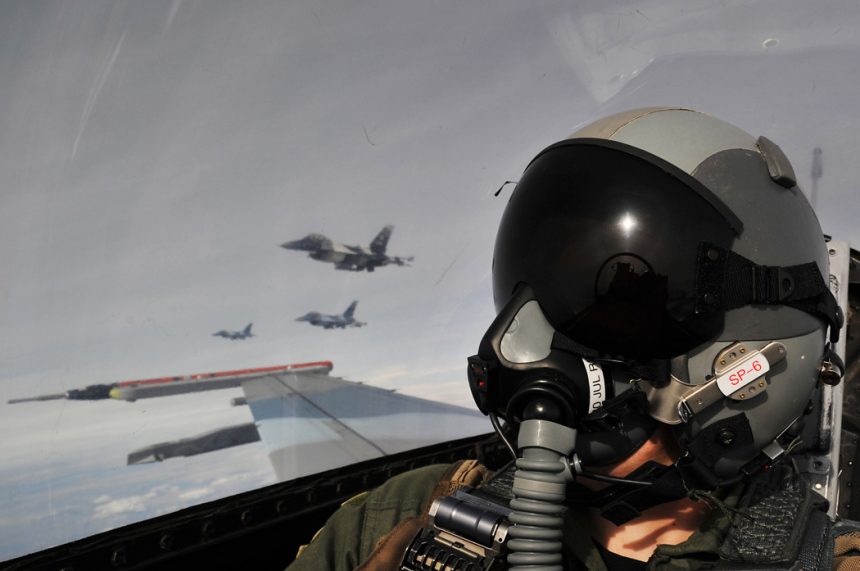
The Lockheed Martin F-16 Fighting Falcon is the western world’s most prolific fighter of the last 40 years.

Even if medium and long range air-to-air massiles, such as the AIM-7 Sparrow and the AIM-120 AMRAAM,  have been integrated in the F-16 since 1986 for the BVR (Beyond Visual Range) engagements, the Viper was born in response to LWF (Light Weight Fighter) program, for a small and agile fighter: the USAF needed a small, cheap, maneuverable airplane to flank the F-15 Eagle, its air superiority fighter, to face the small Soviet fighters, such as the MiG-21 in close combat.

Indeed, Red and Green Flags, Tiger Meetings, and any other major western exercise feature tons of Vipers (the universal F-16’s nickname) of all types and ages and, almost daily, F-16 from different air forces take part to DACT (Dissimilar Air Combat Training) sessions against the most modern fighter jets, sometimes playing the Aggressor role.

Therefore, understanding which are the advantages and the disadvantages of F-16 against the modern western fighters in DACT sessions, based on pilots accounts and most widely known fighter jets characteristics (Rules of Engagement within the training scenario, pilots skills and other factores which may have a significant impact on the outcome of a dogfight will be ignored), can be interesting.

According to one of the more experienced of the U. S. Air Force Viper’s pilots, Lieutenant Colonel Philipe “Rico” Malebranche, the F-16 can do very well against the F-15. The F-16 is small, light and agile: although it has a lower maximum speed and rate of climb, it has a smaller Radar Cross Section and, once on the merge, it’s harder to spot. Furthermore, its turn rate is impressive: it does not lose much energy in turns (unlike, for instance, a Mirage 2000) and can outmaneuver the F-15 in low altitude dogfights.

However, the toughest of the fighter jet to face in aerial combat, at least if you are seated in an F-16, is the F-22 Raptor“It’s not a matter of trying to kill him, but to see how long you can survive!” as “Rico” says in “Viper Force: 56th Fighter Wing–To Fly and Fight the F-16″ book by Lt. Col. Robert “Cricket” Renner USAF (Ret.).

WVR engagements versus the F/A-18E/F Super Hornet can be quite challenging as well.

The F-16 has a higher thrust-to-weight ratio than the “Super Bug” and this is an advantage Viper drivers can exploit in close air combat: “we can climb 3,000 feet above the F-18, then bunt over to put him in the HUD (Head Up Display) for a gun shot” Malebranche, who has also been an exchange pilot in a U.S. Navy Hornet Squadron, says.

However, while it bleeds energy faster than the F-16, the “Rhino” is much better than the Viper if the dogfight gets slow, because the Hornet handle high angles of attack and point the nose at the opponent easier.

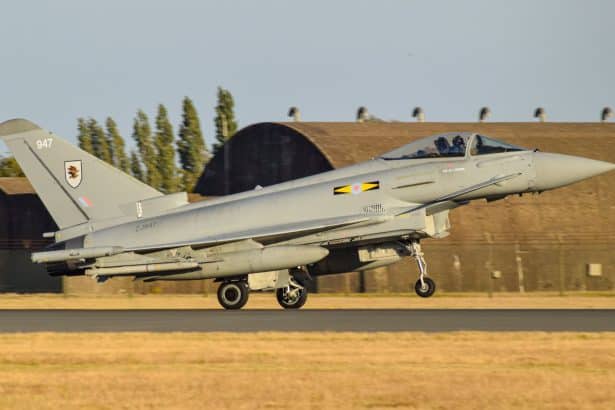
And how can the Viper perform against the Eurofighter Typhoon?

During more or less  a decade of service with the Italian Air Force, the F-16 has been extensively used to train Typhoon pilots in WVR engagements. According to the Italian pilots, the F-16 matches the F-2000 under 10,000 feet. But above FL100 the Typhoon becomes quite difficult to beat since its superior aerodynamics give the Eurofighter can out maneuver the Viper at every engagement.

Dario Leone for TheAviationist.com

Image credit: U.S. Air Force

Enhanced by Zemanta
  • Richard

    “Superior aerodynamics” of the Eurofighter Typhoon? Is it really aerodynamics or the (canard) control surfaces that contribute to its edge in maneuverability?

  • http://Ln593285 Dario Leone

    Both things contribute to the Eurofighter’s edge in maneuverability.

  • Ian Paterson

    The “Rhino” was always an F-4 “Phantom II” when I was in the air force, has that changed?

    • http://theaviationist.com David Cenciotti

      “Rhino” is the Super Hornet’s nickname used on board aircraft carriers

  • Lasse

    How does it do against the JAS Gripen 39

    • TopGunWel

      It all depends on tactics, mission support, pilot training and so on, but the Gripen C/D has faired very well against RoNAF F-16′s aswell as F-16′s in Red Flag.

  • Auroranexus

    Great article.. I can agree with most of it.

    Nothing like a good 9 G turn to get the blood going.

  • Auroranexus

    Then again, I do have to say, I’d like to go against one of those European jocks and see how they fair!

  • Dario Leone

    Auroranexus- I was sure you would appreciate my new article! As you can see my favourite aircraft is the F-14, but I like to write also about other aircrafts! However maybe you can give us more infos on how the F-16 permorms in dogfights.

    Lasse- I have non infos on how the Viper performs against the Gripen. Since I have seen in several airshows both Gripen and F-.16, in my honest opinion I think the Viper is superior in WVR.

    • Auroranexus

      I personally think “Rico” is pretty accurate. It’s sleek, tiny, and agile as heck. It’s a beautiful plane, and the instability giving it the ability to go to 9 Gs is breathtaking.. Literally! I think it may be one of the sexier aircraft to be made, I mean, look at it– it’s sleek and beautiful. I feel sorry for women in my life who need to compete with it! Haha.

      I may have a bit of an ego, but personally I don’t see the Gripen as much of a threat. I personally feel adept to take on anything but an F-22, as that would be like cat and mouse, if the mouse could hide anywhere and shoot the cat with no warning.

      The T-50 looks like a fierce competitor, and I would be on alert from a Eurofighter, but personally I wouldn’t even bother with an F-22. One radar signature from that and I think any sane pilot would turn back.

    • energo

      Probably old news, but speaking WVR some remarks from pilots is that – generally – the Gripen has a quicker turn and that the Viper has a bigger engine and thus an edge in ‘the vertical’ and sustained turn. In BVR the Gripen is said to have the advantage with a very good radar and refined datalinking.

  • Tang

    Great article.

    But what about the edge with the Mig 29, Su 27 and Rafale for instance ? Thanks to Red Flags we should have some clues …

  • Dario Leone

    Auroranexus- I admired last year Thunderbirds’ show and I think their F-16C Block 52 were beatiful and powerful. They perform a beatiful flight display. But when the solo F-16 perfomed a schneider in mi opinion it was less hard than the one Typhoon performed later. I think the Eurofighter can turn tighter than Viper.

    I think you are right aircrafts are often sexier than women ah ah!

    Tang- From what I see during an airshow Rafale hasn’t a high edge above the F-16. I guess the Viper can turn tighter than Fulcrum based on the MiG 29 display I enjoied last year, while I think the SU 27 is a hard adversary not only for the Vipers but also for the other fighters, even if when fully loaded Flanker loses part of its maneuverability. However what it makes the difference is pilot’s training.

  • Zack North

    In the Frisian Flag excercises last spring Finnish Air Force Hornets downs NATO F-16s and Eurofighters 17.5 to one.


Switch to our mobile site