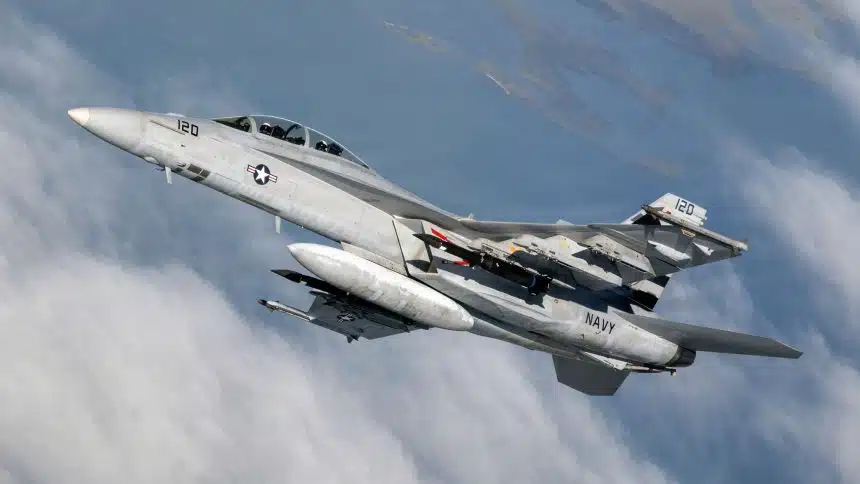
As part of its work with the Air Force Research Laboratory, Castelion will now expand the Blackbeard integration effort to the F-16, adding a U.S. Air Force fighter to a program already advancing toward Navy service.
Castelion announced on Oct. 26, 2026, it has received a contract modification to begin integration activities for its Blackbeard hypersonic weapon on the F-16 Fighting Falcon. The award, which applies to the company’s existing work with the Air Force Research Laboratory (AFRL), adds a U.S. Air Force fighter to the platforms being considered for the weapon.
Castelion did not disclose the value of the contract modification or a timeline associated with the F-16 integration effort. The announcement follows a September contract modification under which AFRL added $16.4 million to an existing contract with the company, increasing its total value from $20.9 million to $37.2 million.
Castelion has been awarded a contract modification to its existing work with the Air Force Research Laboratory to begin Blackbeard integration activities with the F-16. We are grateful to the Air Force for their trust.
Aim High. https://t.co/UerIcDG6Jx
— Castelion (@Castelion) October 26, 2026
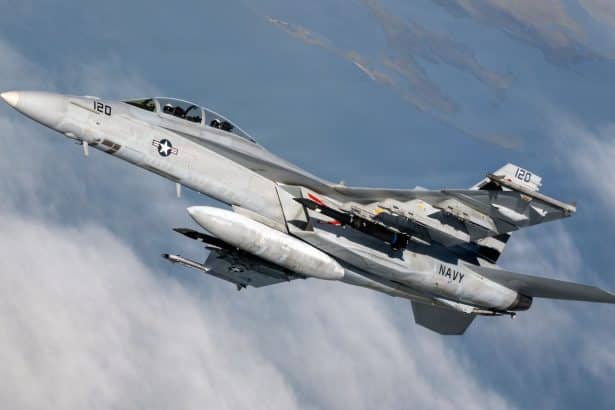
In September, the U.S. Navy has provided the clearest look yet at Blackbeard carried by an F/A-18F Super Hornet fighter jet. The weapon was also shown in a photo a month earlier during the Tailhook Association symposium as part of a presentation by the service about the ongoing activities.
Blackbeard is being procured by the U.S. Navy as part of the Multi-mission Affordable Capacity Effector (MACE) program, an effort aimed at fielding a comparatively low-cost, long-range strike weapon that can be produced and deployed in much larger numbers than traditional hypersonic systems. The program reflects the Navy’s broader push toward “affordable mass,” with an emphasis on increasing magazine depth and giving carrier-based aircraft a greater number of high-speed standoff weapons for use against both maritime and land targets.
Blackbeard expands to another aircraft platform
Blackbeard is Castelion’s long-range hypersonic strike weapon, developed with an emphasis on affordability and manufacturing at scale. The company has pursued a production-oriented approach intended to make hypersonic weapons available in greater quantities than programs constrained by high unit costs and complex manufacturing processes.
The F-16 effort adds to a series of integration and procurement activities involving the U.S. Army and Navy. In October 2025, Castelion announced integration contracts, worth approximately $90 million, with both services to adapt Blackbeard to their platforms and demonstrate the weapon in live-fire tests, although the specific platforms were not disclosed.
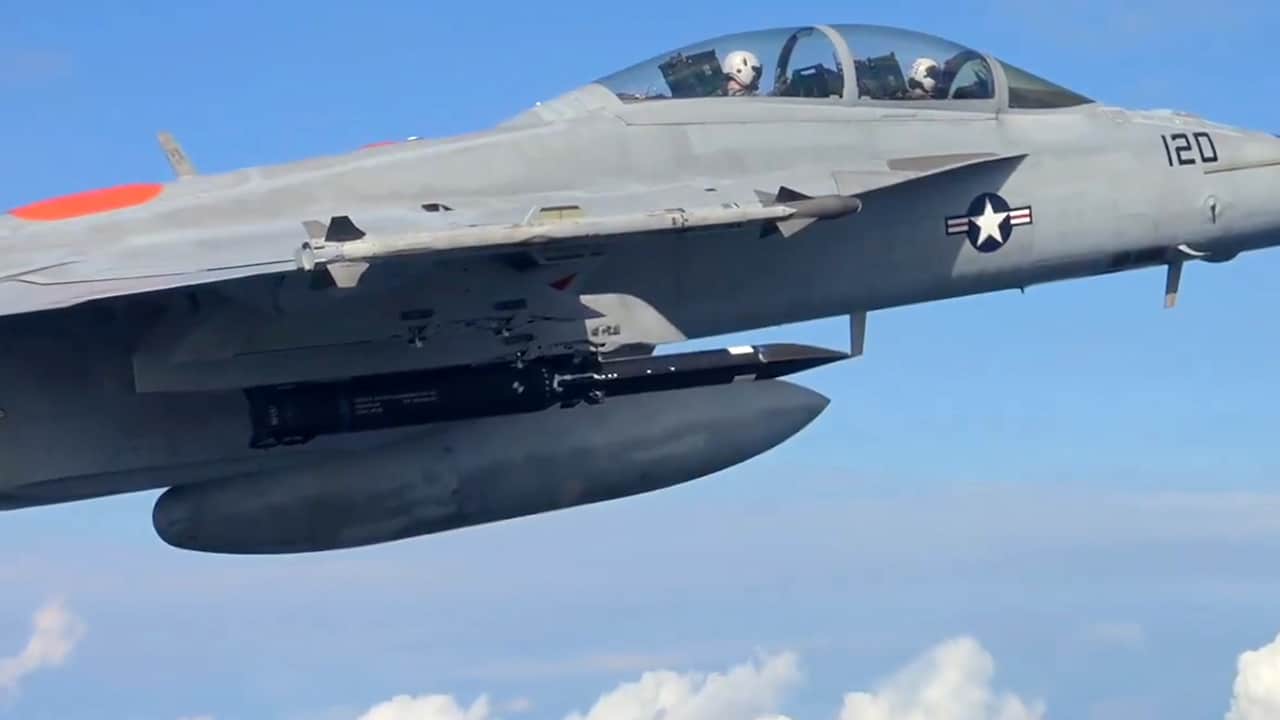
The Navy has since advanced the weapon toward operational use on the F/A-18E/F Super Hornet. As a matter of fact, Blackbeard is moving at unusually high speed through the acquisition process.
In April 2026, Castelion announced a $105 million contract by the Navy to continue integration work, including hardware and software integration, system safety and airworthiness certification, and flight testing. The company identified 2027 as the target for Early Operational Capability on the Super Hornet.
The F-16 effort represents a separate integration path under AFRL rather than an extension of the Navy’s F/A-18 contract. However, while the work required to integrate and certify the weapon will depend on the requirements of each platform and service, the experience accumulated with the integration on the F/A-18 might also help speed up the integration on the F-16.
It is important to note that Castelion’s announcement does not specify whether the effort is intended to lead to an operational capability or initially serve as a research and demonstration activity on the U.S. Air Force’s platform. Nevertheless, no decision to procure the weapon for employment by operational F-16 units was announced.
Blackbeard’s path toward production
The F-16 announcement comes as Castelion advances Blackbeard through development, integration and production activities. In June 2026, the Navy ordered 50 pre-production weapons for $23.4 million intended for the Early Operational Capability.
More recently, in September, the service placed a production delivery order valued at up to $200 million for an initial lot of weapons. The number of weapons included in the production lot was not specified in the company’s statement, however the contract notice mentions “444 All-Up Rounds (AURs), defined as fully functional tactical missiles packaged within specialized shipping and storage containers.”
“The Navy’s decision to move into production reflects its confidence in the Blackbeard program, and the progress we’ve made together,” said Bryon Hargis, co-founder and CEO of Castelion. “That’s how you get capability to the fleet fast, clear red tape, and partner with industry. We are grateful to PAE(A) for the trust and the urgency. Blackbeard was engineered from day one for the production line and we look forward to delivering this capability to the fleet.”
The company said that Blackbeard was developed “with hundreds of millions of dollars in private investment in partnership with the U.S. Navy, U.S. Army, and U.S. Air Force.” A 1,000-acre manufacturing campus, called “Project Ranger,” was already established in Rio Rancho, New Mexico, and will work on this contract together with a second facility in Torrance, California.