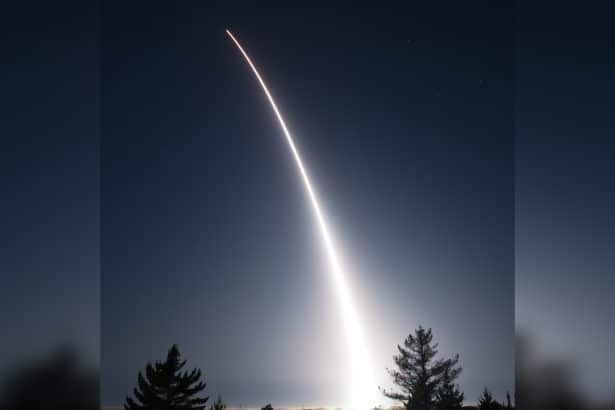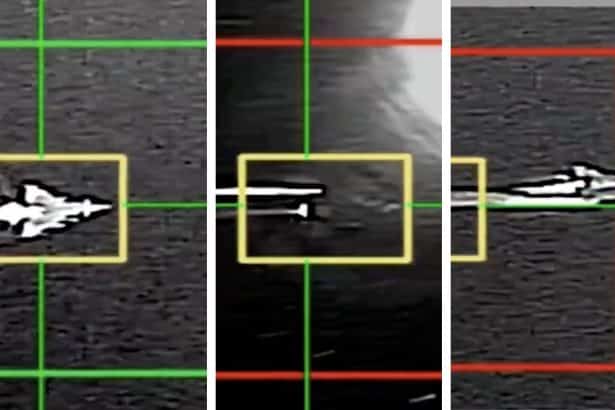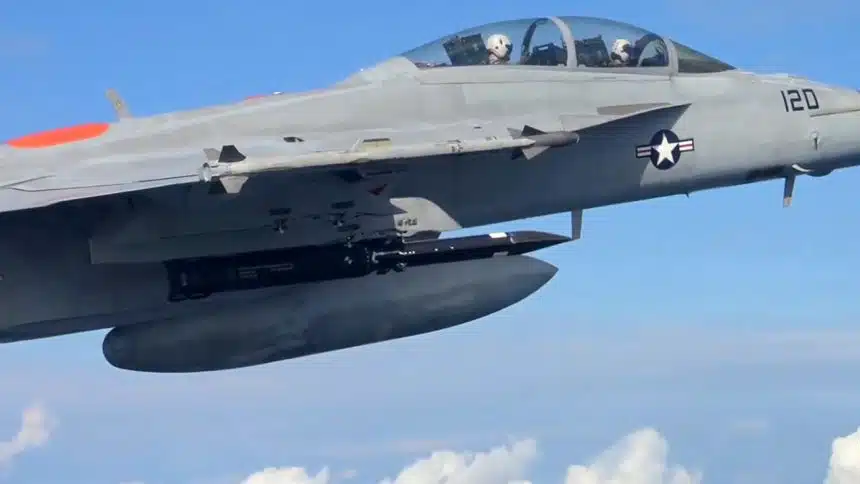
For the first time, newly released imagery shows Castelion’s Blackbeard low-cost hypersonic weapon carried by a U.S. Navy Super Hornet during a test flight.
Newly released imagery provides the clearest look yet at Castelion’s Blackbeard hypersonic strike weapon mounted on a U.S. Navy F/A-18E/F Super Hornet.
The footage, released by Naval Air Systems Command (NAVAIR), shows two Blackbeard weapons installed under the wing of a Super Hornet, offering detailed views of the missile and its integration on the Navy’s carrier-based strike fighter.
Coming soon to a theater near you…BLACKBEARD!@USPACOM @CENTCOM @PAEAviation pic.twitter.com/KgBtIqdf8I
— NAVAIR (@NAVAIRNews) September 25, 2026
While this is not the first time Blackbeard has been seen on the aircraft, the new material offers a much better view of the weapon and its installation than the image that surfaced during the Tailhook Association symposium in August 2026. That earlier photograph, displayed as part of a Navy presentation, showed two Blackbeard test articles mounted beneath the right wing of a Super Hornet and represented the first public confirmation that physical integration work on the fighter was already underway.
The newly released imagery, showing the missile flying on the Super Hornet, comes as Blackbeard is moving at unusually high speed through the acquisition process.
Blackbeard
Blackbeard is an air-launched hypersonic strike weapon developed by California-based Castelion and intended to provide U.S. naval aviation with a relatively inexpensive, long-range weapon capable of attacking both maritime and land targets.
The U.S. Navy describes Blackbeard as a “responsive, long-range, high-speed strike option” for carrier-based aircraft, meant to improve their ability to operate against sophisticated air defenses while increasing the number of long-range weapons that can be fielded.
The F/A-18E/F Super Hornet is the initial air-launched platform for the weapon. The Navy has not publicly detailed exactly when or where the latest imagery was recorded.
In April 2026, Castelion received a 105 million USD Navy contract covering further integration of Blackbeard on the F/A-18, including hardware and software integration, flight testing, system-safety work and airworthiness certification for carrier operations. At the time, the company said the objective was to transition the weapon to Early Operational Capability in 2027.
A low-cost hypersonic weapon
One of the most significant characteristics of Blackbeard is not simply its speed, but the philosophy behind the program.
Castelion has designed the weapon from the outset around large-scale production and comparatively low unit cost, in contrast with the traditionally small inventories and extremely high prices associated with U.S. hypersonic weapon programs.
The company describes Blackbeard as its first low-cost, mass-producible hypersonic strike missile and says the design makes extensive use of vertically integrated propulsion and guidance technologies as well as commercial manufacturing techniques.
Detailed performance figures remain classified; the weapon is described as hypersonic, meaning it is designed to reach speeds above Mach 5.
Rapid transition into production
Blackbeard has moved from development into procurement quite quickly.
In February 2026, the Navy awarded Castelion 49.9 million USD to advance the missile from the prototype stage toward an integrated Early Operational Capability, with that work scheduled to run through November 2027. That was followed by the $105 million F/A-18 integration contract in April.
In June 2026, the Navy placed a 23.4 million USD firm-fixed-price order for 50 Blackbeard Early Operational Capability pre-production prototypes, together with 50 shipping and storage containers. Castelion said the order marked the transition from development and flight testing toward operationally relevant production.
On Aug. 25, another 89.997 million USD award was announced to support the 50 EOC weapons and the transition of Blackbeard toward a formal Navy Program of Record. Interestingly, this work also includes Defense Exportability Features aimed at facilitating potential future sales to U.S. allies and partners.
More recently, on Sept. 14, 2026, Castelion announced a U.S. Navy production delivery order worth up to 200 million USD to manufacture, assemble, test and deliver an initial batch of production Blackbeard weapons. The Navy officially announced the award the following day. Castelion said work under the award will be performed at Project Ranger, the company’s 1,000-acre manufacturing campus in Rio Rancho, New Mexico, and at its facility in Torrance, California.
According to U.S. government contracting information subsequently reported by USNI News, an initial 43.65 million USD order covers 444 Blackbeard All-Up Rounds, an unusually large quantity for a weapon in the hypersonic category.
Blackbeard is being procured by the U.S. Navy as part of the Multi-mission Affordable Capacity Effector (MACE) program, an effort aimed at fielding a comparatively low-cost, long-range strike weapon that can be produced and deployed in much larger numbers than traditional hypersonic systems. The program reflects the Navy’s broader push toward “affordable mass,” with an emphasis on increasing magazine depth and giving carrier-based aircraft a greater number of high-speed standoff weapons for use against both maritime and land targets.
In fact, among the most important lessons learned from the recent conflicts in Ukraine and the Middle East, is the need to keep an eye on the stocks of munitions which can be quickly depleted during sustained operations. As a consequence, it is important to maintain sufficiently deep inventories and to have the industrial capacity to replace expended weapons at speed. Blackbeard appears to have been conceived with exactly these requirements in mind.