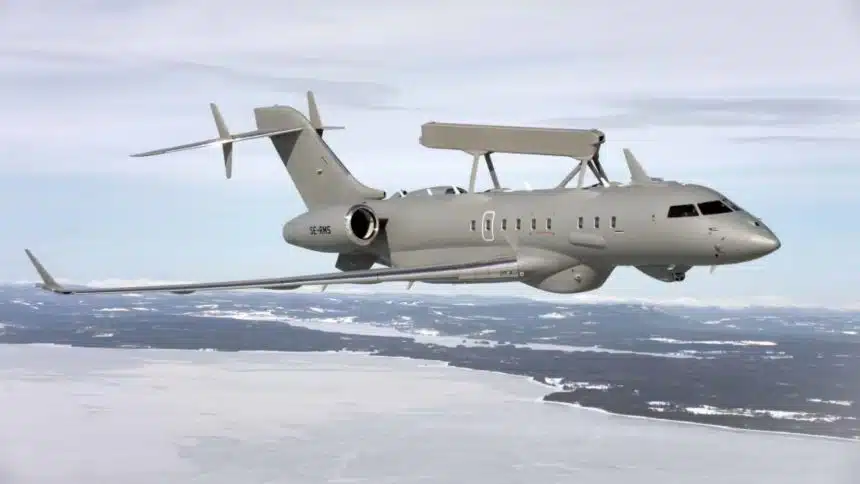
While not a formal purchase contract, the term sheet agreement establishes the framework for negotiation after Canada identified Saab as the preferred supplier for its future AEW&C system.
Canada and Saab have entered negotiations for the acquisition of the GlobalEye Airborne Early Warning and Control (AEW&C) system, with the company signing a “non-binding term sheet agreement” with the Canadian Defence Investment Agency. The development comes four months after Canadian Prime Minister Mark Carney in May announced Saab as the preferred supplier for the country’s future AEW&C system.
Saab announced on Sept. 25, 2026, that the agreement lays the “scope and foundation for detailed negotiations” toward the GlobalEye’s acquisition. The company clarified that the framework agreement is “not a formal purchase contract or commitment to procure” the GlobalEye.
Nevertheless, it lays the path for the current discussions towards the possible contract. “[The agreement] reflects the progress made through close collaboration between Saab, the DIA and the RCAF and provides the framework for upcoming negotiations,” said the company in its statement.
The Royal Canadian Air Force (RCAF) and Saab have said that Ottawa estimates the need to acquire six GlobalEye aircraft. The company added that the aircraft would have customized systems reflecting Canada’s operational needs.
Ottawa advances talks with Saab over possible GlobalEye purchase https://t.co/jJmG3XF5wZ
— The Globe and Mail (@globeandmail) September 25, 2026
The agreement
Saab said the agreement “marks an important milestone” following Canada’s May 27, 2026, announcement identifying the company “as the preferred supplier for the nation’s future AEW&C capability.”
Saab’s president and CEO Micael Johansson said in the release: “The term-sheet agreement reflects the strong collaboration between Saab and Canada and establishes a clear framework for the next phase of our engagement. With a well-defined scope in place, we are well positioned to continue discussions and demonstrate how Saab’s proven and highly capable AEW&C solution can meet Canada’s requirements.”
As mentioned earlier, the proposed program so far outlines six GlobalEye aircraft for the RCAF, including associated systems, training and support. “The discussions will focus on a system configuration reflecting Canada’s operational requirements, as well as industrial participation, capability development and programme execution,” explained Saab.
Was a pleasure to meet with senior leadership from @Saab to discuss how our province’s advanced manufacturing expertise can contribute to the next generation of defence and aerospace opportunities.
We received an update on their Global Eye platform and the role the Ontario-made… pic.twitter.com/FDIRDKqgek
— Victor Fedeli (@VictorFedeli) September 25, 2026
The statement further added that “Saab is committed to supporting Canada’s defence and security objectives, strengthening interoperability with allies and delivering proven capabilities that meet evolving operational requirements.”
The company described the GlobalEye as an advanced AEW&C system offering an “array of active and passive sensors for long-range detection and identification of incoming threats across the domains.” Saab further said that, “by providing real-time information to military commanders, GlobalEye enhances situational awareness and enables the early detection of potential threats.”
The Netherlands, France and the North Atlantic Treaty Organization (NATO) have also selected GlobalEye, reflecting the platform’s growing popularity. Additionally, Saab announced in July an order for the system by an unidentified West Asian country.
Saab has received an order for two GlobalEye aircraft from a country in the Middle East region.
The order value is SEK 10.1 billion, and deliveries will take place in 2030. https://t.co/8eFBaV9iuo
— Saab (@Saab) July 27, 2026
Canada’s GlobalEye Connection to European Defense Industry
Both Saab and Canada are leveraging their pre-existing mutual dependence in the GlobalEye system. Canada is the country of origin of the Bombardier Global 6500 business jet on which GlobalEye is based.Saab integrates the aircraft with its Erieye radar and other mission systems to create the GlobalEye AEW&C platform.
As per the May announcement, Saab said it was looking to establish substantial Canadian industrial participation in GlobalEye production, with Canadian companies involved in building, maintaining and upgrading the aircraft.
The development also comes as Canada appears to be deepening its defense-industrial ties with Europe. Recently, the country has inked a $564 million Joint Strike Missile (JSM) deal with Norway’s Kongsberg, and is actively considering Saab’s Gripen – with a substantial localized industrial workshare element.
This comes as ties with the U.S. remain tense and questions remain abound over the future of Canada’s F-35A Lightning II fleet. “Carney’s government still has not made a decision on its planned acquisition of 88 F-35 stealth fighter jets. That review, which was launched in response to diplomatic and trade tensions with the Trump administration, was supposed to have concluded a year ago,” CTVNews said, while reporting about the new agreement with Saab.