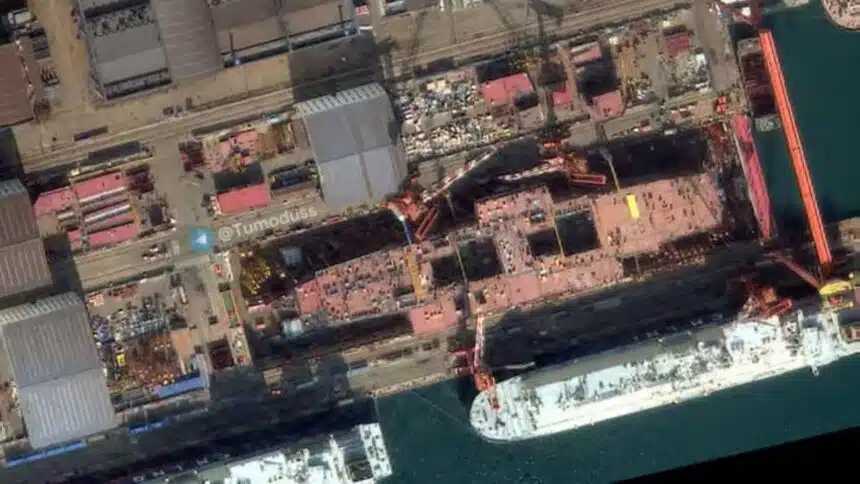
Satellite imagery shows further progress on the Type 004 aircraft carrier at Dalian, with additional sections of the flight deck and hull now rapidly taking shape.
China’s fourth aircraft carrier, currently under construction at Dalian Shipyard in Liaoning Province in northeastern China, continues to rapidly make progress, satellite pictures from Nov. 12, 2026 show. The latest images show additional sections along both sides of the hull and further development of the flight deck and bow, giving the vessel an increasingly recognizable aircraft-carrier profile.
The images were captured by a Vantor WorldView Legion-1 satellite and shared by the X account ‘Tumoduss’. They were subsequently reposted by Chinese military aviation analyst Andreas Rupprecht.
The images in question were captured by a Vantor WorldView Legion-1 satellite and shared by the X account ‘Tumoduss’, before being shared on X by leading Chinese military aviation analyst Andreas Rupprecht. Additional satellite imagery and unofficial aerial shots of the hull throughout this year show the rapid pace of shipbuilding.
Previously, images from August showed the progress of the ship, commonly referred to as Type 004, in the dry dock with some forward sections of the flight deck still missing. Interestingly, this also appears to be the same dry dock where the PLA Navy’s first carrier Liaoning was completed, and the second carrier Shandong was built.
Latest upadate on the 004 aircraft carrier via @Tumoduss. https://t.co/CARjbt0EcA
— @Rupprecht_A (@RupprechtDeino) November 13, 2026
Çin’in inşa halindeki Type 004 uçak gemisine ait 12 Kasım tarihli uydu görüntülerinde, geminin uçuş güvertesindeki ilerleme dikkat çekti. https://t.co/LcbcD3XT43
— Enis Şenol (@senolenis) November 13, 2026
What the satellite images show
A picture shared by Rupprecht on Sept. 22 showed an extension along the port side of the hull. The November picture shows further development of this structure, alongside a corresponding extension on the starboard side – adjacent to which the island usually is.
Latest update on the 004 carrier at Dalian https://t.co/0A39WEEUcf
— @Rupprecht_A (@RupprechtDeino) September 22, 2026
The Center for Strategic and International Studies (CSIS) has identified these as preparations for the carrier’s port and starboard weapons sponsons, while also noting construction work to support the starboard-side superstructure. In the period before and after August, Rupprecht has shared images of modules of the ship, including the bow and flight deck, being transported to the Dalian shipyard.
Latest update on the 004 aircraft carrier via kane72/SDF: https://t.co/dJbVOjbMsT
— @Rupprecht_A (@RupprechtDeino) June 26, 2026
The conventional-powered Fujian, equipped with an Electromagnetic Aircraft Launch System (EMALS), carries Type 1130 11-barrelled close-in weapon systems (CIWS) and HQ-10 short-range anti-air missiles. These will likely also equip the new carrier, and analysts expect them to be installed on the sponsons.
The purpose of the starboard-side extension is not yet entirely clear, although CSIS identifies preparations for the carrier’s starboard-side superstructure in the same area. It remains to be seen whether the island will extend to the edge of the flight deck, as on the Gerald R. Ford, or be separated from it by a narrow gap, as on Nimitz-class carriers.
Apparently, the 004’s bow module has been installed. https://t.co/jvxP8hDs0O
— @Rupprecht_A (@RupprechtDeino) August 14, 2026
Further construction will also provide clues about how closely the Type 004 follows the configuration of the full-scale carrier mock-up in Wuhan. The facility previously replicated the flight deck of the Fujian, and was modified after the carrier started operational testing.
And again a small & blurry update on the 004 aircraft carrier at Dalian. https://t.co/73RPq8EGox
— @Rupprecht_A (@RupprechtDeino) August 26, 2026
Shipbuilding method
The Type 004 is being built using modular construction, with large prefabricated sections assembled in the dry dock. This approach allows shipbuilders to manufacture and outfit individual blocks before joining them together during the construction of the hull.
Satellite imagery has documented the assembly of prefabricated hull sections at Dalian since 2025, with the structure progressively taking the shape of an aircraft carrier. The pace of construction has led analysts to suggest that the Type 004 could be launched as early as 2027, as reported by the South China Morning Post (SCMP).
CSIS has compared its October 2026 construction stage with that of the Fujian in May 2021, approximately one year before the latter was launched. However, the Type 004’s larger size and potentially more complex design could affect the timeline.
Notably, a 2027 launch would coincide with the centenary of the People’s Liberation Army on August 1. However, there is no official confirmation of such a schedule.
Again an update on the 004 at Dalian … I can hardly wait for the side extensions to be fitted. https://t.co/8JqpRF2XQZ
— @Rupprecht_A (@RupprechtDeino) September 2, 2026
The U.S. Navy’s USS Gerald R. Ford (CVN-78), by comparison, began construction in August 2005, was launched on November 9, 2013, and commissioned on July 22, 2017. The carrier achieved Initial Operational Capability (IOC) in December 2021, although its first deployment did not begin until October 2022.
The rapid progress at Dalian contrasts with the delays affecting several U.S. Navy shipbuilding programs. An April 2026 Congressional Budget Office (CBO) assessment found that the time needed to build U.S. destroyers and submarines has increased from approximately five to six years in the 2000s to nine to ten years today.
Ford-class carriers, meanwhile, are taking an estimated ten to eleven years to build under current schedules. The CBO attributed these difficulties to several factors, including workforce shortages, design challenges and cost growth.
An update on the 004 aircraft carrier at Dalian again, unfortunately quite dark! https://t.co/QxKknoGkDs
— @Rupprecht_A (@RupprechtDeino) September 18, 2026
Conventional or nuclear powered?
The vessel is commonly referred to as Type 004, following the Type 001, Type 002 and Type 003 designations commonly used for the Liaoning, Shandong and Fujian, respectively. These designations are widely used in open-source reporting, although China has not officially disclosed the designation of the new carrier.
The Liaoning and Shandong are ski-jump carriers designed for Short Take-Off Barrier Arrested Recovery (STOBAR) operations. The Fujian introduced electromagnetic catapults, making it China’s first Catapult-Assisted Take-Off But Arrested Recovery (CATOBAR) carrier.
どうも今回の演習で遼寧はJ-35を積んで来てる可能性がある模様。
西太平洋とのことだがそろそろ自衛隊が初遭遇できないもんだろうか。 https://t.co/VLcumcFgip
— お砂糖wsnbn (@sugar_wsnbn) October 14, 2026
This precedent has also led to a strong belief that the Type 004 could become China’s first nuclear-powered aircraft carrier. In its October 2026 assessment, the CSIS considered nuclear propulsion likely, pointing to two approximately 15-by-15-meter compartments within the hull that appear consistent with shielded reactor containment structures and which were not seen on the Fujian.
Janes reached a similar preliminary assessment based on satellite imagery showing the compartments’ dimensions and multilayered construction. However, China has not officially confirmed the carrier’s propulsion system, and the available imagery does not conclusively establish that it will be nuclear-powered.
#PLAN
The Fujian aircraft carrier demonstrates its capabilities. https://t.co/WwyDJOby8j
— Iron Lady (@nuwangzi) November 7, 2026
Nuclear propulsion would offer several advantages, including eliminating the need to carry large quantities of fuel for propulsion and allowing sustained high-speed operations without the logistical constraints associated with conventional powerplants. It could also provide a substantial electrical power supply for energy-intensive systems such as EMALS, while freeing internal volume for aviation fuel, weapons and other stores.
The Type 004 is expected to operate a carrier air wing similar to the Fujian’s, consisting of J-35 stealth fighters, J-15T catapult-capable fighters, J-15DT EW (Electronic Warfare) aircraft and KJ-600 Airborne Early Warning and Control (AEW&C) aircraft. The carrier could also potentially operate unmanned naval aircraft.