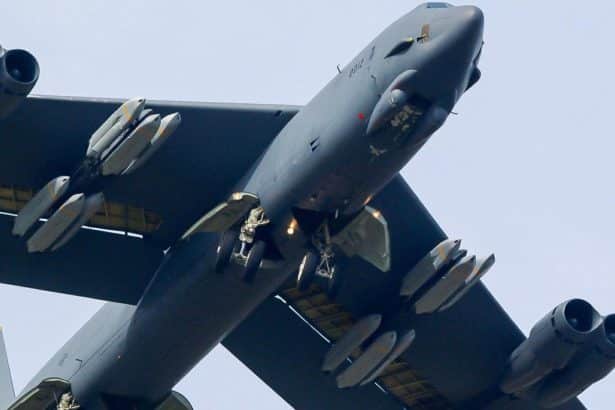
A recent U.S. Navy contracting notice outlines plans to negotiate with Lockheed Martin to integrate the AGM-158C Long-Range Anti-Ship Missile (LRASM) on the B-52 Stratofortress.
The U.S. Navy is planning to negotiate a sole-source contract with Lockheed Martin Missiles and Fire Control to integrate the AGM-158C Long-Range Anti-Ship Missile (LRASM) on the B-52 Stratofortress strategic bomber, according to an Oct. 7, 2026 contract notice.
The planned integration would add another long-range maritime strike option to the U.S. Air Force’s bomber fleet. Both the B-1B Lancer and the B-2 Spirit already have the ability to launch the LRASM, and thus all three of the U.S. Air Force’s strategic bombers would be capable of employing the LRASM after the integration on the B-52.
The notice by the Naval Air Systems Command (NAVAIR) has announced a Cost Plus Fixed Fee (CPFF) sole source negotiation with Lockheed Martin Missiles and Fire Control, which also covers “missile software updates, associated testing, test asset repair, and failure review boards.” The notice however does not specify a timeline for fielding the new capability.
The LRASM is derived from the AGM-158 Joint Air-to-Surface Standoff Missile (JASSM) family, sharing the same general airframe design and form factor, but with components customized for striking ships in contested maritime environments. The B-52 can carry up to 20 JASSMs, of which twelve are carried externally, as seen in March during Operation Epic Fury, while the remaining eight are carried in internal conventional rotary launchers.
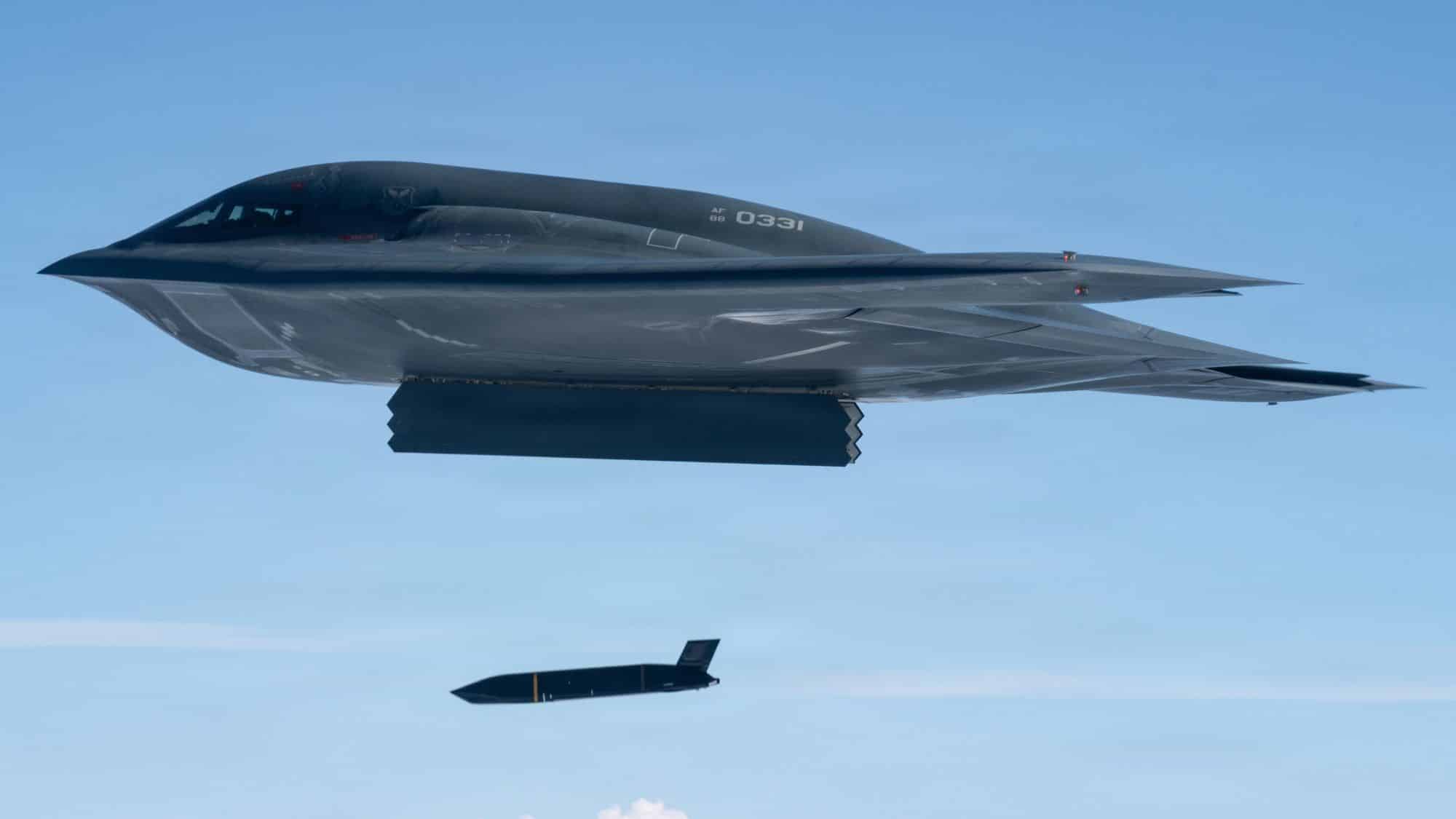
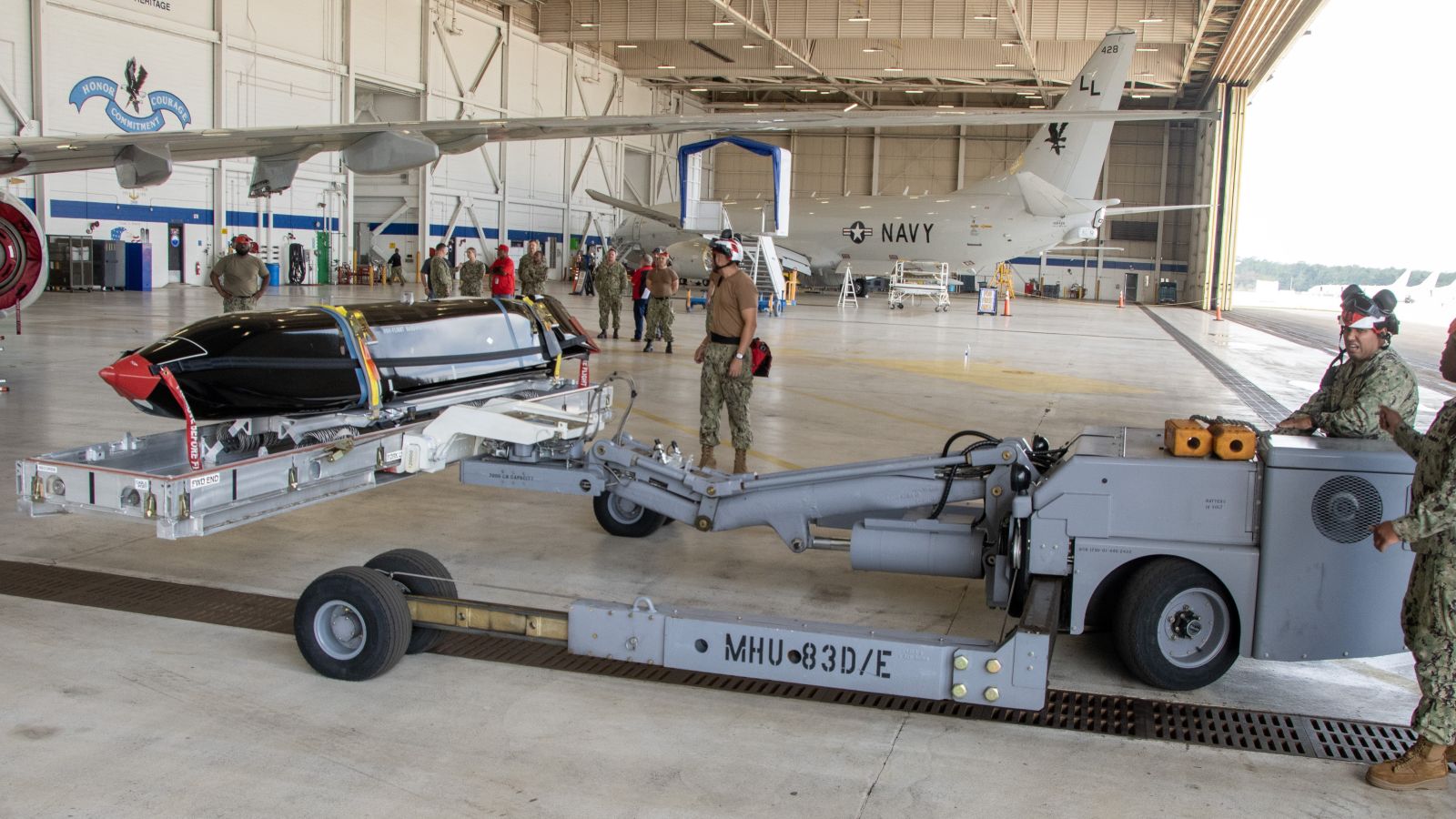
Beside the B-1B and the B-2 Spirit, other Air Force platforms set to receive the LRASM capability include the F-15E Strike Eagle, F-15EX Eagle II and the F-16C/D. Naval aircraft such as the F/A-18E/F Super Hornet and the P-8A Poseidon have also been integrated with the LRASM.
B-52 and LRASM
Plans to integrate the B-52 with the LRASM have been around since 2019, although the effort has been in a limbo for the next few years.
According to The War Zone, the Air Force FY 2027 budget request also outlines plans to integrate the latest LRASM and JASSM variants onto the B-52. Planned work in FY 2027 covers incorporating the missiles’ operational flight programs into the B-52’s baseline bomber software, validating safe weapon separation from both wing-mounted stations and the internal carriage launcher, updating armament interfaces, and completing system-safety testing.
Derived from the AGM-158B JASSM-Extended Range (JASSM-ER), NAVAIR describes the low-observable, stealthy AGM-158C LRASM as a near-term Offensive Anti-Surface Warfare (OASuW) air-launch capability. It offers flexible, long-range, advanced, anti-surface capability against high-threat maritime targets.

NAVAIR says the weapon reduces dependency on Intelligence, Surveillance and Reconnaissance (ISR) platforms, data-link networks and GPS navigation in electronic warfare environments. Upon being fired, the LRASM guides to an initial point using a GPS guidance system and employs onboard sensors to locate, identify, and provide terminal guidance to the target. Semi-autonomous guidance algorithms enable it to engage specific targets in contested environments with less-precise target cueing data.
The OASuW Increment 1 phase includes the LRASM 1.0, LRASM 1.1, and LRASM C-3 variants. The LRASM 1.0 was fielded with early operational capability in 2019, and has already been integrated on the B-1B Lancer and F/A-18E/F Super Hornet.
The newer LRASM 1.1 variant was fielded in 2023 and is undergoing Initial Operational Test & Evaluation, according to the Director, Operational Test and Evaluation’s report. The weapon is also being integrated on the P-8A Poseidon.
Lockheed Martin also recently unveiled the new FLEX modular airframe for the AGM-158 family of weapons. It is designed to accommodate different sensor packages, airframe lengths and launch configurations while leveraging the existing JASSM/LRASM industrial base.
The B-52 is also set to expand its weapons capability with the addition of the AGM-181 Long-Range Stand-Off (LRSO) missile, the Air Force’s next-generation stealth nuclear cruise missile.
B-52 and LRASM in a maritime warfare scenario
A large volume of ship-killing missiles carried by a group of B-52s could possibly contribute to larger strikes in coordination with other aircraft and naval forces. Fired from safe standoff ranges over the vast maritime distances of the western Pacific, the large volume of weapons would generate the critical mass needed against China’s expanding fleet and penetrate its anti-access/area-denial umbrella.
The B-52 is poised for the upgrade to the B-52J standard, expected to help keep the bomber operational at least until 2050. The B-52J’s new engine, networking, sensing, radar and avionics suite would aid independent and real-time targeting of adversary surface vessels.
While it is premature to say whether the incoming B-21 Raider would integrate the LRASM, since the bomber is still in the testing phase, that possibility is very much real.