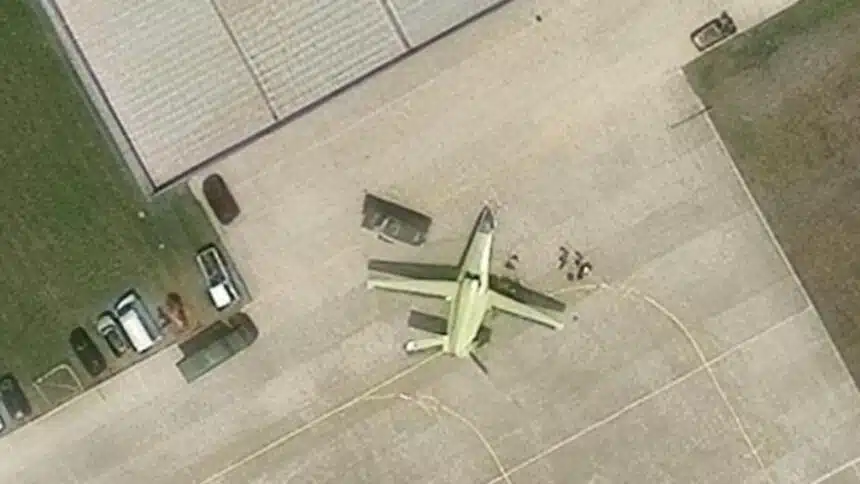
The unnamed drone shares several features with the Stingray, but also differs in key aspects of its design.
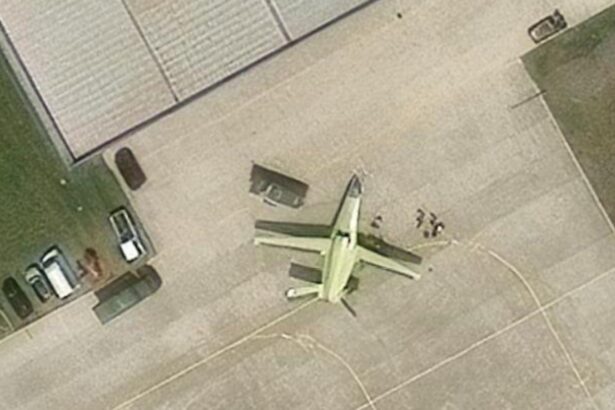
A satellite image of an air base at Pucheng in central China’s Shaanxi province has revealed a drone that appears strikingly similar to the Boeing MQ-25A Stingray. This has prompted speculation that Beijing is developing an unmanned aircraft to refuel its carrier-borne aircraft, similarly to the U.S. Navy.
The location is also home to two other known Chinese drones, the CH-7 and the Jiutian, both of which have flown. However, there is little evidence in the available image to conclude that the unnamed Stingray look-alike has an aerial refueling role, aside from its notable differences from the Stingray itself.
This does not rule out the possibility that the drone could have such a mission, but we need additional side and overhead photographs to make that determination. For instance, in the case of the GJ-21 naval UCAV, its successive images and parallel developments with the Type 076 Sichuan LHD confirmed the drone is intended to fly from the Sichuan.
I know the usual suspects are always quick to cry out, “look, a copy again”, but I’m more interested in the differences such as the non-flat air intake & the rather tapered front end possibly featuring a radome, which might suggest different roles besides an indeed similar design https://t.co/UVLfr7Q2sC
— @Rupprecht_A (@RupprechtDeino) November 19, 2026
Comparison with the Stingray
The unnamed drone has a wing configuration similar to the MQ-25A Stingray – near-straight wings with a very small sweep angle and a V-tail. The rectangular exhaust also appears to extend slightly beyond the roots of the two V-tail surfaces, which are positioned along a prominent chine line.
However, the biggest difference is the protruding dorsal exhaust, which appears to have serrated edges around the engine nacelle. Such features can contribute to a Low-Observability (LO) by managing radar reflections, although their purpose on this drone cannot be established from the image alone.
Given the quality of the image, we can’t also exclude the possibility of these being only shadows. The Stingray’s inlet, meanwhile, is integrated into the upper fuselage, which has a comparatively flat profile.
The Chinese drone’s nose also appears to be more tapered, unlike the shovel-like front end of the Stingray. Chinese military aviation researcher Andreas Rupprecht also noted a colored nose, saying it could be “possibly featuring a radome.”
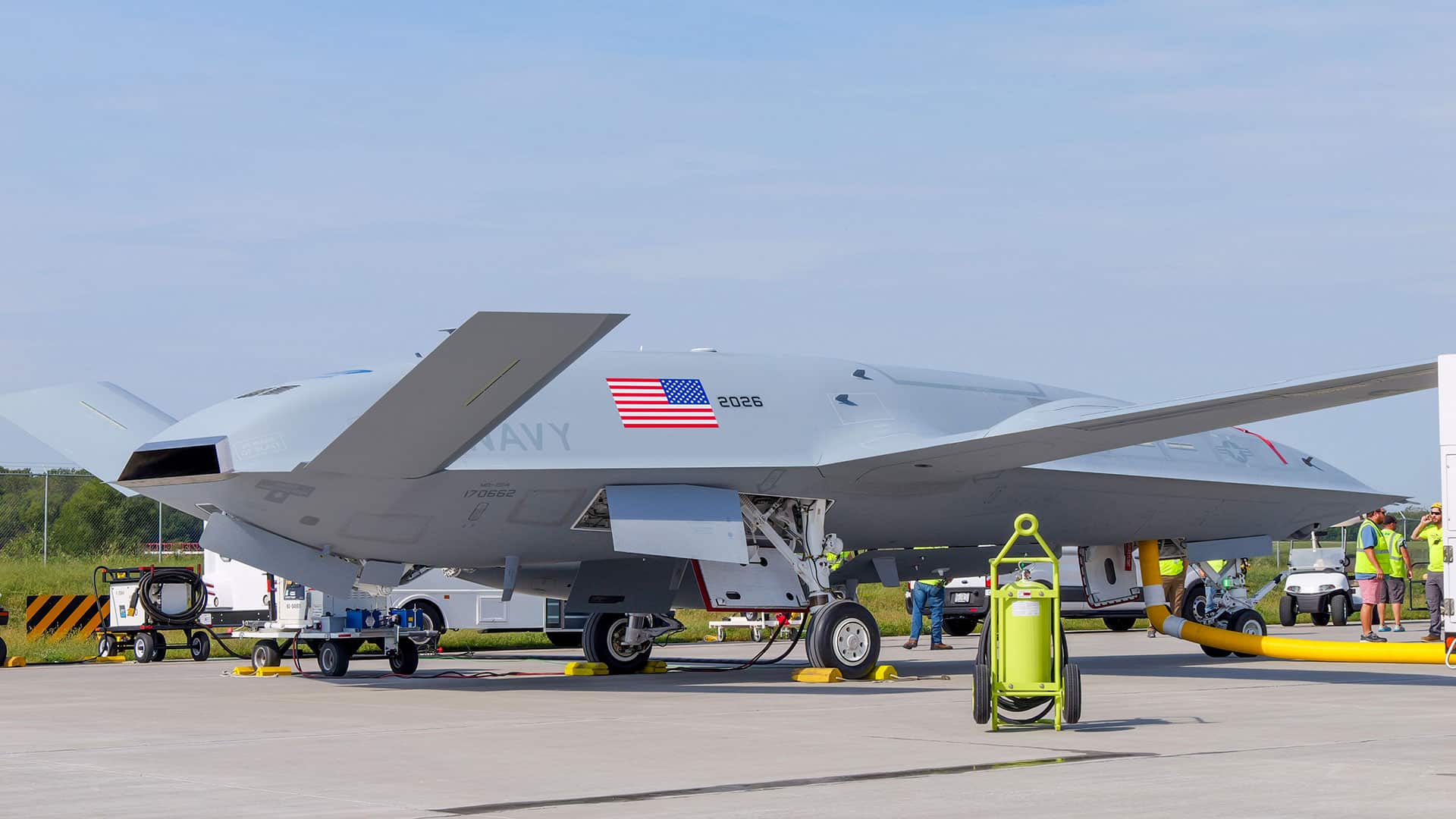
Rupprecht too opined against an immediate comparison with the MQ-25 based on these differences: “I’m more interested in the differences such as the non-flat air intake & the rather tapered front end possibly featuring a radome, which might suggest different roles besides an indeed similar design.”
Colored radomes don’t always mean a radar sensor is present, as we had noted in this piece about China’s other next-generation jet, the J-50/J/XDS. Different countries can have their own prototyping standards and protocols. Moreover, the drone could also be another example of aircraft that have appeared at radar test sites but have not subsequently been seen flying.
The drone appears to be covered in factory primer, with colored markings along the trailing edges of the wings and tail surfaces. The presence of an aerial refueling pod under the wings, similar to the Stingray’s Cobham Aerial Refueling Store (ARS), would have provided a strong indication of the drone’s role as an unmanned refueler
What does stand out, however, is the drone’s massive size, which becomes more evident when compared with the rectangular object near its port (left) wing.
Unmanned aerial refueling transforms naval power projection. We’re testing remote connections, flight profiles, and more to ensure we capitalize on this game-changing capability. https://t.co/8hqDva4xj7
— Acting Secretary of the Navy Hung Cao (@SECNAV) October 19, 2026
Does the PLA Navy need an unmanned refueler?
In the case of the J-15D electronic warfare (EW) aircraft, we previously argued that the question of whether the PLA Navy needs an aircraft comparable to the U.S. Navy’s E/A-18G Growler is not a matter of “if,” but “when.” The same reasoning applies to an unmanned refueler, as the PLA Navy may need an alternative to reduce the burden on its J-15s as operational commitments and deployments intensify in the western Pacific.
At the same time, the PLA Navy has also officially shown the YY-20A Multi-Role Tanker Transport (MRTT) refueling the J-15s. The new Y-20B has also appeared in an MRTT configuration with underwing hose-and-drogue systems.
The PLA Navy conducted air-to-air refueling training with the PLAAF , further enhancing coordinated combat capabilities.
— ChinaNavy (@China_Navy) June 4, 2025
However, given China’s tendency to field systems comparable to those operated by the U.S. military amid the ongoing great-power competition, the development of an MQ-25A analogue could also be driven by prestige. An unmanned refueler could also have an operational role as China’s carrier fleet continues to expand its capabilities.
J-15, buddy-buddy, loupé… https://t.co/E5jsTXPlnQ
— East Pendulum (@HenriKenhmann) April 19, 2020
A formation of three Chinese Navy (PLAN) J-15 “Fei Sha” carrier-based aircraft is seen in flight. The center jet is the J-15D electronic warfare variant, flanked by two J-15T fighters — one of which is equipped with a ‘buddy’ aerial refueling pod.
📸 Photo courtesy: Nick Jennings
— Global Defense Insight (@Defense_Talks) July 5, 2025
China’s older J-15 and the catapult-capable J-15T, operating from the CNS Liaoning, Shandong and Fujian, are currently assigned the buddy aerial refueling role. Ideally, the PLA Navy would benefit from an unmanned aerial refueler, but the current image does not show features consistent with that role.