While the J-XDS was recently seen with a painted radome, an exhibition poster also appears to depict a laser-related system associated with China’s other next-generation aircraft, the J-36.
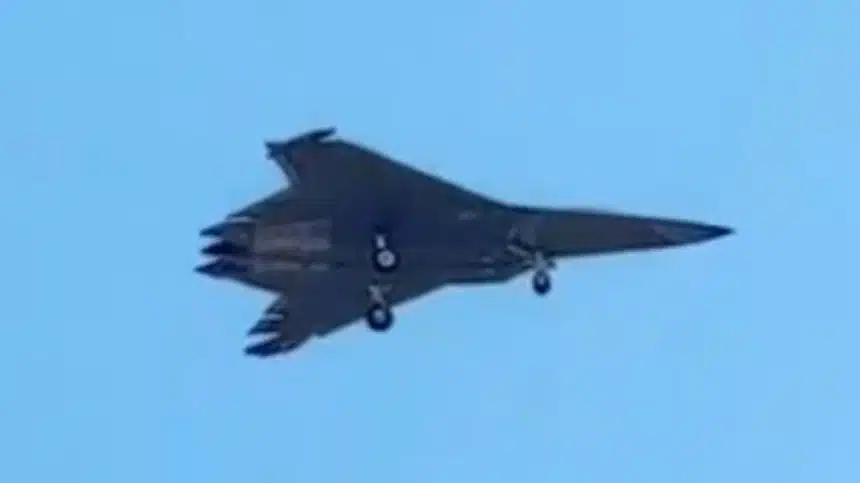
New unofficial visuals of China’s second next-generation jet, the J-XDS (also identified as the J-50) have revealed some interesting details, shedding some more light on the aircraft’s evolution. The aircraft was captured flying at low altitude, likely around the Shenyang Aircraft Corporation (SAC) facility, and appeared to feature a differently colored nose radome.
‘Hurin’, a popular user tracking the Chinese military, believes the feature suggests the presence of a radar. While this is a common practice internationally when prototypes progress to more advanced stages of flight testing, it is, however, not always the case.
Different countries and companies can have their own aircraft prototyping standards. Given the other reported changes, including larger exhaust nozzles, the aircraft could also simply represent a new prototype or development configuration.
As it seems again the prototype with the revised larger nozzles (highly likely WS-15 IMO!)
Do we have any concrete information on how many prototypes are already flying? I won’t be surprised if there already at least three. 🤔https://t.co/vDdq0tnQ6y pic.twitter.com/079o9M1aR2
— @Rupprecht_A (@RupprechtDeino) September 17, 2026
Additionally, the image of an exhibition poster depicting the larger J-36 with what is translated from Mandarin as an “Acquisition Tracking Pointing (ATP)” laser system, lends some more insight on the three-engine jet’s role. We have reported on two prototypes of the J-36, while experts believe an airframe that was captured in December 2025 could be a third one.
Leading Chinese military aviation researcher Andreas Rupprecht said in a LinkedIn post that at least two additional J-36 airframes may exist, potentially bringing the total to five. As for the J-XDS/J-50, Rupprecht believes there may be three flying examples.
J-XDS painted nose radome
This J-XDS/J-50 airframe in the video, assuming it is the third prototype, retains the moving wingtip control surfaces. When moved independently, these surfaces contribute to roll control; when moved together, they can contribute to pitch control.
The latest picture appears to be a screengrab of one of at least two clips taken by persons on the ground, showing the J-XDS/J-50 flying overhead at low altitude. The landing gear is extended, while its wingtip control surfaces are turned backward. The landing gear, the aircraft’s general trajectory and the position of the wingtip control surfaces suggest the J-50 might be on approach to land.
Yeni nesil J-50’nin test uçuşları sürüyor. pic.twitter.com/w3ze5WpZ8Y
— Enis Şenol (@senolenis) September 17, 2026
— ᵀ¹ᵐᵉ (@WZZJWZ) September 17, 2026
Notably, no flight data probe (or a pitot tube) is clearly visible on the nose. Rupprecht also observed that this airframe has larger nozzles, and believes they could be connected to the WS-15 fifth generation jet engines. In our previous report on the J-50, we observed 2D thrust vectoring nozzles on the aircraft while it was on the ground. The two split surfaces, like the one on the F-22, were at the time in the ‘open’ position.
The light-gray radome and the apparent absence of a flight-test probe could indicate a significant change in the aircraft’s configuration. Still, it should not be taken as direct evidence of the presence of a radar.
Wow 😯 … I know we have to be careful, especially since the latest CG and PS photos are getting more and more realistic, but according to some rumours the alleged photographer climbed the wall at SAC and was caught. pic.twitter.com/NRW8E5V2uO
— @Rupprecht_A (@RupprechtDeino) September 25, 2025
One of the best images showing SAC’s J-XDS …
(Image via @萌虎鲸 from Weibo) pic.twitter.com/UXfUPsmhHW
— @Rupprecht_A (@RupprechtDeino) May 28, 2025
J-36 ‘laser weapon’
The poster shared by Rupprecht, from the 14th China International Defence Electronics Exhibition, identified the laser system as the “Acquisition, Tracking and Pointing (ATP) system of the J-36’s laser weapon.” The reference to a “laser weapon” could indicate a Directed Energy Weapon (DEW), although the poster alone does not establish the system’s intended function or maturity.
If the J-36 is eventually confirmed to possess a DEW, its third engine could potentially provide additional power generation capacity. However, the engine’s precise function and the aircraft’s power-generation architecture remain unconfirmed.
Interesting, if indeed legit! 😮
An alleged “Acquisition, Tracking, and Pointing (ATP) system of J-36’s laser weapon” showcased at the 14th China International Defence Electronics Exhibition.
(Via @Devil_R22 in FighterJets)https://t.co/smTebLGC4Z pic.twitter.com/mmbkwo90g5
— @Rupprecht_A (@RupprechtDeino) September 16, 2026
As we had noted in our report about the supposed third prototype of the J-36, images had emerged in November 2025 showing a presentation suggesting China had completed ground tests of its own adaptive cycle engine. The engine shown in the presentation may be intended for future Chinese aircraft such as the J-36, although its exact application has not been confirmed.
An adaptive-cycle engine could offer advantages in fuel efficiency, thermal management and power generation. Whether these characteristics are intended to support a directed-energy weapon on the J-36 remains unknown.
The graphic illustration on the poster shows the laser ATP system as a ball turret that can swivel to various directions. If this is what the J-36 is actually seen carrying in future images, it could potentially be a retractable system, similar in concept to the retractable or internally housed sensor arrangements used on some aircraft.
A large, permanently protruding electro-optical turret could create aerodynamic and signature-management challenges for a stealth aircraft, making an internally housed or retractable configuration one possible solution.
Allegedly two images showing the J-36 flown yesterday … however, if it is indeed the fourth prototype or no. 02 or 03 is not confirmed. pic.twitter.com/5jjMkc29X9
— @Rupprecht_A (@RupprechtDeino) January 30, 2026
The wording on the poster suggests that the ATP system may be associated with laser-based acquisition, tracking and pointing functions. Its precise purpose – whether related to sensing, targeting or a directed-energy weapon – remains unclear.
Either way, the power from the third engine can be utilized for a more powerful laser beam. However, laser performance would still be affected by atmospheric conditions such as clouds, rain, fog and aerosols.
Since recently too many faked Images of the J-36 were posted and this one looks almost too good to be true I would say, let‘s be sceptical again! 🤔 https://t.co/7VpVOerxE9
— @Rupprecht_A (@RupprechtDeino) June 6, 2025
These observations could support the possibility that the larger J-36 has a significant air-to-ground mission, although its intended operational role remains unconfirmed.
Meanwhile, the J-XDS/J-50 appears to feature a diamond-shaped sensor or aperture beneath the nose. The system is visually resembling the Electro-Optical Targeting Systems (EOTS) seen on aircraft such as the F-35 and Turkish Kızılelma and Kaan.