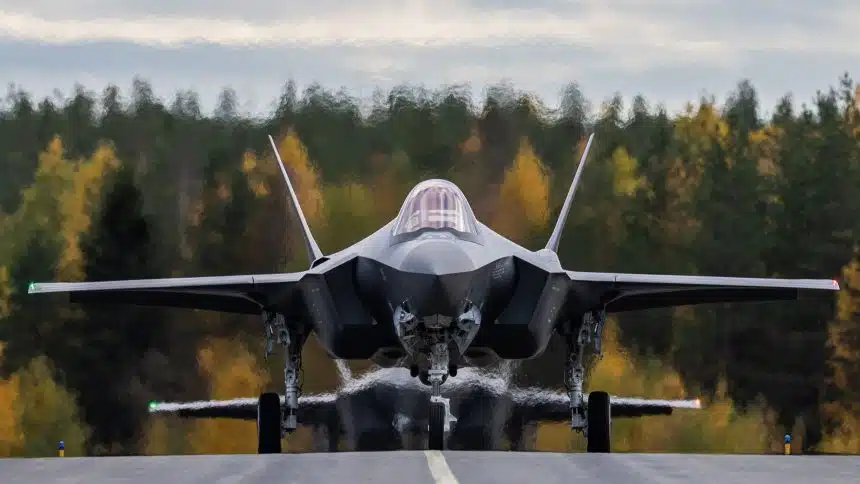
The first two F-35A Lightning IIs of the Finnish Air Force, which has signed on for 64 aircraft, arrived at the Lapland Air Wing.
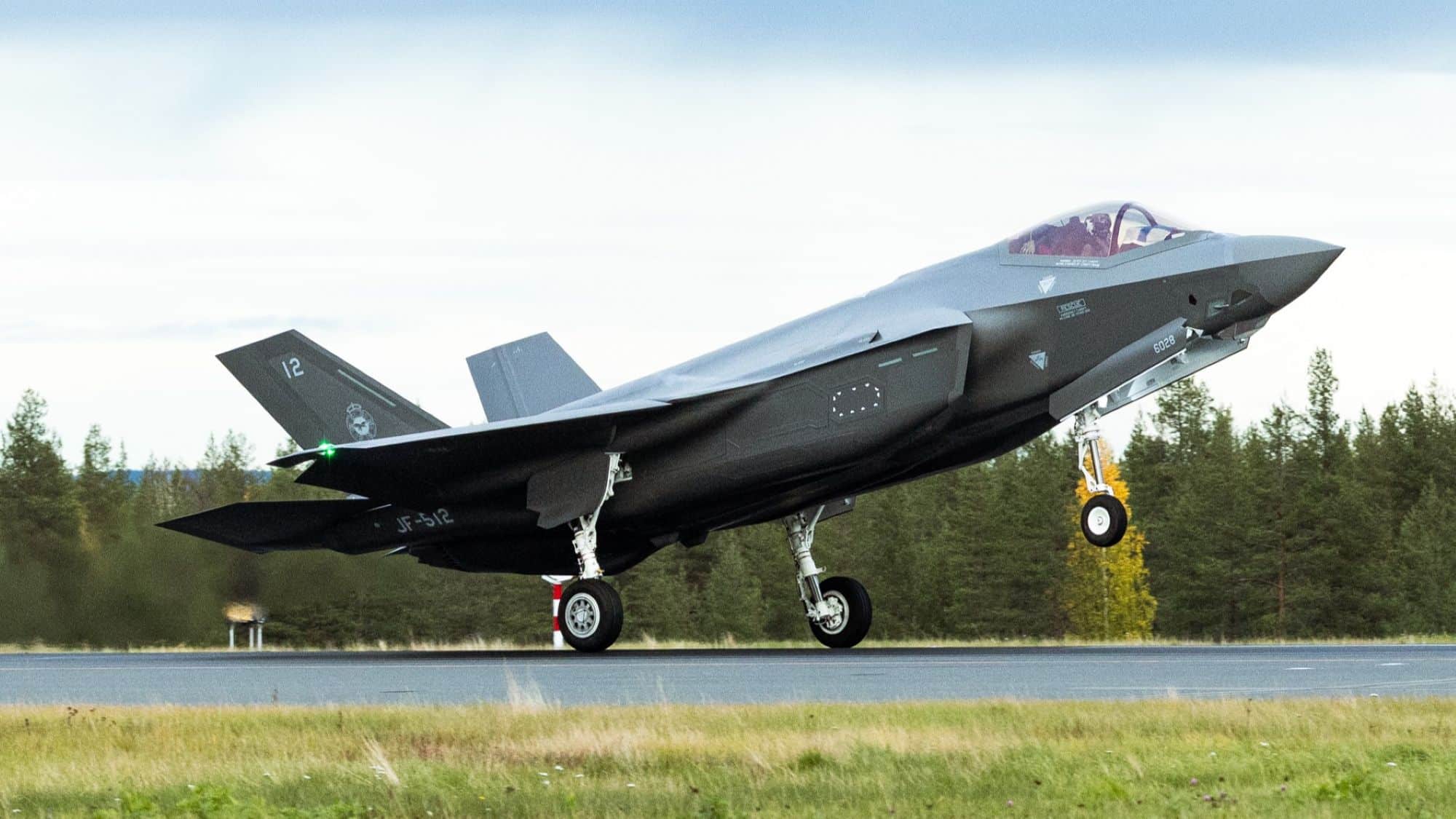
The Finnish Air Force’s (Ilmavoimat) first two F-35A Lightning II landed in Finland on Sep. 18, 2026. Tail numbers JF-510 and JF-512 landed at the Lapland Air Wing in Rovaniemi, where they will join the HävLLv 11 (11 Squadron).
The aircraft completed a three-day journey that began at Lockheed Martin’s facility in Fort Worth, Texas, and included a stop at Lajes Air Base in the Azores on Sept. 15.
However the delivery was meant to comprise three aircraft, as the two Finnish jets were part of a group of six F-35As that crossed the Atlantic, and were recorded landing at Lajes. The three others were bound for Belgium to be delivered to the Belgian Air Force.
As spotters at Lajes and the flight tracking community reported, one of the Finnish F-35As, JF-511, could not depart Lajes owing to an unidentified technical issue. All the Belgian F-35As (FL-013, FL-015, FL-016) took off successfully.
VIDEO:https://t.co/L0FdwVYxeR
— DefenceGeek 🇬🇧 (@DefenceGeek) September 18, 2026
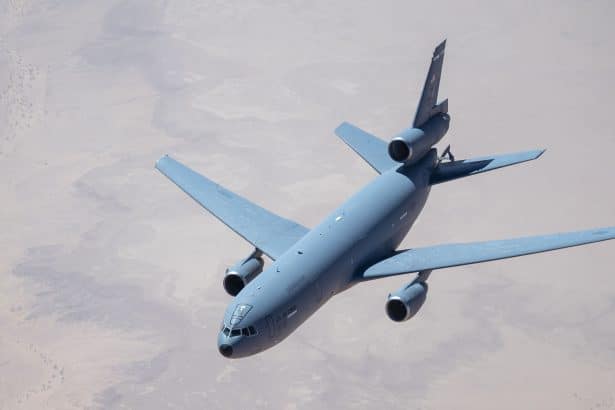
The six jets were supported by two U.S. Air Force KC-135 Stratotankers from the 100th Air Refueling Wing (100th ARW), based at RAF Mildenhall. The tankers, which flew with the callsigns “BLUE01” and “BLUE02,” refueled the fighters during the first leg of the journey and continued with them on the onward flight.
The Belgian F-35As were using the callsigns “RETRO61” to “63,” with the Finnish F-35s using “RETRO64” to “66.” RETRO is a common callsign for U.S. fighter movements across the Atlantic, particularly delivery and deployment flights.
Finnish F-35A program
Finland has ordered 64 F-35As, numbered JF-501 to JF-564, that will replace its current fleet of F/A-18C/D Hornets. The Ilmavoimat plans to achieve Initial Operational Capability (IOC) and begin delivering Lighting IIs to the Karelia Air Wing at Rissala, the service’s second main F-35 base, in 2028. The service would operate both the Hornets and the Lightning IIs simultaneously until 2030.
Eight Finnish F-35As, with JF-501 being the first one and part of Lockheed Martin’s Production Lot 17, will remain at the Ebbing Air National Guard Base (ANGB), Arkansas, for training. Around 150 Ilmavoimat personnel, including pilots and other specialists, are being trained by the 57th Fighter Squadron (57th FS).
JF-501 was delivered to Ebbing ANGB in January 2026. This training program is scheduled to conclude in early 2028, when the remaining F-35As will be ferried across the Atlantic.
Arrival and entry in service in Finland
The Ilmavoimat stated that the F-35As entered Finnish airspace at 5:21 pm Local Time and landed in Rovaniemi at 5:45 pm, escorted by F/A-18 Hornets. However, since the jets were piloted by U.S. Air Force pilots for the delivery flight, the Ilmavoimat roundel on the nacelle were covered.
The service added that the “JF” designation in the tail numbers is derived from the English term “Joint Fighter.” The statement mentioned “It underlines the added value and importance of the aircraft for the capability of all the Services.”
The aircraft will now be put through a full “post-ferry flight inspection” ahead of a formal Arrival Ceremony on Oct. 1. It will be attended by the country’s President, Alexander Stubb, and the outgoing and incoming commanders of the Lapland Air Wing, Colonels Saku Jokas and Tuuka Elonheimo, respectively.
Finland’s first F-35 fighters arrived at Lapland Air Wing in Rovaniemi on 18 September 2026 at 5:45 pm. Welcome, JF-510 and JF-512! 🇫🇮
#ilmavoimat #F35programme #F35 @Puolustusvoimat @thef35 @theF35JPO pic.twitter.com/iDVCw8vCfC
— Ilmavoimat (@FinnishAirForce) September 18, 2026
The Ilmavoimat said that after the conclusion of the U.S.-based training at Ebbing ANGB and Eglin AFB, Florida, in 2028, the training of pilots, mechanics and specialists will be conducted entirely in Finland. Eglin AFB hosts the F-35 Academic Training Center and the initial six-month training course. Finland would also receive support from other F-35 operators, including Norway and Denmark.
The service had also previously talked about undertaking massive infrastructural work to support the F-35, including “shelter, maintenance and training and storage facilities and airport structure.” While the work at Rovaniemi, home to the Lapland Air Wing, is complete, the work at Rissala (Karelia Air Wing) is due to be completed in 2027.
Meanwhile “preparations are underway” at the Satakunta Air Wing (Pirkkala) and the Air Force Academy in Tikkakoski “for the upcoming F-35 era.”
A new era in the Finnish Defence Forces! 🇫🇮 Finland’s two first F-35A Lightning II multirole fighter jets have arrived at Lapland Air Wing in Rovaniemi, Finland on 18 September 2026. #ilmavoimat #F35programme @Puolustusvoimat @thef35 @theF35JPO @LockheedMartin pic.twitter.com/5rwZ6fdJ9z
— Ilmavoimat (@FinnishAirForce) September 18, 2026
New era for Finland’s and Europe’s defense
The Ilmavoimat release called the F-35 “critical for the Air Force’s combat capability into the 2060s,” for which it has been preparing since April 2023 when it joined NATO. General Janne Jaakkola, Commander of the Finnish Defence Forces, said they plan to fully utilize the advanced muti-role fighter’s performance potential for both Finland “and as a seamless part of the Alliance’s air defence and striking power.”
Ensimmäiset suomalaiset F-35-hävittäjät saapuivat Lapin lennostoon Rovaniemelle 18. syyskuuta 2026 kello 17.45. Tervetuloa, JF-510 ja JF-512!
#ilmavoimat #F35hanke #F35programme #F35 pic.twitter.com/RqDr1Gn5it
— Ilmavoimat (@FinnishAirForce) September 18, 2026
The Commander of the Finnish Air Force, Major General Timo Herranen, described the F-35 as a “force multiplier and a battlefield quarterback” that brings in advanced features compared to Finland’s current Hornet fleet.
“The complex and advanced sensors of the fighter enable detecting and identifying new types of targets, and sensor fusion merges data […] to support the pilot’s situational awareness,” he said. “This information […] can be shared with the other actors on the ground, at sea and in the air.”
-Cooperation went smoothly both on the ground and in the air, and our discussions with the Norwegians were once again extremely useful as we prepare to begin operating our new F-35 aircraft, says Fighter Squadron 11’s Executive Officer major Antti Hanhirova from Lapland Air Wing.
— Ilmavoimat (@FinnishAirForce) September 11, 2026
Finland is deepening cooperation with Norway, Denmark, the Netherlands, Belgium and the United States in F-35A Lightning II flight operations, cross-servicing and armament sharing. #ilmavoimat #F35
🇫🇮🇳🇴🇩🇰🇳🇱🇧🇪🇺🇲
Read more: https://t.co/YdMLeQSE5z pic.twitter.com/XzMv2GcYpG
— Ilmavoimat (@FinnishAirForce) September 17, 2026
Herranen noted the F-35’s growing range of munitions, jamming systems and stealth capabilities that are vital in highly contested environments, and “further enable us to engage in combat together with the Army and the Navy.”