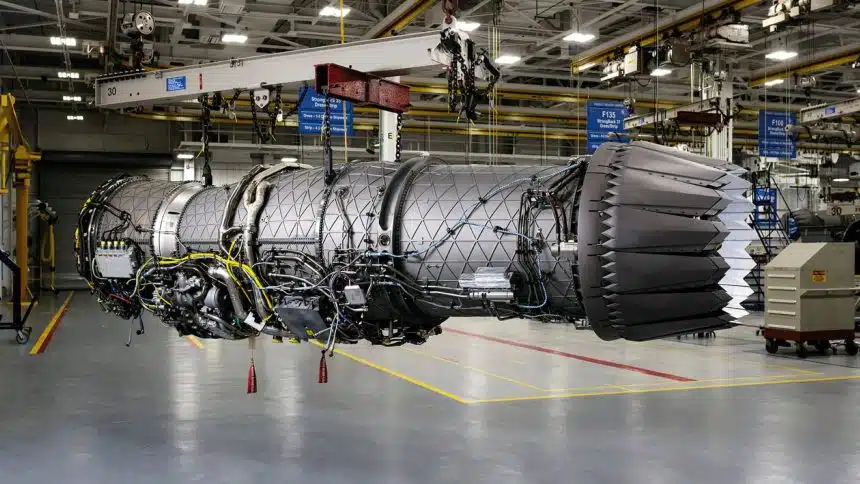
The review validates the maturity of the F135 Engine Core Upgrade, designed to support the additional power generation and thermal management needs of the future Block 4 upgrades.
Engine maker Pratt & Whitney has completed the Risk Reduction Design Review (RRDR) for the Engine Core Upgrade (ECU) of the F-35’s F135 engine. The milestone validates the ECU’s maturity before moving to production, parent company RTX announced on Sep. 15, 2026.
The F135 ECU is a major program intended to support the future Block 4 hardware upgrades, ranging across a new radar, displays, sensors, avionics and advanced computing hardware. The ECU is intended to provide the additional power and thermal-management capacity required by the Block 4 systems.
Earlier Pratt & Whitney and Collins material said the ECU, when combined with the EPACS power-and-cooling system, could provide a 7% increase in range and thrust and twice the cooling capacity. RTX says the ECU maintains high commonality with the existing F135 architecture and is designed as a “drop-in upgrade” for both new-production and fielded aircraft, with retrofits performed at F135 depot facilities.
The review evaluated the ECU’s ability to provide the additional power and thermal management capacity needed to support Block 4 and beyond capabilities across all three F-35 Lightning II variants.
— RTX (@RTX_News) September 15, 2026
Review covers design maturity to supply chain reliability
RTX described the RRDR as “a major program milestone that validates the maturity of the ECU design and advances the program toward production.” The RRDR covered engineering aspects including detailed design elements, propulsion technologies, integration considerations and risk-reduction activities.
These are “critical to delivering full engine life and providing the additional power and thermal management capacity needed to support advanced sensors, weapons and other Block 4 and beyond capabilities across all three F-35 Lightning II variants.”
The industrial aspect included assessing the supplier and vendor base’s “readiness to support future production and retrofit.” President of Pratt and Whitney Military Engines Jill Albertelli touched upon how the RRDR demonstrates the maturity of the F135 Engine Core Upgrade: “As the selected propulsion modernization solution for the F-35, ECU builds on the proven F135 architecture to enable the power and thermal management needed for future capabilities, while leveraging an established global production and sustainment enterprise. This approach strengthens fleet readiness and provides operators with a proven, cost-effective path to sustain and modernize the F-35 for decades to come.”
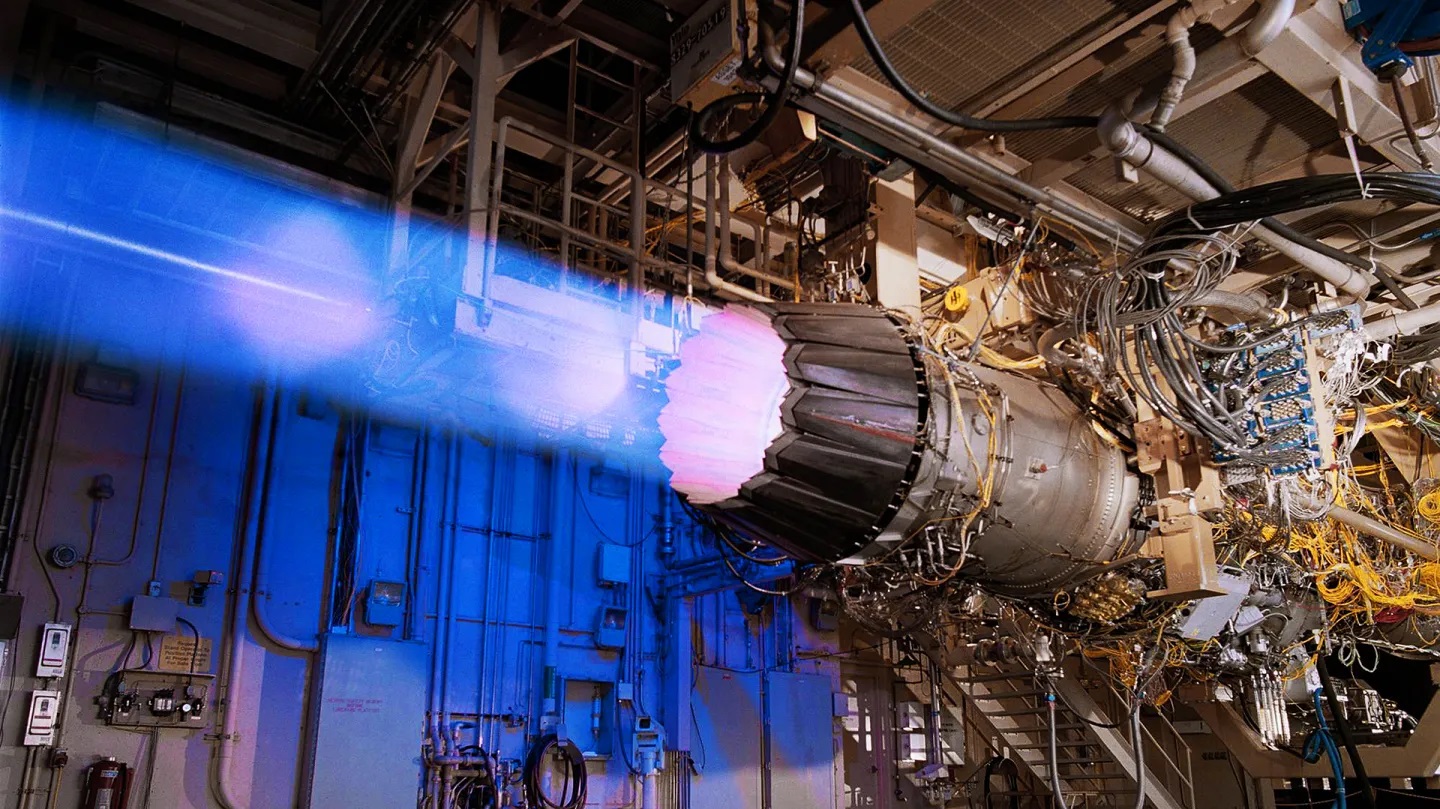
The F-35 Propulsion Program Manager, U.S. Navy Capt. Mitch Grant, said strong collaboration between the industry and the government was crucial to the successful RRDR and demonstrated the ECU design. “The ECU program remains on track to deliver substantially improved readiness and to support F-35 modernization to outpace our adversaries,” Grant added.
Block 4 hardware upgrades
The Northrop Grumman AN/APG-85 Active Electronically Scanned Array (AESA) radar, part of the new Block 4 upgrades, is the biggest piece of electronic hardware that the F-35 fleet is slated to receive. The APG-85 is being developed as a new-generation replacement for the APG-81 and will be compatible with all three F-35 variants.
Other known Block 4 hardware upgrades include a new Integrated Core Processor (ICP) chip delivering higher computing and data processing power for the increased sensor fusion needs, a next-generation Distributed Aperture System (DAS), new electronic warfare (EW) capabilities, better cockpit displays, enhanced communications suites, and an improved navigation system.
The aforementioned Block 4 hardware is supported by the Technology Refresh 3 (TR 3) hardware and software baseline. The TR-3 effort has itself faced major technical deficiencies and delays.
New hardware, more power and more cooling
These increasingly sophisticated electronic systems require more electrical power, while their higher processing and sensor capabilities also increase the aircraft’s thermal-management requirements. Pratt & Whitney says the F135 ECU is intended to address part of this requirement while also improving engine durability and performance.
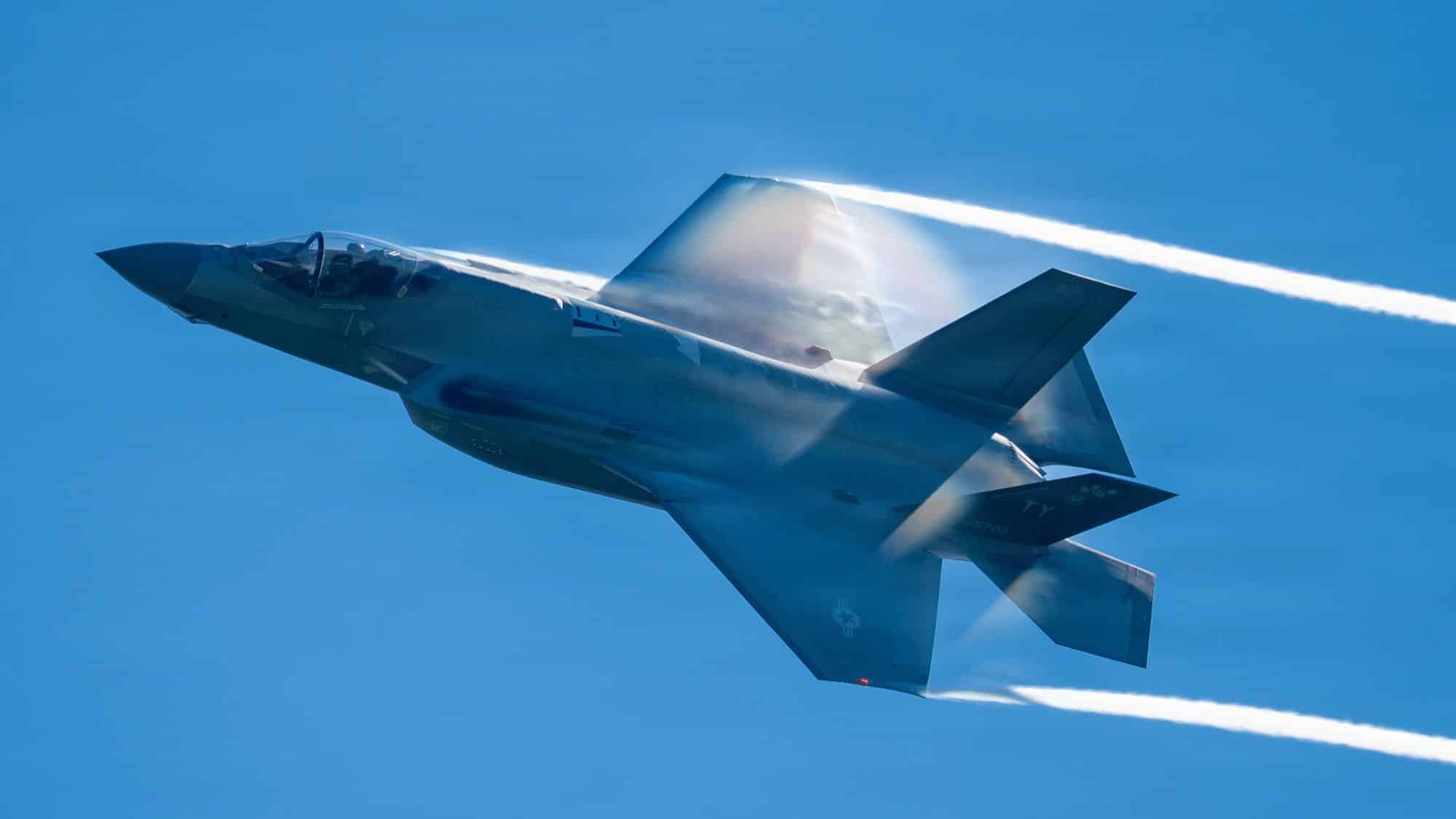
As we had reported in context of F-35s being delivered without the AN/APG-85 radars, Rep. Rob Wittman has previously said the APG-85 could require about 82 kW of electrical power, illustrating the scale of the F-35’s growing power-generation requirements.
The existing F-35 PTMS provides about 30 kW of cooling capacity, while future configurations are expected to require substantially more cooling as additional Block 4 capabilities are introduced. Earlier program discussions have put future power and cooling requirements in the roughly 47-51 kW range, although subsequent requirements have evolved.
Honeywell revealed to Janes in September 2023 that it was developing the new PTMS for the F-35. The PTMS uses bleed air from the F-35’s Pratt & Whitney F135 engine to cool the aircraft’s heat-generating subsystems including some key avionics.
The PTMS also supports the F-35’s main engine start, cockpit conditioning, and provides emergency power. Janes added that the existing PTMS provides up to 30 kW of cooling capacity for the F-35.
Collins Aerospace also reported in August that it completed “altitude testing” of its own Enhanced Power and Cooling System (EPACS) for the F-35’s thermal management. The new system is intended to replace the Honeywell-built PTMS currently installed on the F-35. Honeywell is also pursuing a phased upgrade to the existing PTMS architecture.