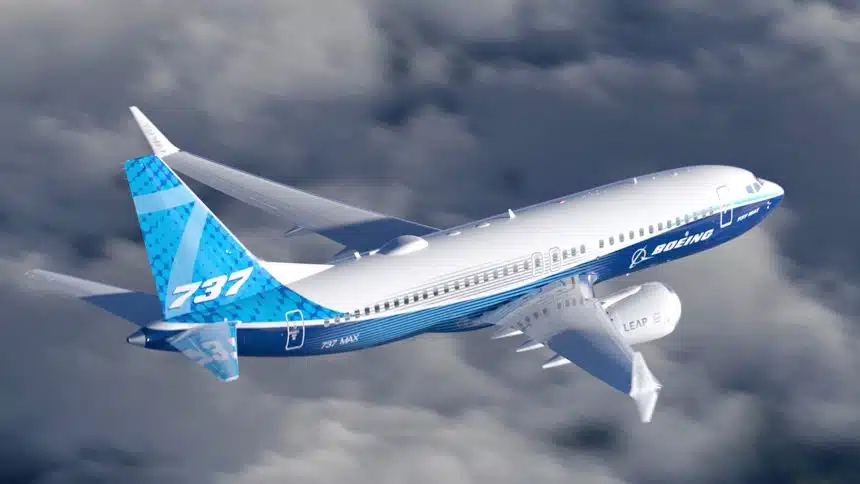
Aviation Week reports on a statement by an Air Mobility Command (AMC) spokesperson confirming the USAF’s intent to procure the Boeing 737’s MAX variant for the first time, becoming one of the type’s first military operators.
In 2026, budgetary approval was granted to the U.S. Air Force for a single-aircraft expansion to the service’s fleet of C-40 (Boeing 737) VIP aircraft. The C-40B and C-40C variants currently in service are derived from the Boeing 737-700, which is part of the 737 Next Generation or NG series that preceded the MAX.
“The Air Force intends to purchase a 737 MAX to meet this requirement,” an unnamed AMC spokesperson said, in a statement noted by Brian Everstine of Aviation Week.
The buy had been explored before but didn’t proceed. However, now the service is using $250m authorized in the ’26 NDAA to expand C-40 capabilities.
Some background: https://t.co/MjW7ZZQf5O
— Brian Everstine (@beverstine) September 16, 2026
The potential procurement of MAX series aircraft had been floated the year before, when it was reported that the Air Force had settled on the prospect of a single type to replace both its C-32 (Boeing 757) and C-40 fleets. As the use of a European-designed Airbus aircraft for a high profile role that includes transporting senior members of the U.S. Government would be politically unviable, interest quickly turned towards the MAX.
While there is no direct Boeing 757 replacement in Boeing’s current lineup, the 737 MAX 10 would match its capacity while suffering from reduced range, and the MAX 7 would offer a direct lineage from the 737-700 based C-40s.
The MAX, however, is well known for its troubled beginnings in civilian service. A worldwide grounding of the MAX series for almost two years followed two high profile incidents, Lion Air Flight 610 in 2018 and Ethiopian Airlines Flight 302 in 2019, which resulted in the fatalities of all on board. Erroneous angle of attack (AoA) data led to the airliners’ MCAS (Maneuvering Characteristics Augmentation System) activating and overriding the control inputs of the pilots, eventually causing a stall. Boeing were heavily criticized after it became apparent that details about MCAS had been withheld from pilot training and operations manuals.
Boeing and FAA failed to comprehend how powerful and persistent MCAS is on the Boeing 737 MAX. Now it is apparent that if effective action is not taken in less than 40 seconds, recovery is not possible. https://t.co/wIUkO64ELM via @nytimes @dgelles
— Sully Sullenberger (@Captsully) April 11, 2019
Rectification measures, requiring data from two AoA sensors for MCAS to activate, and allowing pilots to override MCAS, were implemented in order to secure the MAX’s return to service. 737 MAX aircraft have, for the most part, operated safely since the return to service, but its shaky reputation lingers among public opinion.
Details about MCAS are sure to be included in the ‘differences training’ for C-40B/C crews that was contracted out by AMC earlier this year.
The exact MAX variant the Air Force plans to procure has not yet been identified, and the service is likely still considering its possible options. While, as mentioned above, the MAX 7 would be the most direct analog to the current C-40B/C, it was only certified by the Federal Aviation Administration in August 2026 and has yet to be delivered to any customer. This infancy compared to the more mature MAX 8 and MAX 9 options might dissuade the Air Force, particularly for such a high stakes mission set.
✈️ The FAA has granted an amended type certificate for the @Boeing 737-7, paving the way for deliveries of the penultimate MAX derivative to get underway in early 2027.https://t.co/9Yg9N3OPAO#Boeing @FAANews pic.twitter.com/lfUPLga745
— Aviation Week (@AviationWeek) August 4, 2026
In service, the aircraft will almost certainly become known as the C-40D. The – for now – single aircraft will operate alongside the existing fleet, though it will undoubtedly be used as part of the overall assessment for the gradual replacement of legacy aircraft over the years to come.
This article originally reported that this would make the U.S. Air Force the first military 737 MAX operator. It has been updated to reflect the fact that Boeing Business Jet (BBJ) variants of the 737 MAX 8 are in service with the Royal Australian Air Force and Republic of Korea Air Force.