Newly declassified footage aired by ’60 Minutes’ offers a closer look at the complex rescue of the F-15E crew shot down over Iran, including the previously reported C-295W and a deliberately blurred Little Bird whose appearance raises new questions about what the Pentagon still wants to keep hidden.
U.S. news and feature television show ’60 Minutes’ aired an exclusive interview with the U.S. Air Force F-15E Strike Eagle weapons systems officer (WSO) who, along with the unidentified pilot of the aircraft, was shot down over Iran on April 3, 2026.
While the interview featured information and video not previously seen in the public domain, it also left many questions about the rescue unanswered. The pilot of the F-15E Strike Eagle was not included in the interview.
The Sunday, Sept. 13, 2026 segment, titled “Shot Down Over Iran,” was included in the season premiere of the award-winning CBS news and documentary program, now in its 59th season. The interview with the F-15E WSO, identified only by his mission callsign, “DUDE 44 Bravo,” was hosted by Emmy Award-winning correspondent Norah O’Donnell.
As already reported here at The Aviationist, the WSO provided significant new details about the missile impact that catastrophically damaged the Strike Eagle, his damaged ejection seat and parachute, the injuries he suffered during the landing, and his efforts to evade Iranian forces before being rescued.
However, from an aviation perspective, some of the most interesting material in the 60 Minutes report was contained not in the interview itself, but in the newly declassified footage accompanying it.
The Blurred Little Bird
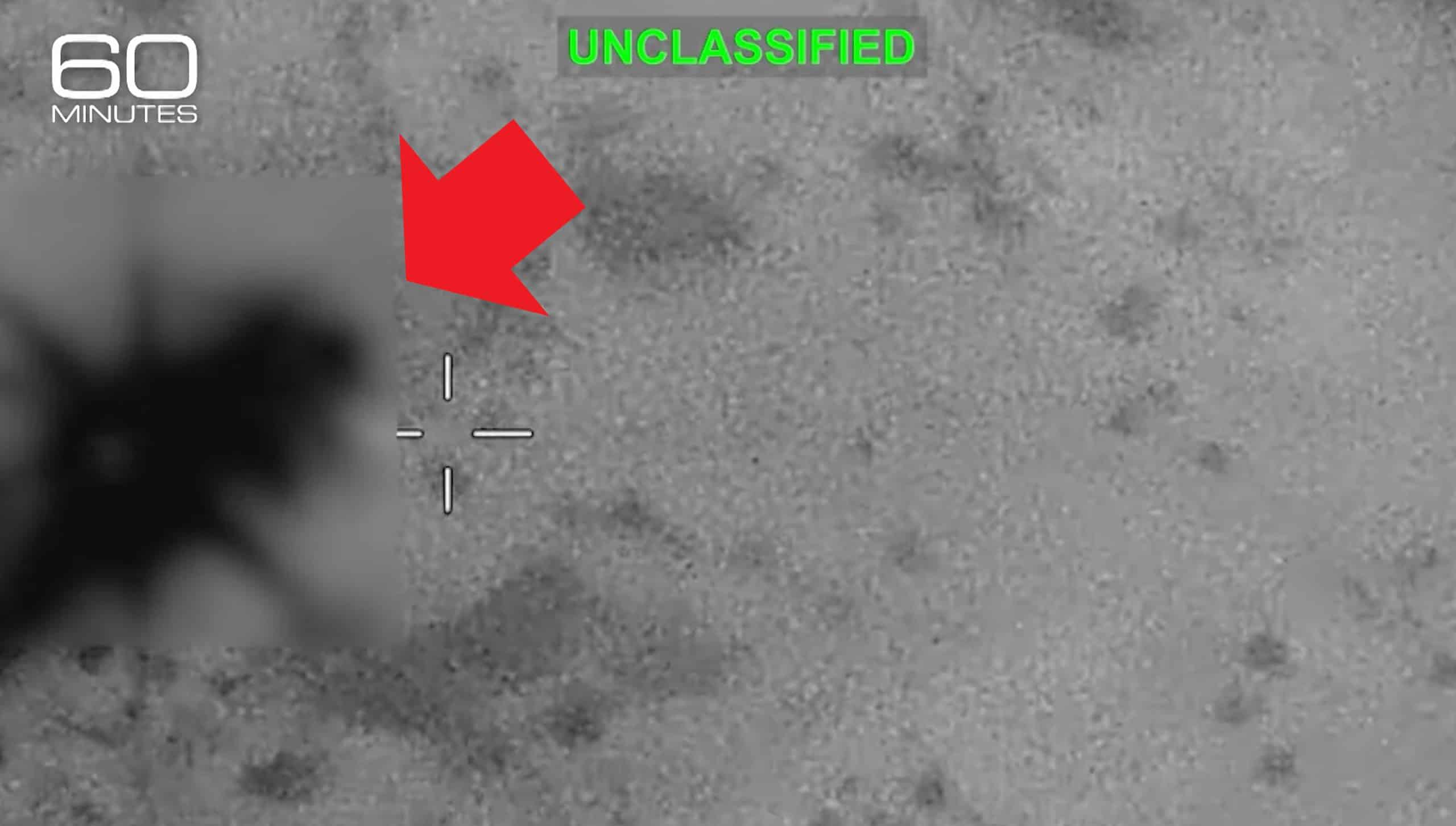
One of the videos shows what appears to be imagery recorded by an unidentified surveillance platform during the final extraction of DUDE 44 Bravo from the ridgeline where he had taken refuge.
Curiously, while the earlier HH-60W Jolly Green II helicopters involved in the rescue of DUDE 44 Alpha were shown without censorship, the helicopter used during Bravo’s extraction was deliberately blurred.
The basic identity of the aircraft is hardly a secret at this point. As previously reported, the second rescue mission involved two MC-130J Commando II aircraft landing on wet, sandy terrain inside Iran and unloading three A/MH-6 Little Bird helicopters. The Little Birds then flew to the objective area to recover the downed WSO.
The blurred helicopter visible in the newly released imagery is also consistent in size and general configuration with a Little Bird.
What is more interesting, therefore, is not necessarily what type of helicopter was used, but why the Pentagon still considered it necessary to conceal its appearance.
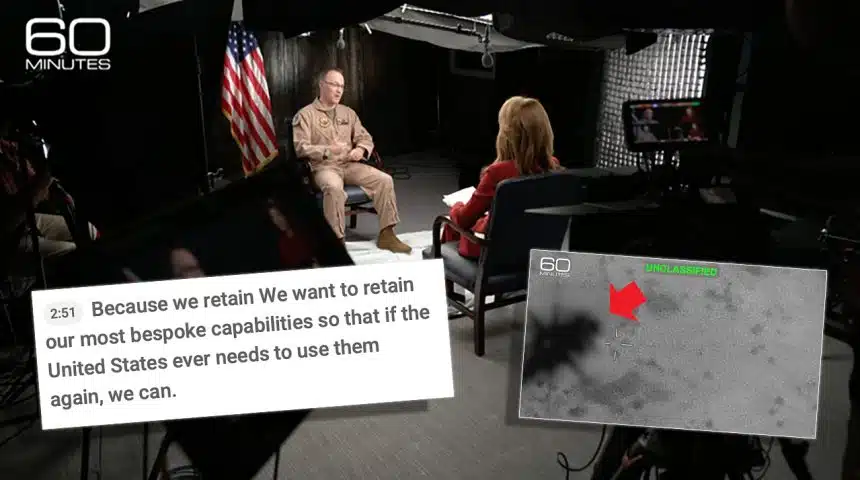
That question was put directly to Air Force Gen. Dan Caine, Chairman of the Joint Chiefs of Staff, in a separate video published by 60 Minutes.
O’Donnell asked Caine why the image of the helicopter had been obscured. Caine explained that the United States wants to protect its “most bespoke capabilities” so they can be used again if required, adding that he did not want potential adversaries to see exactly what was involved.
That answer is particularly noteworthy because the involvement of Little Birds in the operation had already been publicly discussed months earlier.
The decision to censor the aircraft could therefore be intended to conceal details of its configuration rather than the basic helicopter type itself. These might include modifications to the airframe, sensors, defensive systems, exhaust treatment or other features that could potentially reveal infrared or other signatures useful to an adversary.
There is, however, no evidence in the footage released so far that the helicopter was some previously unknown “stealth Little Bird.”
A Stealth Little Bird?
Nevertheless, the decision to blur the aircraft inevitably revived speculation surrounding highly modified special operations helicopters.
Interestingly, this is a subject The Aviationist explored more than 15 years ago.
On May 25, 2011, only weeks after Operation Neptune Spear and the raid that killed Osama bin Laden in Abbottabad, Pakistan, The Aviationist founder and editor David Cenciotti raised the possibility that a modified, quieter Little Bird might one day accompany other low-observable helicopters on particularly sensitive missions.
At the time, illustrator Ugo Crisponi prepared a conceptual rendering of what such a fictional “Stealth Little Bird” might look like.
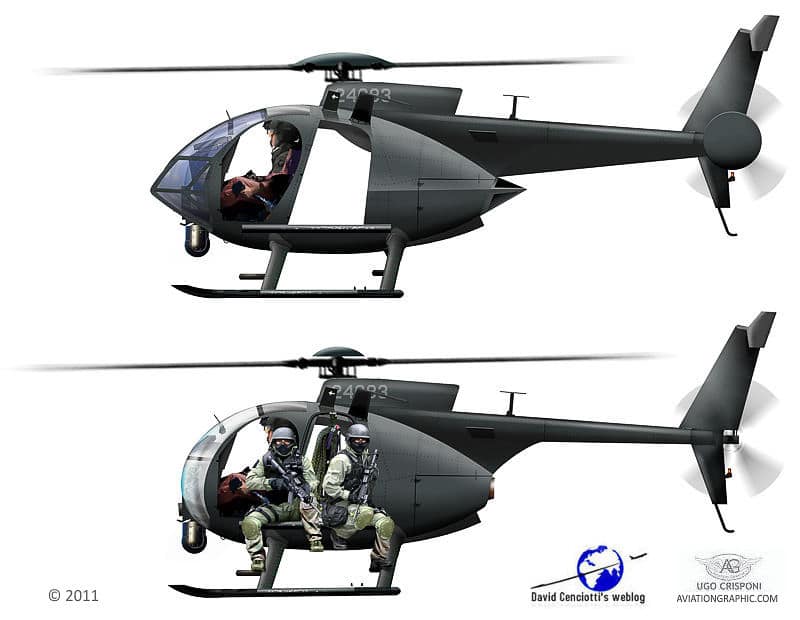
The idea was partly inspired by the known history of highly modified Hughes OH-6 helicopters used by the CIA during the Vietnam War. The so-called “Quiet One” incorporated extensive modifications intended to reduce the acoustic signatures normally associated with a helicopter.
The Little Bird article followed The Aviationist’s extensive analysis of the mysterious modified Black Hawk exposed by the May 2, 2011 raid on bin Laden’s compound.
One of the helicopters used during Operation Neptune Spear crash-landed inside the compound and was subsequently destroyed by U.S. forces, leaving portions of its modified tail section behind. Those remains provided the first public evidence that a heavily modified, low-observable Black Hawk derivative had been used during the operation.
Cenciotti and Crisponi produced a series of conceptual renderings based on the limited evidence available at the time. Those images subsequently appeared in media outlets around the world and influenced many later depictions of the still-secret helicopter.
It is important, however, not to draw too much from that historical connection.
Nothing in the newly released DUDE 44 imagery demonstrates that a stealth version of the MH-6 was involved in the Iran operation. A much less exotic explanation is that the helicopter incorporated mission-specific equipment or signature-reduction features that U.S. Special Operations Command does not want shown in high-quality imagery.
Caine’s comments establish that something about the aircraft was considered sensitive. They do not tell us exactly what that was.
The C-295W
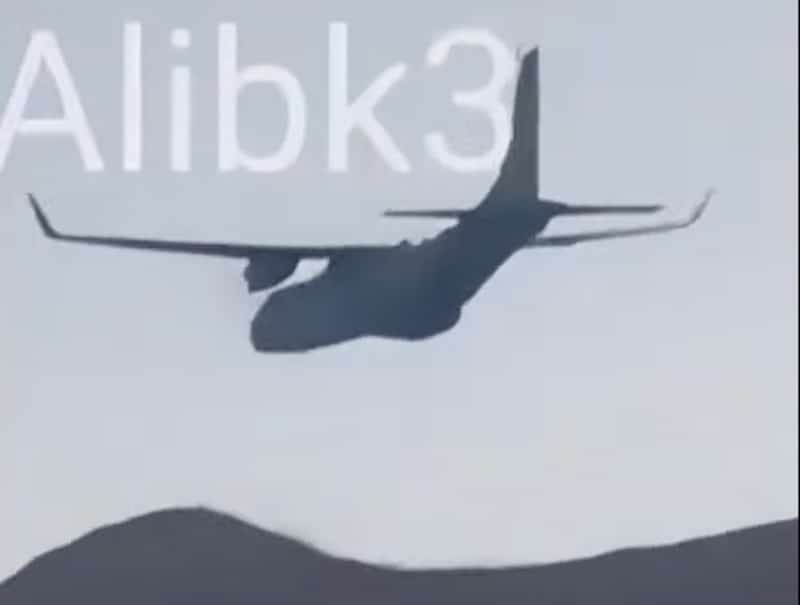
Another interesting video clip in the 60 Minutes program shows what appears to be a C-295W twin-engine turboprop aircraft flying at low altitude.
Unlike the blurred Little Bird, however, the presence of the C-295W is not a new discovery.
Videos showing an unmarked C-295W flying at low altitude inside Iran emerged while the rescue operation was still unfolding, and The Aviationist reported as early as April 5 that the aircraft appeared to belong to the secretive U.S. Air Force 427th Special Operations Squadron.
The 427th SOS operates a small and unusually diverse fleet for specialized missions, including aircraft configured for discreet infiltration, exfiltration and other special operations support. The unit’s activities are rarely publicized.
Two days later, additional details released by U.S. officials provided important context for the C-295W sighting.
The second rescue mission involved two MC-130J Commando II aircraft landing on what President Donald Trump described as wet and sandy farmland. The aircraft delivered the Little Birds and the personnel required for the extraction.
Once on the ground, however, the MC-130s became stuck and were unable to take off again.
Trump said that “lighter, faster aircraft” were subsequently sent in to evacuate the personnel, a description that appeared to correspond with the C-295W footage already circulating online.
The C-295W imagery shown by 60 Minutes therefore provides another look at an aircraft whose apparent involvement in the operation had already been identified through open-source reporting in April.
Based on the context of the footage, the aircraft could be associated with the improvised extraction required after the MC-130s became immobilized, although the short video alone does not establish the exact phase or purpose of the flight.
The stranded MC-130s could not simply be abandoned intact. According to the account subsequently provided by U.S. officials, the aircraft and Little Birds remaining at the improvised landing site were destroyed to prevent sensitive equipment from falling into Iranian hands.
What Did the Pentagon Want to Hide?
The contrast between the C-295W and the blurred Little Bird is perhaps one of the more intriguing details of the newly released material.
The C-295W had already been filmed by civilians during the operation. The basic use of Little Birds had also been publicly disclosed. Yet the Pentagon still chose to obscure the helicopter that actually extracted DUDE 44 Bravo.
This suggests the censorship may have been less about hiding the existence of the aircraft and more about preventing close examination of its precise configuration.
Special operations helicopters frequently incorporate systems and modifications that are not present on standard aircraft, particularly equipment related to communications, sensors, navigation, electronic warfare, survivability and operations at night or under degraded visual conditions.
Signature management may also be a consideration. Infrared imagery, depending on its quality and geometry, can reveal details about engine exhaust and heat distribution that operators would prefer not to make available to potential adversaries.
For now, however, anything more specific remains speculation.
A Rescue Destined for Hollywood
While many details surrounding the mission remain classified, the rescue of DUDE 44 Alpha and Bravo is already on its way to becoming a major Hollywood production.
In May 2026, reports emerged that Universal Pictures and director Michael Bay were developing a feature film based on the operation.
According to reporting at the time, the movie will tell the story of the two U.S. airmen and the extraordinary effort undertaken to recover them after their F-15E Strike Eagle was shot down during Operation Epic Fury.
The project is expected to be based on an upcoming book by author Mitchell Zuckoff, scheduled for publication in 2027. Bay previously worked with Zuckoff on 13 Hours, the film based on the 2012 Benghazi attack.
Given the scale of the mission, the extraordinary survival story of DUDE 44 Bravo and the array of specialized aircraft and personnel involved, it is easy to understand Hollywood’s interest.
But despite the new information and imagery released by “60 Minutes,” a significant portion of the operation remains hidden from public view.
And, perhaps fittingly for one of the most complex special operations aviation missions in recent history, one of the clearest reminders of that secrecy is an aircraft that everyone already knows was there, but that the Pentagon still does not want us to see clearly.