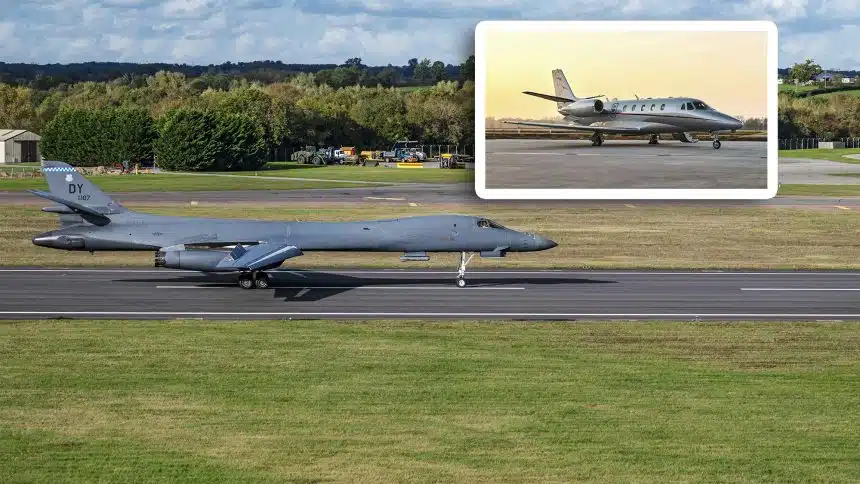
An odd incident unfolded on Sep. 12, 2026 when Cessna 560XLS+ D-CJMK operated by VistaJet landed at the U.S.-operated RAF Fairford instead of Cotswold Airport (Kemble), just 11 miles to the west.
Immediately after the aircraft touched down an emergency response by the base’s security forces was triggered. RAF Fairford is, of course, not only an active U.S. Air Force facility, but is currently – and controversially among some – hosting B-1B Lancer strategic bombers which have taken part in the U.S.-Iran war.
Though the Cessna business jet’s pilot, quickly realising their mistake, wished to make an immediate departure to head to the correct airfield, base security insisted the aircraft stay until interviews and paperwork could be completed. Arriving just after 09:00 local time, the jet departed for the short hop to Cotswold Airport – commonly known as Kemble – three hours later at 12:10.
D-CJMK, a Cessna 560XLS+ or Citation Excel, was built in 2019 and is available for private charters worldwide. It offers customers nine luxurious leather seats, power outlets, and a private lavatory.
Kemble and Fairford’s close proximity, as well as their similar latitude and runway configuration, mean this is not the first time a civilian pilot has made such a mistake. This would have been readily apparent to the base’s security services, and been part of the reason why the incident was resolved relatively quickly.
In fact, an incredibly similar error was infamously made by a U.S. Air Force C-17A Globemaster III pilot in 2012, albeit in Florida rather than Gloucestershire. In that occurrence, the C-17’s excellent short takeoff and landing (STOL) performance were demonstrated clearly – the planned arrival airfield featured a runway in excess of 11,000 feet, while the small airfield they actually landed at boasted only a 3,580 foot runway.
Notably, like in Florida, the planned arrival airfield operates without full air traffic control, instead offering a Flight Information Service (FIS). Instead of actively controlling aircraft, the FIS frequency provides only advisory information, usually relating to weather, surface conditions, and basic reports of active traffic. As such, all approaches to Kemble – despite the airfield regularly handling business jet traffic as well as occasional airliners – including, historically, up to the size of Boeing 747s – are flown at the discretion of pilots and there is no controller to warn them if they are appearing to line up for the wrong aerodrome.
Well that’s it done!! Bringing the noise on a wet runway at Kemble.
“Negus” is at its new home in the Cotswolds. If rumours are to be believed, this aircraft will be preserved for a museum. I’d love to be involved in making that happen if the boss is watching! #BA747Farewell pic.twitter.com/gVI5LXmcJV
— Scott Bateman MBE (@scottiebateman) October 8, 2020
If there is to be further investigation into this erroneous landing, the continued operation of an airfield of Kemble’s size and activity in this manner in a very airfield-crowded region could be called into question, although it has notably done so successfully since its shift into private hands from the Royal Air Force in 2001.
The airfield itself was built in the 1930s as RAF Kemble. Rather than serving as a key frontline airfield, Kemble was a hub for support operations including the Air Transport Auxiliary during the Second World War and a major U.S. Air Force maintenance facility for F-15 Eagles, A-10 Thunderbolt IIs, and even KC-135 Stratotankers during the Cold War.
Between 1966 and 1983, Kemble was the home of the Royal Air Force Aerobatic Team (RAFAT), the Red Arrows.
7 Folland Gnat T.1s of Central Flying School’s ‘The Red Arrows’ flying in ‘King’s Cross’ formation in 1966, near their base at RAF Kemble. The number of Gnats available during their first season limited the team to seven aircraft. pic.twitter.com/vwUxKK2PQH
— Chris Bolton (@CcibChris) December 6, 2025
It was essentially mothballed at the end of the Cold War, relegated to the storage of equipment and vehicles. The site was eventually sold in 2001 to a local businessman, Ronan Harvey, who continues to own the site. His daughter, Susannah Harvey, serves as the airport’s Chief Executive Officer, and notably also holds the title of Honorary Commander of the 99th Expeditionary Reconnaissance Squadron (ERS) at RAF Fairford.
View this post on Instagram
This incident, simultaneously bizarre and somewhat routine, is an indication of how easily mistakes can still be made even with all of the modern navigation technologies available today.