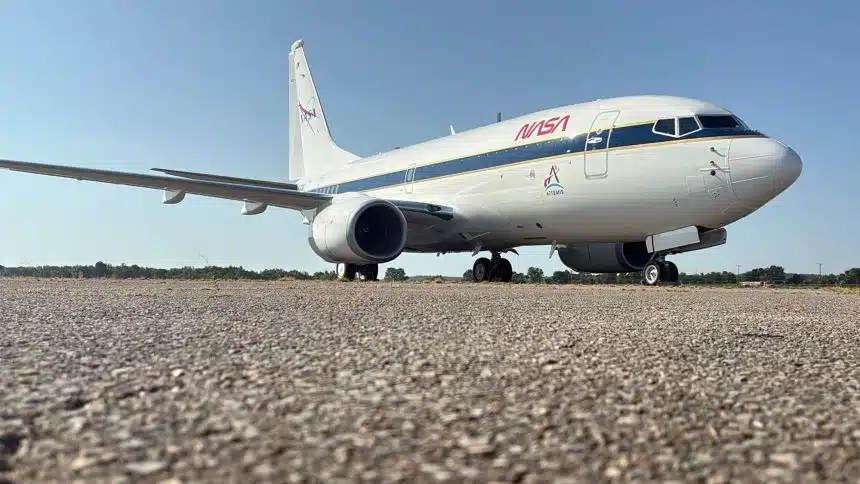
The Boeing 737-700, formerly operated as N712JM, spent years as a secretive U.S. Air Force flying testbed, and is now becoming NASA’s new reduced-gravity research aircraft with the registration N837NA.
NASA has unveiled on Aug. 13, 2026, its newest reduced-gravity research aircraft, which will support the Artemis program to validate astronaut lunar suits and associated crew systems during lunar-gravity parabolic flights. Additionally, this Boeing 737-700 will be used for systems‑integration research for flight testing autonomy, sensors, and other digital systems, says NASA.
Interestingly, this aircraft has a secretive past as a U.S. Air Force flying testbed. The agency’s Armstrong Flight Research Center in Edwards, California, took ownership of the jet from the Air Force in June 2026.
The aircraft, now registered as N837NA, is the former N712JM, a Boeing 737-73W that spent several years undergoing extensive modifications for an Air Force program whose precise purpose remains undisclosed. The modifications for its new mission are currently in progress, with the photo of the new livery showing it at an undisclosed location in Oklahoma.
2/3 pic.twitter.com/VfzQUpPkvp
— 𝗦𝗥_𝗣𝗹𝗮𝗻𝗲𝘀𝗽𝗼𝘁𝘁𝗲𝗿 (@SR_Planespotter) June 17, 2026
N712JM and the U.S. Air Force
The aircraft is a Boeing 737-73W, which was first delivered in 2013 with the registration N712JM, according to available information. The aircraft first attracted attention in 2020 after appearing with an unusual green finish, which is a protective coating applied before the final painting process, and extensive external modifications while operating from California.
Photos showed what appeared to be extensive instrumentation, wiring and sensors distributed around the fuselage, immediately suggesting that the aircraft was not a conventional 737. At the time, the aircraft has been acquired by the U.S. Air Force as a specialized flying testbed.
Just a year before, the aircraft had been associated with Denmar Technical Services, a company involved in specialized aviation and radar measurement work. There has been considerable speculation over the years about its possible roles, particularly because of the visible sensors, wiring and other modifications.
The ever-elusive ex-USAF Boeing 737 (formerly N712JM, now N837NA), held at COS’s Sierra Nevada Corporation hangar since 2020, departs COS to get a makeover for NASA. This aircraft will in time, help train Artemis astronauts how to move in sub-earth gravity conditions. pic.twitter.com/nM6gM9PjtZ
— cos_spotter (@cos__spotter) June 17, 2026
Notably, as The War Zone noted when it first reported about this aircraft, the registered address in N712JM’s documents was the exact same address of the Air Force’s Rapid Capabilities Office (RCO). The RCO, created to develop, procure and field high-priority advanced technologies quickly, oversees programs such as the B-21 Raider stealth bomber.
NASA’s contracting documentation indicated that indeed the aircraft served in the Air Force under a classified military program. However, the agency also stated it did not have the necessary “need to know” to receive details of the classified modifications or provide them to another contractor ahead of the modifications for the new mission, which will thus be performed by Denmar Technical Services.
The available evidence does not establish exactly what N712JM was testing for the Air Force. The service also confirmed to TWZ that it ended the program which saw the involvement of this 737 as a flying testbed.
The Other NASA 837
Recent photographs and flight tracking records identify N837NA as the same Boeing 737-700 previously operated as N712JM. The FAA database still displays the N837NA record in its historical form, showing NASA as the reserving party, without mentioning the airframe associated, while all data is still present for N712JM.
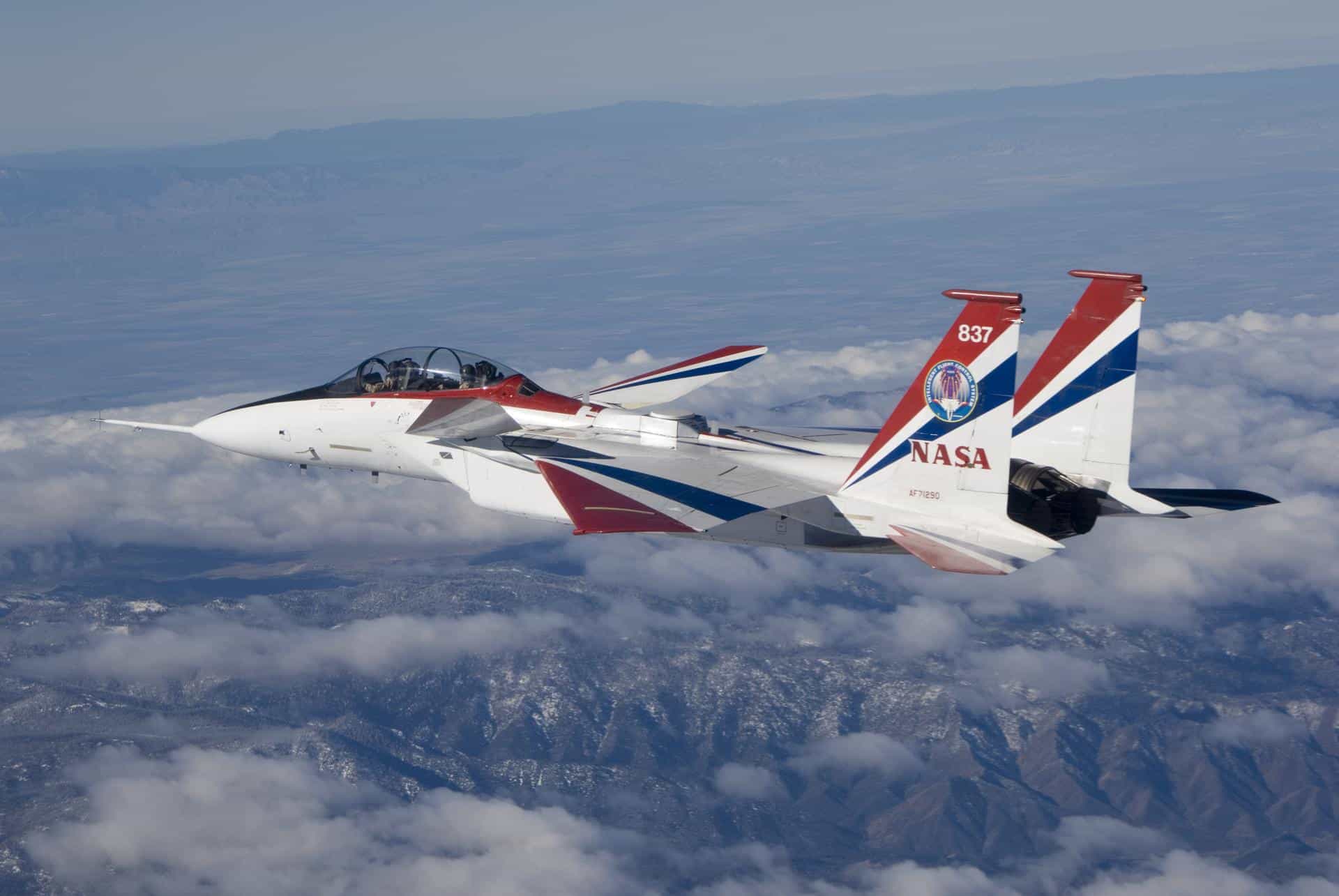
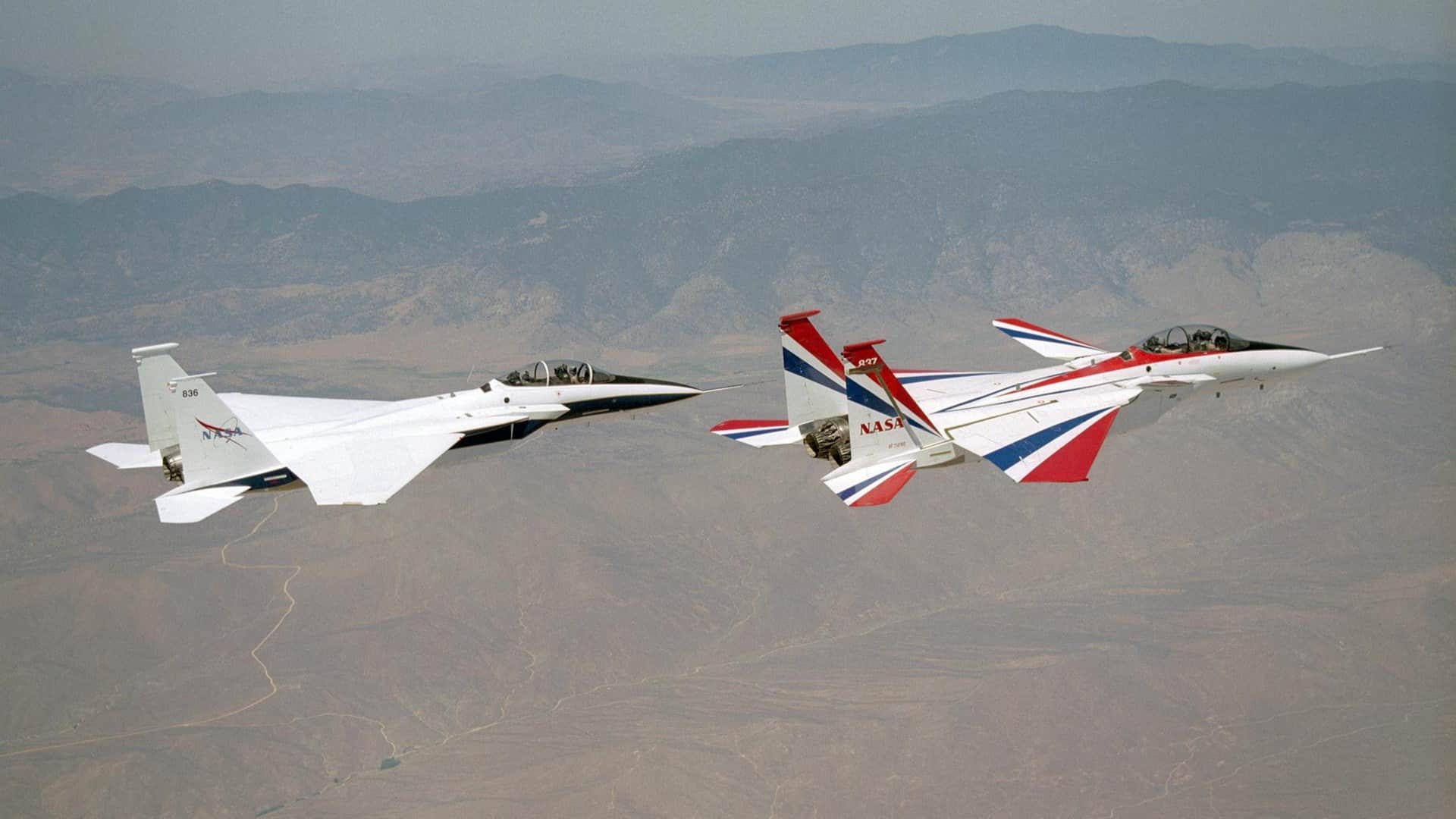
The new registration is also more interesting than it might initially appear. In fact, in the past NASA used the N837NA registration for a very different aircraft: the highly modified NF-15B Eagle, serial number 71-0290.
The aircraft began life in 1973 as the first two-seat TF-15A prototype, before being was later redesignated F-15B and extensively modified for flight-test work. NASA received the aircraft in 1993, becoming known as NASA 837 and later registered as N837NA in 2001.
NASA used the NF-15B (where the “N” prefix stands for “Special Test, Permanent) for a succession of advanced research programs, including the Advanced Control Technology for Integrated Vehicles (ACTIVE) program and the Intelligent Flight Control System (IFCS). The agency described the aircraft as a highly modified pre-production F-15B, incorporating features including canards, thrust-vectoring nozzles and an advanced digital flight-control system.
The aircraft made its final flight in January 2009, after almost 36 years of service in U.S. Air Force, McDonnell Douglas and NASA research programs. NASA subsequently preserved it at Edwards AFB, where it is on display near the Armstrong Flight Research Center.
NASA’s New Reduced-Gravity Research Aircraft
NASA plans to use its new 737 for parabolic flights designed to reproduce lunar gravity. During a parabolic maneuver, the aircraft follows a carefully controlled flight profile that produces short periods of reduced gravity inside the cabin.
The reduced-gravity phase of each parabola lasts for around 20 seconds, with typical flights including 15-30 parabolas. By varying the trajectory, researchers can simulate different gravitational environments.
This testing will allow Artemis astronauts, engineers and researchers to evaluate spacesuits and associated crew systems under conditions similar to the ones they would find on the Moon, which are substantially different from those experienced on Earth. A lunar spacesuit can be described as a pressurized life-support system that affects an astronaut’s mobility, balance and ability to perform physical tasks while experiencing roughly one-sixth of Earth’s gravity.
Parabolic flight provides NASA with a relatively controlled way of testing those interactions before equipment and astronauts reach the lunar surface. This would be used in combination with other techniques, such as neutral buoyancy activity and dedicated suspension systems.