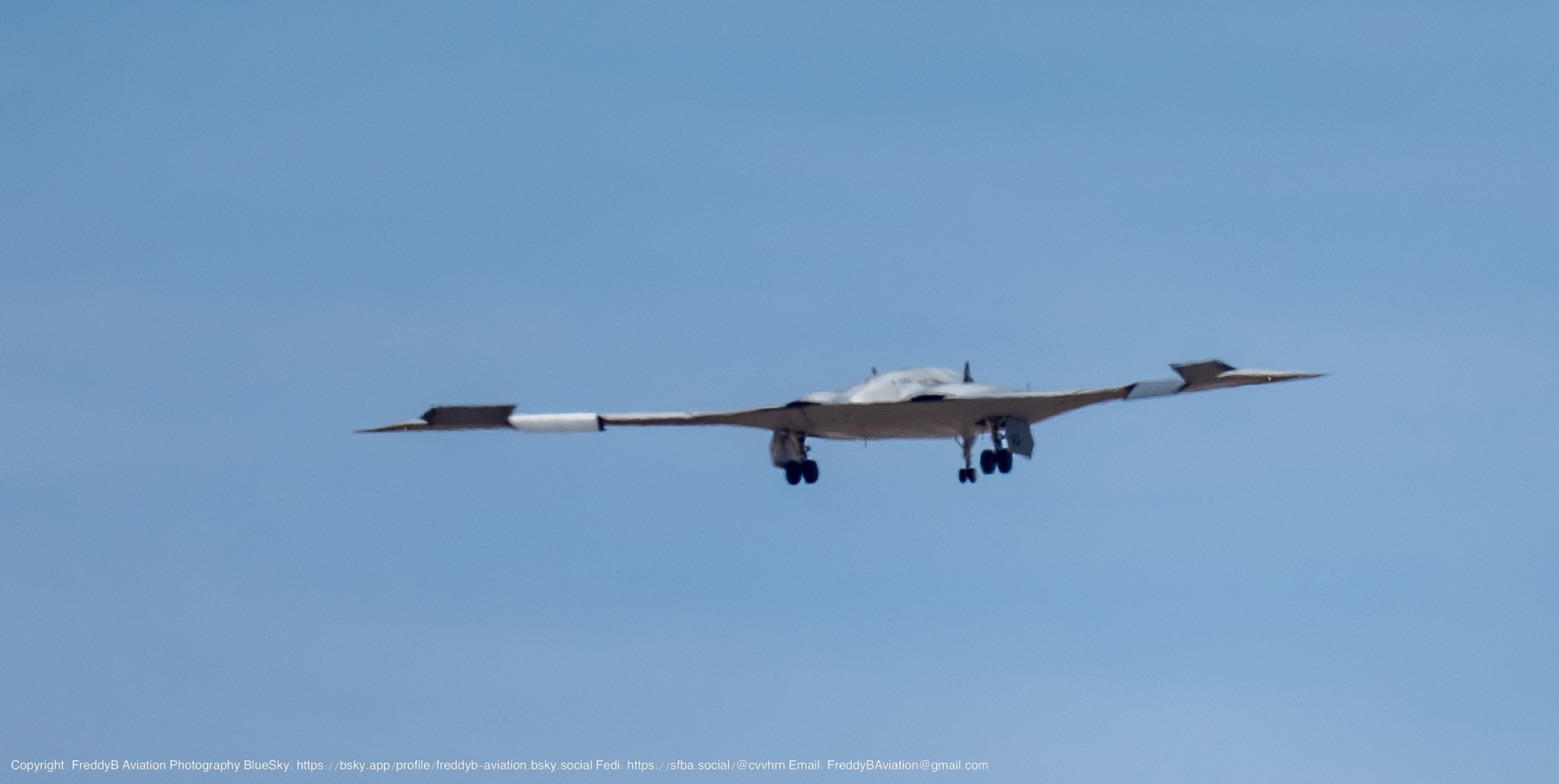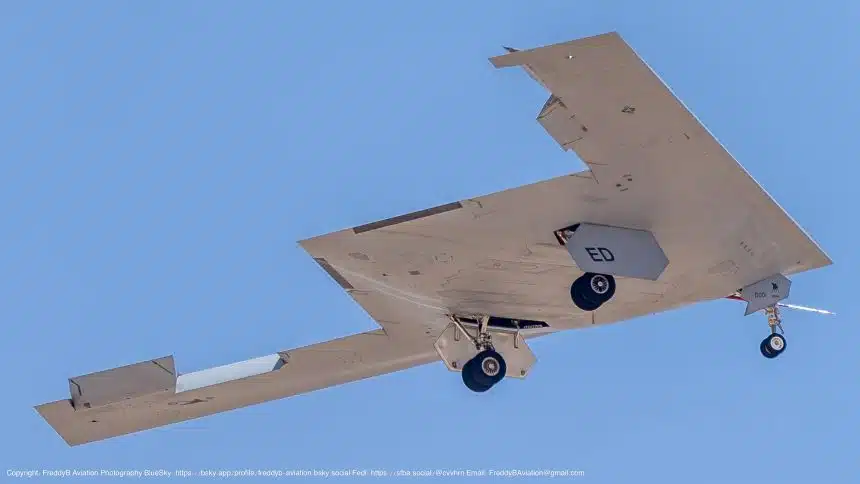
The photos appear to show the B-21 Raider’s outboard trailing-edge control surfaces deflected in opposite directions, suggesting a different speed-brake and drag-management arrangement than the B-2’s familiar split rudders.
On Jun. 3, 2026, the first prototype of the Northrop Grumman B-21 Raider carried out a test mission from Edwards Air Force Base, California. Using the radio callsign RAIDER17, the stealth bomber was airborne as two KC-46s, using ARRIS callsign, were also flying the typical tanker racetrack, and the Scaled Composites Hawker 4000 N639RA was operating in the same area using the radio callsign SCAT21. Both the tankers and SCAT could be tracked online on ADSBExchange.
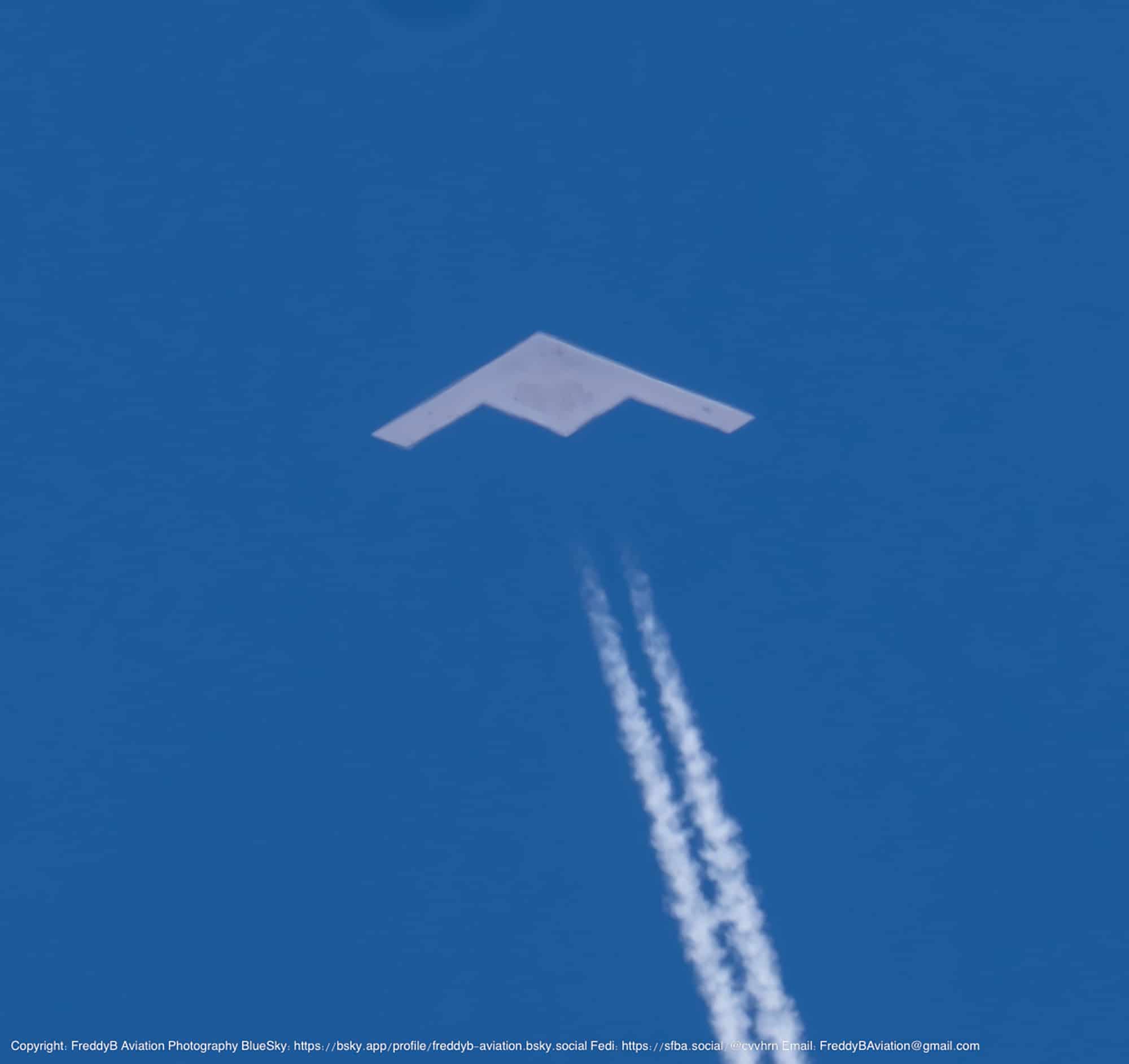
Although the B-21 was obviously not tracking online, it was clearly visible from the ground.
“The Raider was not on tracker, however its orbit seemed to intersect with the other three planes perpendicular to theirs. They all broke orbit when the Raider called into the Edwards Tower to land,” told us photographer Fred Taleghani who was near Edwards to shoot some images of “Cerberus” (as the B-21 test article 0001 is nicknamed).
In fact, the B-21 has recently been involved in air-to-air refueling missions, the first of those took place over Eastern California on Mar. 10, 2026, lasted 5 hours and 33 minutes, was documented by several photographers who were able to shot some incredible images of the first Raider prototype behind the special equipped tanker based out of Edwards Air Force Base. On Apr. 14, 2026, the U.S. Air Force publicly acknowledged that the B-21 Raider has recently conducted aerial refueling from a KC-135 as part of its ongoing test and evaluation program, jointly conducted with Northrop Grumman, at Edwards Air Force Base, California.
As RAIDER17 came in to land, Taleghani was able to get a nice view of the landing gear and, above all, of the B-21’s control surfaces acting as speed brakes.
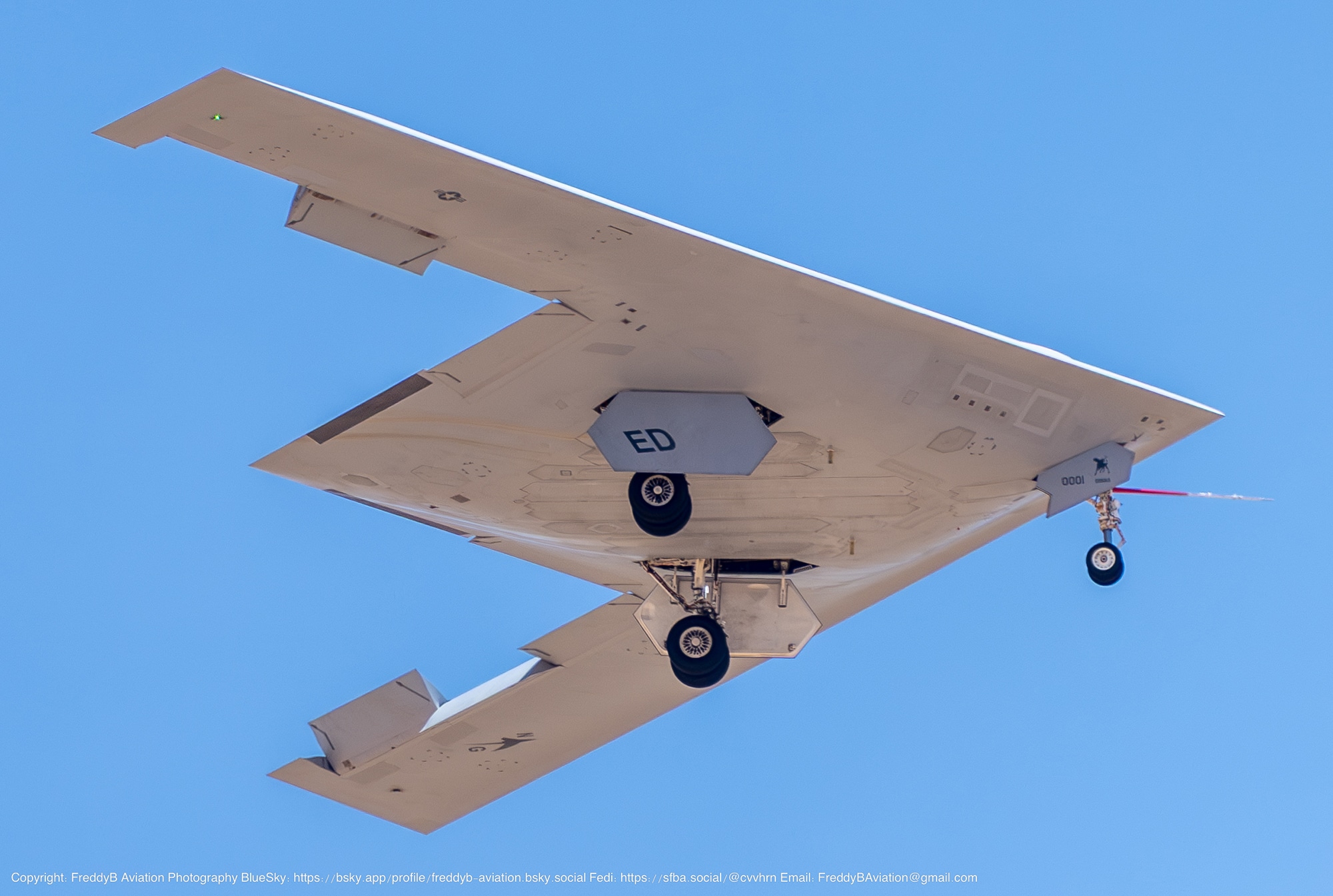
Unlike the B-2, the B-21 appears to feature multiple discrete outboard trailing-edge control surfaces. As Taleghani’s photos show, the outermost surface (also called elevon or flaperon – although the latter definition is probably not correct as the surfaces don’t seem to have lift augmentation capabilities) appears deflected upward, while the adjacent mid-outboard surface appears deflected downward, suggesting that the Raider’s flight-control system may use differential deflection of adjacent surfaces rather than a simple B-2-style split drag-rudder arrangement.
Needless to say, the exact function of each surface and the associated control laws remain undisclosed, still the photos allow to “debunk” simplistic observations that suggested the B-21 used split drag rudders exactly like the B-2.

Few years ago we posted an article with a video showing the movement of the split rudders and elevons of the B-2. As we explained, since the aircraft has no vertical fin, the split rudders and the elevons are used to control the aircraft rotation along the vertical/yaw axis, whereas pitch and roll are controlled by means of (mid and inboard) elevons. The split-rudders also act as speed brakes.
The B-2 Spirit also features a peculiar exhaust and the wedge-shaped flap in the middle of the trailing edge, the GLAS (Gust Load Alleviation System), that looks like the aircraft’s beaver tail and counters the rolling impact or resonance to smooth out the ride of the B-2 in turbulent conditions and extend the aircraft’s fatigue life. Air Force test data finite elemental analysis (FEA) modeling suggest the B-2 will remain structurally sound to approximately 40,000 flight hours.
Latest B-21 news
That being said, as we recently reported, the U.S. Air Force and Northrop Grumman are moving to speed up both production and delivery of the B-21 Raider, with the first bomber expected to reach Ellsworth Air Force Base, South Dakota, next year. In fact, the Department of the Air Force and Northrop Grumman have already announced an agreement aimed at expanding production of the new stealth bomber while accelerating its delivery timeline.
Based on the most recent statements, the first aircraft remains on track to be delivered to Ellsworth AFB, which will become the type’s first operational base, in 2027.
Preparations at Ellsworth are already well underway, with multiple construction projects ongoing to support the arrival of the new platform and provide the required infrastructure. These efforts also included runway expansion work, which forced the base’s B-1B Lancer fleet to temporarily relocate to Grand Forks AFB, North Dakota, last year.
At present, an undisclosed number of B-21s are in production, with final assembly taking place at Northrop Grumman’s Palmdale, California, facility, the same plant where the B-2 Spirit was also built. A second B-21 prototype was delivered on schedule to Edwards Air Force Base, California, in September 2025. As we noted at the time, unlike the first aircraft, it does not feature the air data probe and trailing cone typically seen on prototypes during the early stages of flight testing.