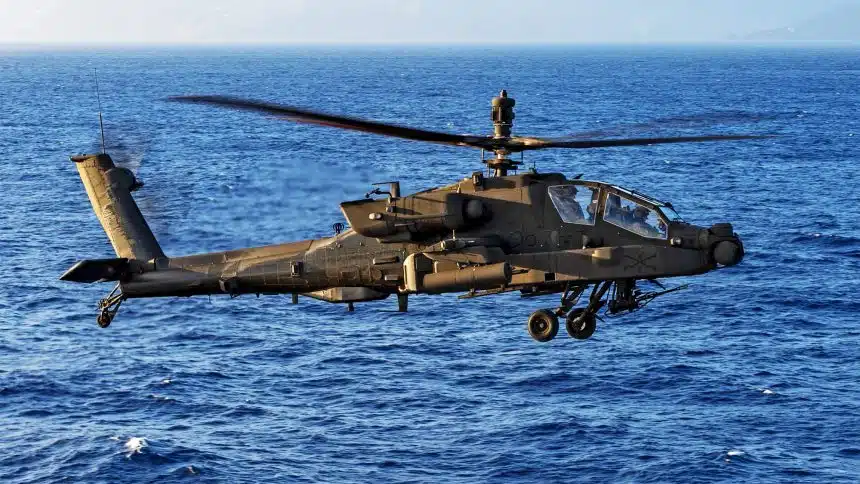
As the U.S. begins retaliatory strikes, officials have told reporters that an Iranian Shahed drone was believed to be responsible for the downing of a U.S. Army AH-64 Apache during a patrol. The two crew members were rescued from the water by a U.S. Navy drone boat.
Hours after we first learned that the U.S. Army had lost an AH-64 Apache over the Strait of Hormuz, more detail is now trickling out about the incident.
President Donald Trump first announced via social media platform Truth Social that Iran had ‘shot down’ the helicopter, vowing that the United States would respond to the apparent attack. Unnamed officials since clarified that an Iranian Shahed drone is believed to be the culprit for the attack, and that it is not yet clear whether it was a deliberately targeted action or an accidental collision.
The Apache was brought down by an Iranian drone, per two US officials and another source familiar with the matter. via @halbritz @ZcohenCNN @Kevinliptakcnn https://t.co/PlGodOgjHT https://t.co/BNZtlIIG4v
— Natasha Bertrand (@NatashaBertrand) June 9, 2026
The incident marks the first time during Operation Epic Fury that an Apache has been lost, and also the first time a U.S. Army Apache has been shot down since the Iraq War.
As we previously reported, both crew members from the helicopter were successfully rescued and are, according to U.S. Central Command (CENTCOM), in a stable condition. It has since been revealed that the initial rescue was performed by an uncrewed surface vessel (USV), specifically a Saronic Technologies Corsair. The Corsair is 24 feet in length, with a range of over 1,000 nautical miles and capable of speeds in excess of 35 knots (64 km/h).
The Corsair is operated by Task Force 59 (TF59), a U.S. Navy unit headquartered in Bahrain formed to operate and evaluate the evolving use of USVs and artificial intelligence (AI) in the naval domain. Most of TF59’s USVs are used for intelligence, surveillance, and reconnaissance (ISR) tasks, with some specialist roles including mine detection and communications relays.
More here: The drone used was a 24-foot Navy Corsair made by Saronic Technologies, said Navy Capt. Tim Hawkins, a Central Command spokesman.
The crew were picked up by the vessel, taken to a second location on the water, and then hoisted up into a helicopter.
The Corsair was… https://t.co/phPk0NEWg3
— Dan Lamothe (@DanLamothe) June 9, 2026
Using USVs in a search and rescue (SAR) role is not a new concept, though this is the first recorded time that one has been used by the U.S. Navy to directly retrieve individuals from the water. After picking the two crew members up, the uncrewed vessel rendezvoused with a helicopter which then transported them to land for medical assessment.
U.S. Navy Captain Tim Hawkins, speaking for CENTCOM, said that TF59 began using the Corsair USV in March of this year.
U.S. Central Command (CENTCOM) forces began launching self-defense strikes against Iran at 5 p.m. ET today at the Commander in Chief’s direction, in response to yesterday’s downing of a U.S. Army Apache helicopter. The mission is a proportional response to unjustified Iranian…
— U.S. Central Command (@CENTCOM) June 9, 2026
CENTCOM confirmed at 21:18 UTC that the U.S. had begun airstrikes against Iran in response to the Apache being downed, as promised earlier by President Trump.
BREAKING: U.S. Central Command (CENTCOM) confirms its forces launched “self-defense strikes against Iran,” in response to Tuesday’s downing of a U.S. Army Apache helicopter. https://t.co/zp9wd55iCM
— Ariel Oseran أريئل أوسيران (@ariel_oseran) June 9, 2026
Patrolling the Strait
U.S. Army Apaches taking part in Operation Epic Fury have been tasked with countering Iranian-backed militia actions in the wider Middle East as well as with keeping an armed overwatch on the strategically important Strait of Hormuz. These operations have run in concert with existing Operation Shader requirements, targeting the small remaining pockets of Daesh fighters in Iraq and Syria.
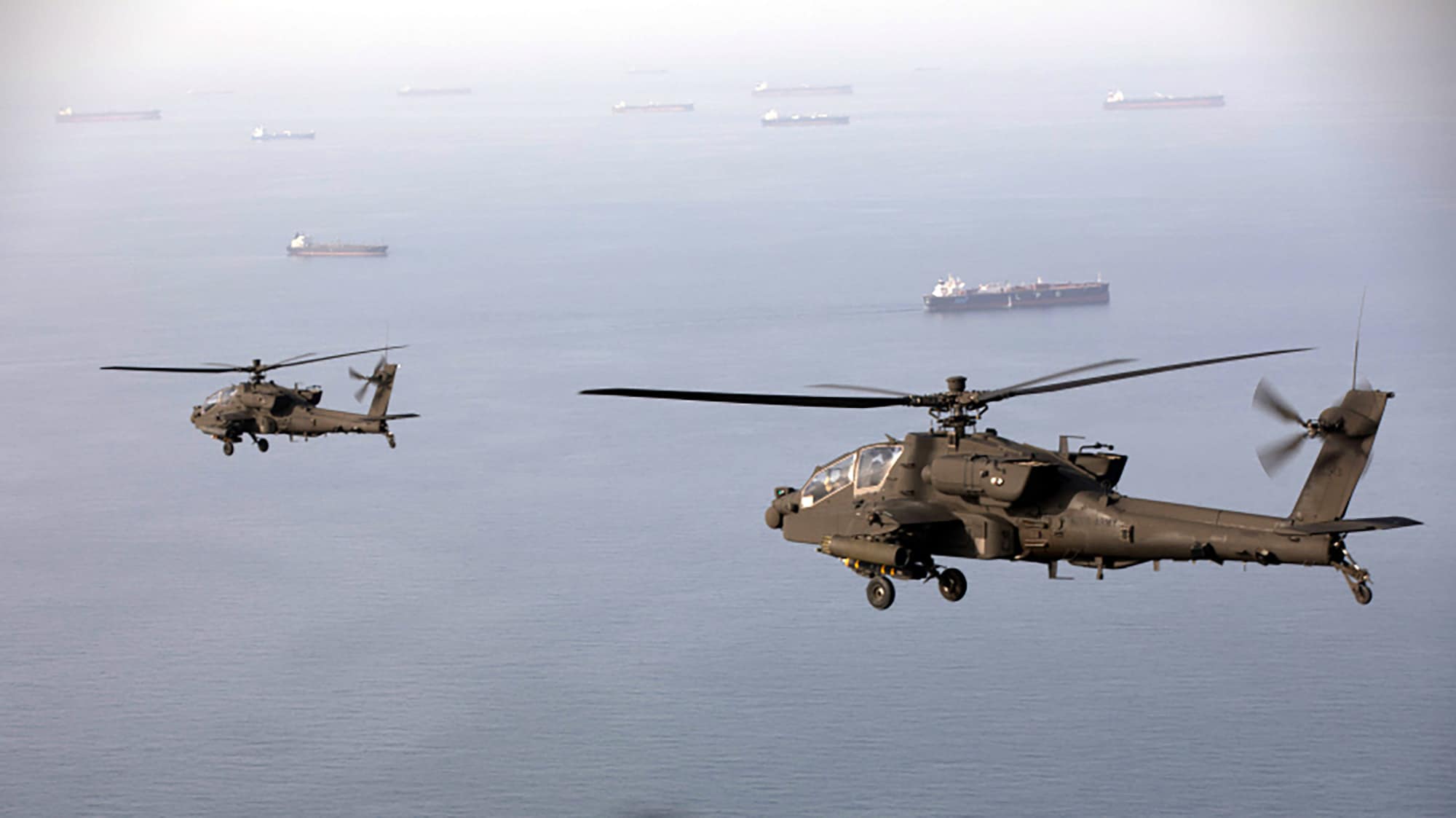
Iran declared on Mar. 4, 2026 – just days after Operation Epic Fury began – that the Strait of Hormuz was closed. As an international waterway Iran has no legal authority to close the strait, but the country’s massive fleet of fast attack craft, small boats, and huge arsenal of sea mines mean that any threat from Iran regarding passage through the chokepoint is taken very seriously. Civilian transits of the strait with cargo vessels and, crucially, oil and fuel tankers have been severely disrupted throughout the crisis.
Dozens of ships have been secretly guided through the Strait of Hormuz, often sailing under the cover of darkness to avoid detection by Iranian radar and patrol boats.
This is how the US is helping the tankers navigate the waterway ⬇️https://t.co/DmEPOlmlkI pic.twitter.com/40pzQvFnJc
— The Telegraph (@Telegraph) June 6, 2026
Ships that are willing to risk the transit have largely relied on an organised effort by U.S. forces to provide overwatch and escort through the area. It is likely that the downed Apache was part of this operation, with its potent ISR capability and mixed weapon load ideal for detecting and responding to a variety of waterborne and airborne threats.
Inside the mine-hunting mothership⚓
RFA Lyme Bay is headed for the Arabian Sea
She is loaded with uncrewed boats, underwater sensors, autonomous sonar equipment and carrying over 100 expert mine-hunting personnel pic.twitter.com/UN91zfnmHD
— BFBS Forces News (@ForcesNews) May 28, 2026
A number of countries have declared their intent to help ensure the Strait of Hormuz is clear of any mines, though any large scale mine clearance operations – usually conducted by ships with relatively limited self defence capabilities – would be risky should hostilities with Iran continue. The ceasefire that entered force between the U.S. and Iran on Apr. 8 theoretically remains in place, though both sides have repeatedly exchanged fire.