A report by the International Institute for Strategic Studies (IISS) assesses that it is ‘highly likely’ many of recent drone incidents throughout Europe were ordered by Moscow as part of a wider hybrid campaign against NATO.
The investigation focuses on incidents taking place between August 2024 and February 2026, including incursions into the airspace of thirteen individual countries. All but one of these nations, the exception being Ireland, are members of NATO.
Among the incursions documented in the report are those which targeted U.S. Air Force sites in the UK – which The Aviationist covered in depth across three articles – as well as the incident over the French Navy ballistic missile submarine base at Île Longue.
This report assesses that it is highly likely the Kremlin conducted a coordinated Uninhabited Aerial Vehicle (UAV) campaign over Europe between August 2024 and February 2026, spanning a dozen NATO states and Ireland.
It is also likely that Russian-linked vessels and the shadow… pic.twitter.com/pGRtWRHPtE
— IISS News (@IISS_org) July 2, 2026
By corroborating the various reports of drone incursions with data relating to ships that are known or suspected to belong to Russia’s shadow fleet, the IISS has named several vessels in particular that it believes were responsible for launching and/or directing the drones.
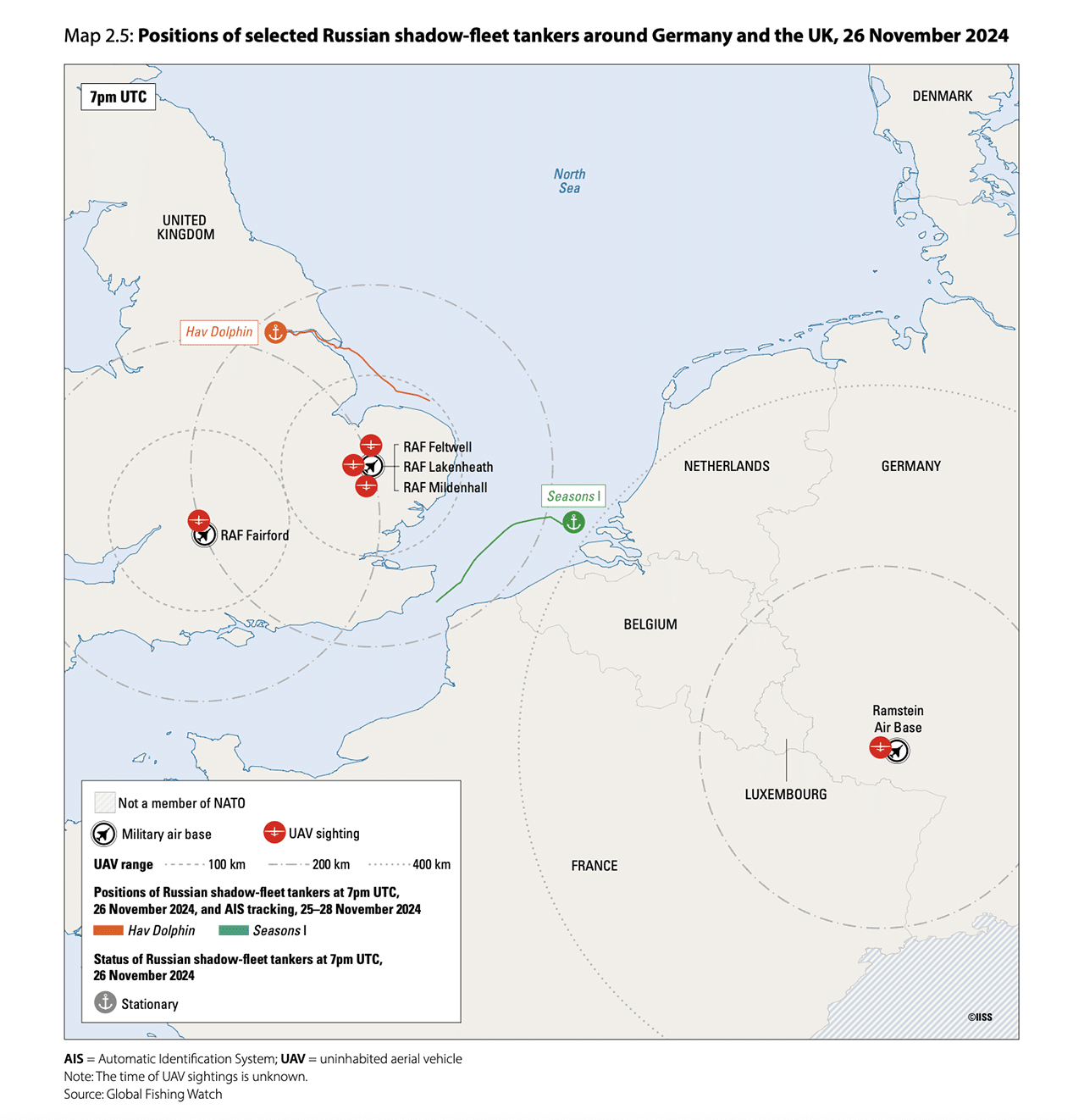
It notes that the cargo vessel Hav Dolphin (IMO 9073854), investigated by both Germany and the Netherlands after drone incursions in the spring of 2025, was in fact docked in Hull, UK, while British and American authorities were dealing with the drone sightings over military sites in November 2024.
Suspected drone carrier / cargo ship HAV DOLPHIN entered Baltic Sea via Kiel kanal, last port Antwerp. Stated destination Vasa, FI
The Russian crewed ship is suspected if being behind drone flights over military installations in NW Germany a few months ago. pic.twitter.com/i4QfsyLyzi
— auonsson (@auonsson) August 24, 2025
At the same time, the tanker Seasons I (IMO 9308950) travelled eastbound through the Straits of Dover and routed approximately parallel to the southern coast of East Anglia where RAF Lakenheath, RAF Mildenhall, and a number of other sensitive U.S. and UK military facilities are located.
Comment from anonymous U.S. officials at the time of the incursions suggested that the drones were of a sophistication beyond what would be expected for commercially available civilian drones. As we noted, the incursions over these important U.S. bases came just days after then President Joe Biden gave Ukraine the long awaited all-clear to use long range missiles to strike targets deep inside Russian territory.
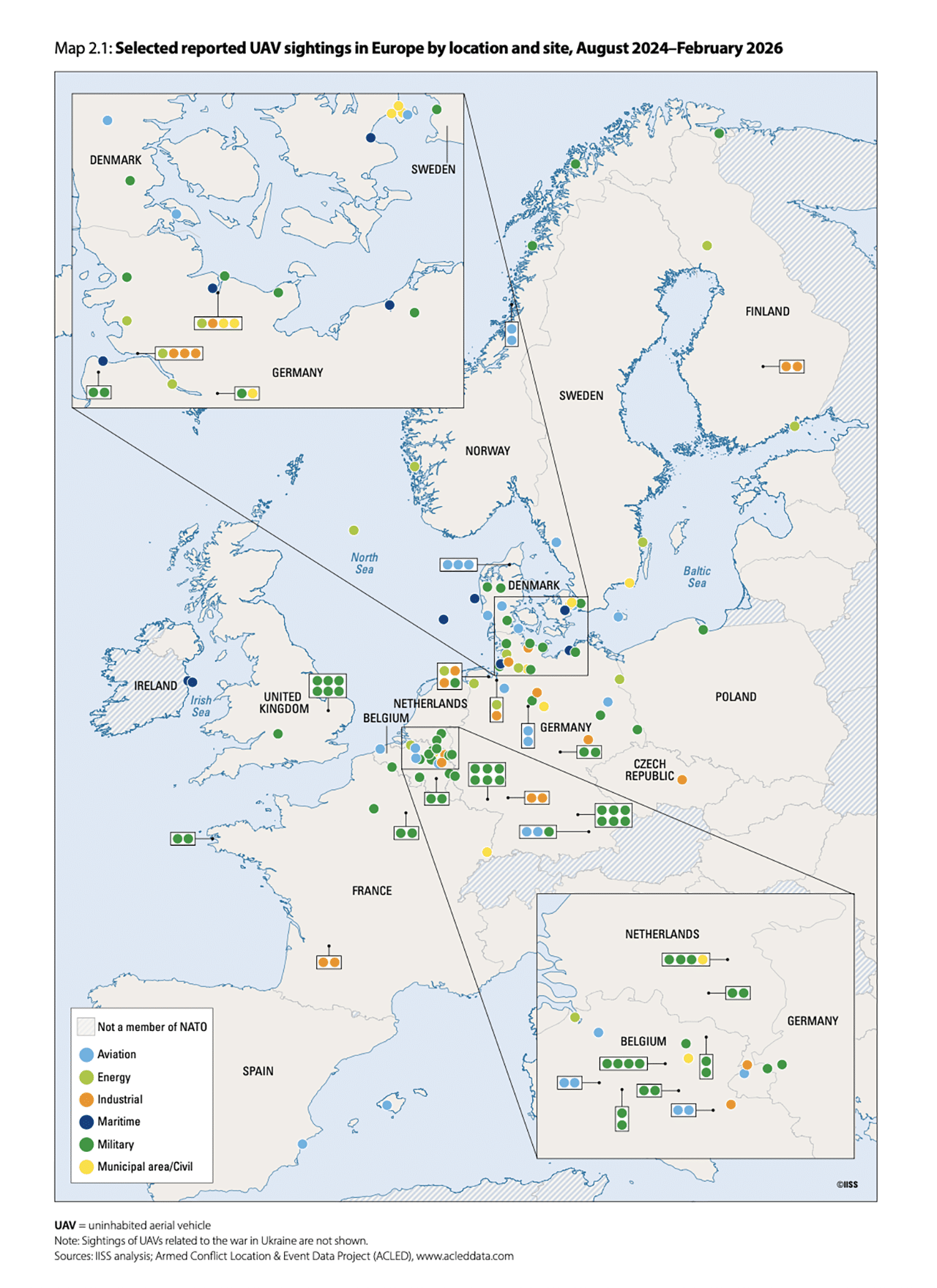
In its executive summary of the lengthy report, the IISS argues that while not every UAV incident during this period is likely to have been linked to Russia, “the aggregate pattern of UAV sightings cannot be adequately explained by misidentification, hobbyist activity or opportunistic harassment alone.”
Careful Scrutiny
There is no smoking gun that definitively proves Russia’s involvement, and none of the nations affected in these drone incursions have yet directly pointed their finger in Russia’s direction, though IISS researchers have suggested that these countries have given their tacit approval of the report. “Every government we spoke to said they would welcome the report being published,” said Charlie Edwards, Senior Fellow for Strategy & National Security.
Without the smoking gun, some have questioned the report’s findings. Dronewatch Europe have said: “The conclusions are striking. However, they also deserve careful scrutiny.”
“The report does not present physical evidence linking any specific drone to any specific vessel. No launch has been observed, no command links have been intercepted, no wreckage has been recovered, no credible video footage was recorded, and no telemetry or forensic data has been released tying a drone to a Russian ship.”
New IISS report revives ‘Russian shadow fleet drone’ theory, but fails to provide evidence https://t.co/aQNZoaX2O3 pic.twitter.com/efG2r4BgCD
— Dronewatch Europe (@DronewatchEU) July 2, 2026
This forensic data is, of course, difficult for a non-state actor to obtain. Primary radar data and advanced intelligence (including the use of electro-optical sensors, signals intelligence (SIGINT), and human intelligence (HUMINT)) capabilities would be of paramount importance to gathering the definitive facts in cases like this.
Whether the capable intelligence agencies – in many cases, world leading – of the nations involved have in fact collected these facts is unclear. While one could argue that the fact no country has stepped forward and set out a comprehensive case for Russia’s involvement, it is also true that doing so could prejudice some of the capabilities and/or sources of intelligence available to them. Proving Russia’s guilt in the public domain might not outweigh the value of these intelligence assets.
The @RoyalAirForce has recently deployed its Counter-Uncrewed Aerial System to Belgium in response to rogue drones interrupting flights at Brussels Airport. This comes just a month after the system was deployed to Denmark.
The RAF’s C-UAS capability is called ORCUS, which is a… pic.twitter.com/bS6buQuCDc
— Leonardo Electronics (@LDO_Electronics) November 11, 2025
Dronewatch’s own investigation into 61 drone sightings across Europe in 2025 found that, in many cases, “reported drones turned out to be perfectly ordinary aircraft, helicopters, stars, planets or other explainable phenomena. In numerous cases there was simply no evidence that a drone had ever been present.”.
The IISS report does touch on these earlier investigations, though it argues that “In an operating environment where European detection capability was demonstrably insufficient to reliably track low-altitude, non-cooperative UAVs, a high non-confirmation rate is the expected outcome regardless of whether the sightings were genuine.”
“A high false-positive rate in public reporting is, if anything, analytically consistent with Russian operational design: engineering an environment of ambiguity in which genuine incursions are difficult to distinguish from noise is itself a feature of the campaign,” the report continues.
Whether any of the drones were in fact linked to Russia or not, the IISS states that Europe’s counter-UAS (C-UAS) strategy has not kept up with the threat now posed by these systems: “detection is uneven, legal authorities are fragmented, response options are often disproportionate, and attribution remains too slow to support timely deterrence.”