Two years after it was first unveiled, the Yak-130M light attack aircraft has conducted its first flight as Russia aggressively pushes the jet and other fighters for international sales.
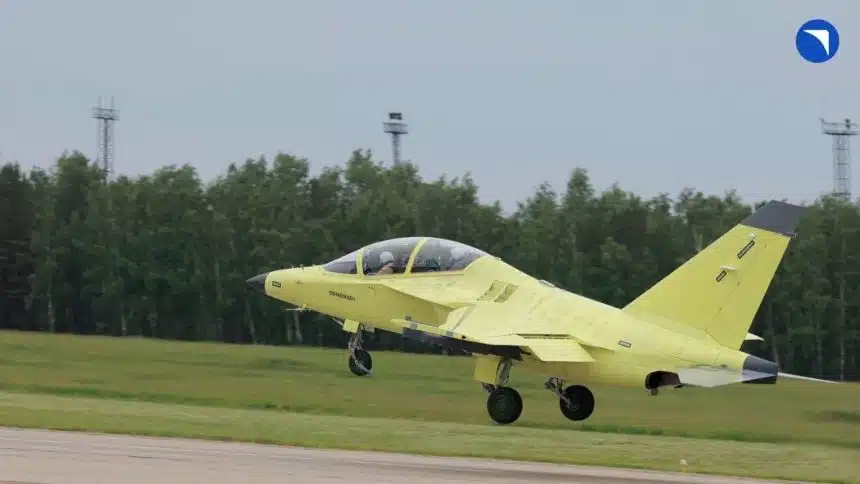
The Yakovlev Yak-130M, the light attack variant of the advanced jet trainer aircraft, made its maiden flight on Jun. 25, 2026, from the Irkut Corporation Sokol Aircraft Plant, the United Aircraft Corporation (UAC) announced. UAC unveiled the first prototype of the new variant in 2024, and a second prototype, ‘002’, in October 2025.
Reports mention a total of three prototypes were planned before the aircraft entered production. The current aircraft bears the serial 13014000001, as seen on the left cheek, and sports a yellow factory primer.
The Yak-130M prototype with BRLS-130R AESA radar. pic.twitter.com/aZmr723tIV
— New Gen Fighters (@GenFighters) October 10, 2025
The aircraft enters a highly competitive trainer and light fighter market dominated by the South Korean FA-50 (the light attack variant of the T-50); Boeing T-7A Red Hawk (which however has yet not been weaponized); the Turkish Hürjet; and the Italian M-346. The standard Yak-130 is already used by Russia, Myanmar, Belarus, Algeria and Iran.
The Yak-130M combat trainer aircraft made its first flight.
🗺️ Irkutsk region.
🎥TV report “VGTRK” (June 25) pic.twitter.com/OM4MV7d25X
— Massimo Frantarelli (@MrFrantarelli) June 25, 2026
First flight
According to various accounts quoting the UAC statement from its Telegram channel, the maiden flight was conducted by 1st Class Test Pilot Alexander Guskov and Distinguished Test Pilot Andrey Voropaev lasted 50 minutes. The aircraft, which was also fitted with underwing pylons, flew at an altitude of 2,000 meters and touched a maximum speed of 600 km/hour.
The dedicated light attack fighter sports a range of new sensors, mission systems, defensive and electronics suites suitable for the role. These include the BRLS-130R Active Electronically Scanned Array (AESA) radar; the SOLT-130K optical targeting pod with CCD, laser designation, tracking and thermal vision modules; the President-S130 onboard defense complex with a Missile Approach Warning System, Radar Warning Receivers, active jammer and a countermeasure dispenser; and the KSS-130 encrypted radio communication system.
“The integration of new onboard systems will allow the Yak-130M to be used for training and combat purposes around the clock and in difficult weather conditions,” the UAC previously said.
A Rostec bejelentette hogy az új Yak-130M kiképző gép végre hajtotta első tesztelését. A gépet az 1. osztályú tesztpilóta Alekszandr Guszkov, és a többszörösen kitüntetett tesztpilóta Andrej Voropajev vezette. A gép 50 percig volt a levegőben, ezalatt elérve a 2000 méteres… pic.twitter.com/Z6ERP5zUd9
— Zsiguli🇭🇺 (@GZsgallos2007) June 25, 2026
TASS quoted Voropayev after the test flight: “At the very outset, huge potential was incorporated into the aircraft by those people who developed the Yak-130. The aircraft has been renewed to meet modern requirements. We can say that the aircraft’s equipment has been renewed by more than 50%.”
The report also quoted UAC’s CEO Vadym Badekha saying the Yak-130M upgrade can “fully address” all training and combat tasks “in any weather conditions, day and night at the level of modern aircraft platforms.” He further added “the Yak-130M’s combat objectives include destroying ground and aerial targets, among them heavy-class unmanned aerial vehicles.”
The Yak-130M is capable of serving not only as a close air support (CAS) platform and a cost-effective successor to the Su-25, but also, thanks to its advanced AESA radar, as an airborne air-defense platform against drones and cruise missiles. https://t.co/4HXnb5znvu pic.twitter.com/8iqZIKPn98
— H. Memarian (@HEMemarian) June 25, 2026
Russian aircraft export plans
The first flight also follows the timeline set by Public Joint Stock Company (PJSC) Yakovlev (or the Yakovlev Design Bureau) managing director Vasily Prutkovsky in April. Prutkovsky said the first test flight would take place by June this year, reflecting the urgency in the Russian administration to display timely progress and secure international orders.
Yakovlev PJSC:
The first test flight of the Yak-130M combat trainer aircraft will take place in June of this year.https://t.co/h1R6ZCJwkd pic.twitter.com/nmaoSMjmr5
— Massimo Frantarelli (@MrFrantarelli) April 3, 2026
The same concerted effort is being seen in the Su-57 Felon and the Su-75 Checkmate. The Felon, which was recently unveiled in its twin-seater variant, has been aggressively marketed in defense exhibitions and even tested with upgraded engines, at a time when Russia has not landed any big ticket defense deal.
Algeria is also a Su-57 and Su-34 Fullback confirmed customer, after the aircraft were spotted in the country, beside being a Yak-130 user. One of the Su-34s has been frequently spotted in desert camouflage.
The New Algerian Su-34, Algeria is rapidly developing its army, air force, and navy, with Russian equipment, the modernization includes fighter-bombers, combat vehicles, coastal patrol boats, and there is also interest in the Su-57. pic.twitter.com/jW3ytLIAa8
— Zsiguli🇭🇺 (@GZsgallos2007) October 15, 2025
The Su-34 itself has been rolled out in the ‘NVO’ variant, incorporating lessons from the ongoing operations against Ukraine. It is distinguished by a small ‘hump’ on the spine, believed to be a satellite link.
The Yak-130M’s parallel development to these fighters suggest Russia is pitching these aircraft as complementary training and operational systems, and to make a mark in foreign weapons sales.