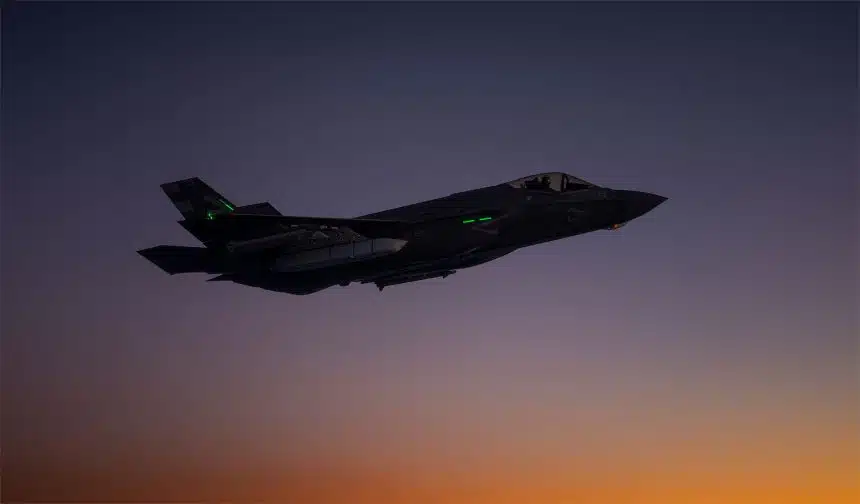
The U.S. Navy, supported by Lockheed Martin, completed the first phase of the F-35C LRASM Flight Sciences Test Program after a series of integration flight tests from September 2024 to April 2026.
Lockheed Martin has announced on June 10, 2026, that the U.S. Navy has completed the first phase of the F-35C LRASM Flight Sciences Test Program. The program saw the service and the company work together on a series of integration flight tests with the AGM-158C Long-Range Anti-Ship Missile (LRASM) from September 2024 to April 2026.
The company says the test program continues LRASM’s full integration plan on the F-35C. The service released the first photos of the weapon on the F-35C Lightning II in late September 2024, shortly after the start of the testing, showing the weapon carried externally as it cannot be carried inside the weapon bays because of its size.
Lockheed Martin described the testing saying that it allowed to validate the aircraft’s behavior with the heavy external store across the flight envelope. These trials are usually called ‘captive carriage’ trials and are meant to test the weapon’s impact on the airframe in different flight envelopes and parameters, and verify both the systems’ core structural integrity.
This represents the first phase of live flight testing before moving to in-flight drop testing to assess the weapon’s behavior during the separation and then the full weapon testing to check the entire engagement profile. No details have so far been disclosed regarding an eventual life fire campaign.
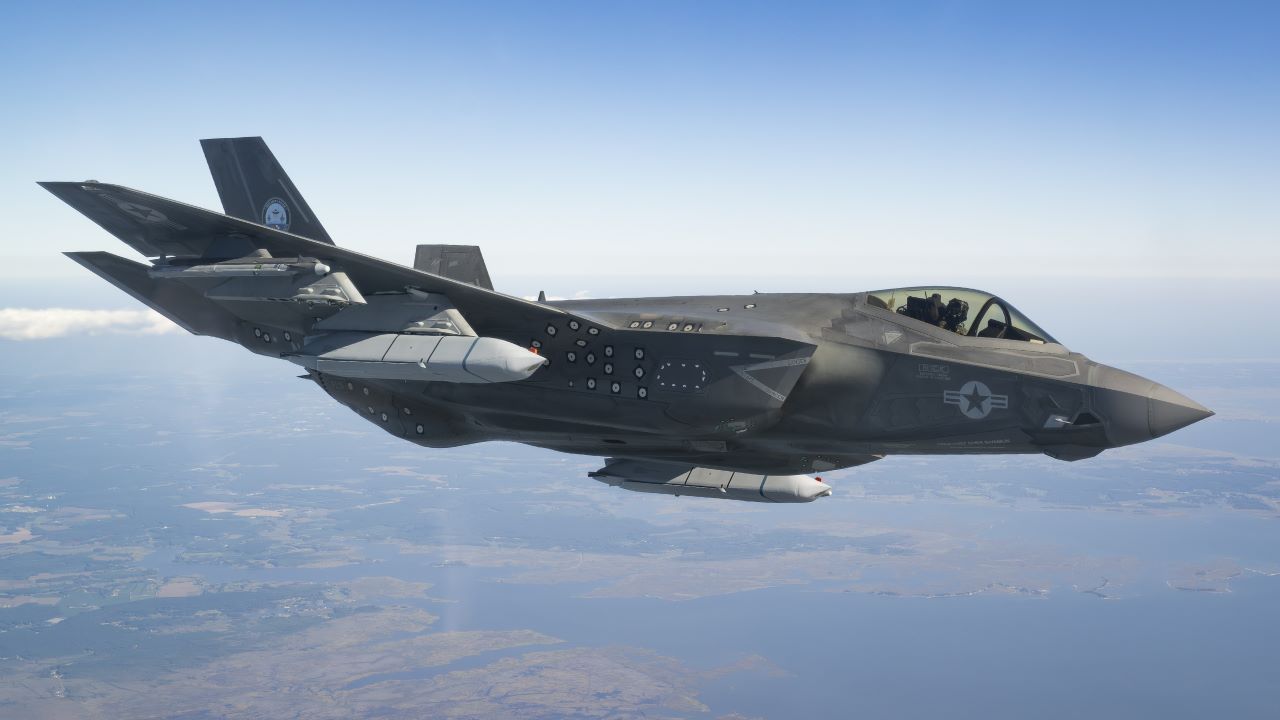
The company further explained that both LRASM and Joint Air-to-Surface Standoff Missile (JASSM) test assets are being used during the testing by the LRASM program. As we previously explained here at The Aviationist, both weapons share the same baseline airframe, with the differences being mainly internal.
“By integrating LRASM onto the F-35, we’re giving our warfighters a powerful capability that enhances mission flexibility and expands their operational options,” said Jon Hill, vice president and general manager, Lockheed Martin Air Dominance and Strike Weapons. As noted by the company in the press release, the addition of the AGM-158 LRASM to the F-35’s arsenal will give it the same stand-off strike capability against modern naval threats which currently equips the B-1B Lancer strategic bomber and the F/A-18E/F Super Hornet carrier-based fighter jet.
The AGM-158C LRASM
The AGM-158C LRASM, based on the AGM-158B Joint Air-to-Surface Standoff Missile – Extended Range (JASSM-ER), is the new low-observable anti-ship cruise missile developed by DARPA (Defense Advanced Research Projects Agency) for the U.S. Air Force and U.S. Navy. NAVAIR describes the weapon as a defined near-term solution for the Offensive Anti-Surface Warfare (OASuW) air-launch capability gap that will provide flexible, long-range, advanced, anti-surface capability against high-threat maritime targets.
NAVAIR says the weapon reduces dependency on Intelligence, Surveillance and Reconnaissance (ISR) platforms, network links, and GPS navigation in electronic warfare environments. In fact, once launched, LRASM guides to an initial point using a GPS guidance system and employs onboard sensors to locate, identify, and provide terminal guidance to the target. Semi-autonomous guidance algorithms will allow it to use less-precise target cueing data to pinpoint specific targets in the contested domain.
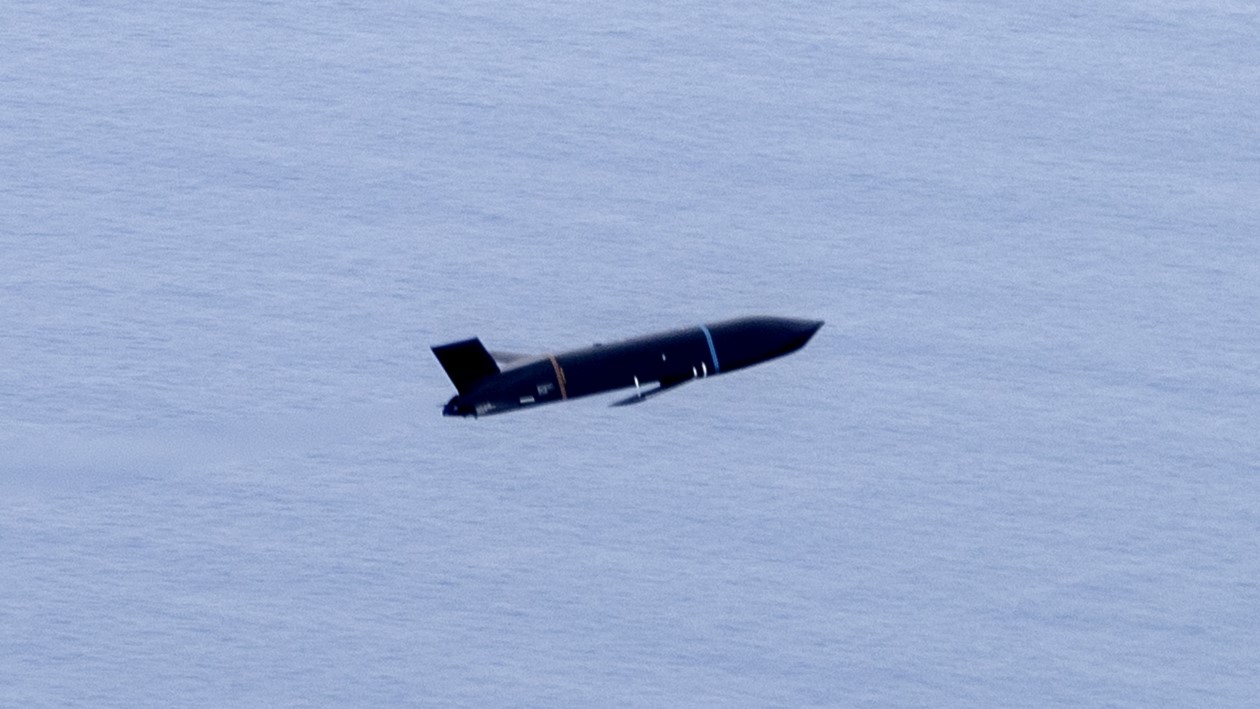
There are currently three variants which comprise the OASuW Increment 1 program, designated LRASM 1.0, LRASM 1.1, and LRASM C-3. The LRASM 1.0 variant, which was fielded with early operational capability in 2019, has already been integrated on the B-1B Lancer and F/A-18E/F Super Hornet.
The newer LRASM 1.1 variant was fielded in 2023 and is undergoing Initial Operational Test & Evaluation, according to the Director, Operational Test and Evaluation’s report. The weapon is also being integrated on the P-8A Poseidon.
As for the future LRASM C-3, which adds extended range capability, the program planned a land strike capability was part of the LRASM C-3 upgrade but has since decided to remain focused on surface warfare capabilities. The missile concept of operations and system requirements were completed last year, focusing on anti-surface warfare employment range and updating the missile target threat library compared to LRASM 1.1.
The Navy has scheduled LRASM C-3 early operational capability (EOC) for 4QFY26. Meanwhile, the Department of Defense continues to plan for OASuW Increment 2 to be developed via full and open competition, with EOC anticipated in FY29 and initial operational capability anticipated in FY31. The Navy funded LRASM C-3 to bridge the gap until an OASuW Increment 2 program of record is established.
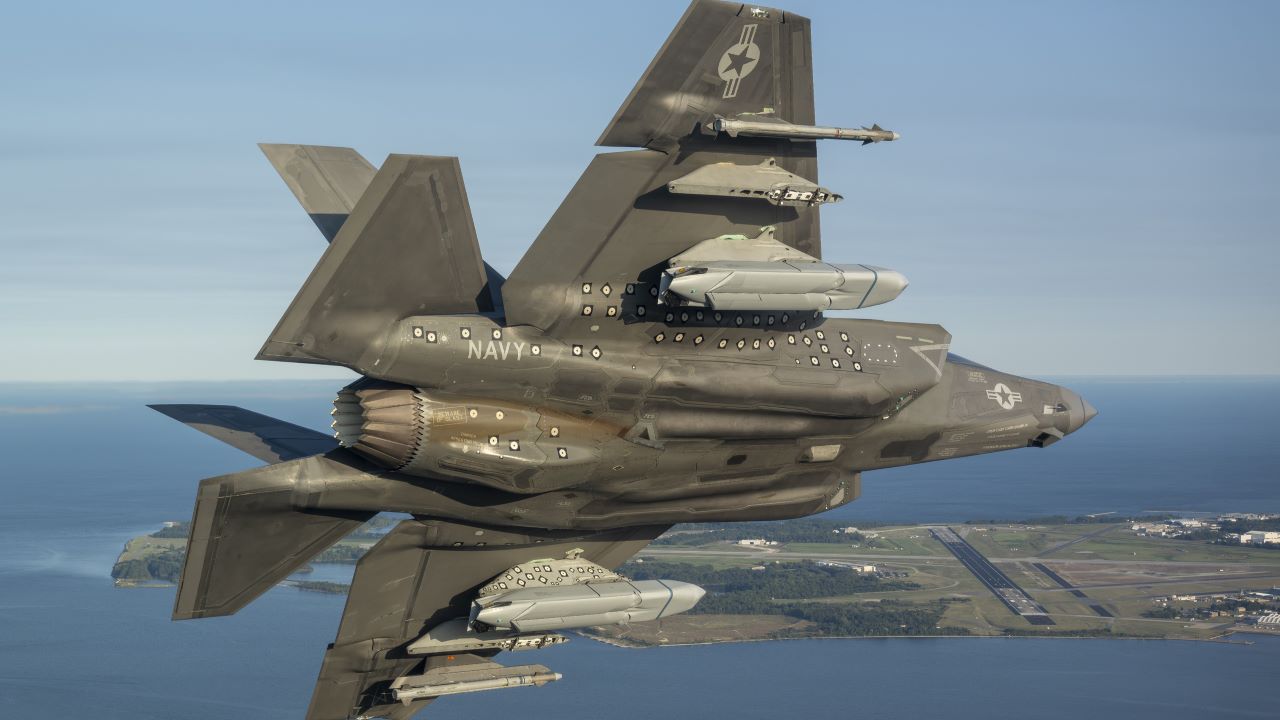
In September 2024, an F-35C test aircraft from Naval Air Station (NAS) Patuxent River, Maryland, conducted the first test flights for the integration of the AGM-158, both in the JASSM and LRASM variants. In January 2025, the same testing was also conducted with the F-35B.
In January 2025, NAVAIR disclosed that the U.S. Air Force’s F-15E Strike Eagle and F-15EX Eagle IIs are now set to be armed with the LRASM. This was followed by the disclosure in March 2025 of the integration of the weapon also on the F-16.